Nhamo Luxon, Rwizi Lameck, Mpandeli Sylvester, Botai Joel, Magidi James, Tazvinga Henerica, Sobratee Nafiisa, Liphadzi Stanley, Naidoo Dhesigen, Modi Albert T, Slotow Rob, Mabhaudhi Tafadzwanashe
Water Research Commission of South Africa (WRC), Lynnwood Manor, Pretoria 0081, South Africa.
Centre for Transformative Agricultural and Food Systems (CTAFS), School of Agricultural, Earth and Environmental Sciences, University of KwaZulu-Natal, Scottsville, Pietermaritzburg 3209, South Africa.
Cities. 2021 Sep;116:103266. doi: 10.1016/j.cities.2021.103266. Epub 2021 May 23.
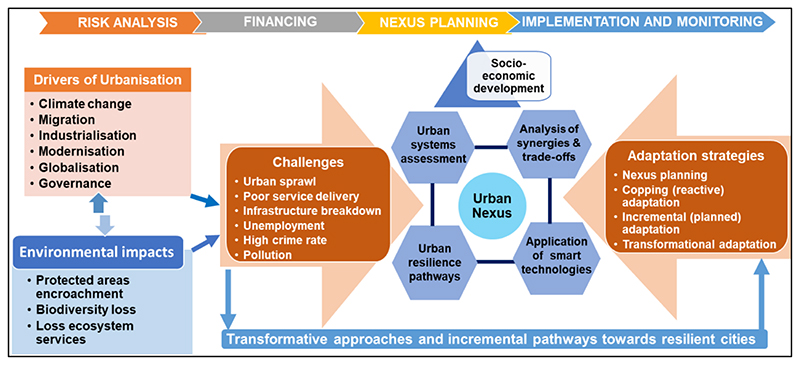
Challenges emanating from rapid urbanisation require innovative strategies to transform cities into global climate action and adaptation centres. We provide an analysis of the impacts of rapid urbanisation in the Gauteng City-Region, South Africa, highlighting major challenges related to (i) land use management, (ii) service delivery (water, energy, food, and waste and sanitation), and (iii) social cohesion. Geospatial techniques were used to assess spatio-temporal changes in the urban landscapes, including variations in land surface temperatures. Massive impervious surfaces, rising temperatures, flooding and heatwaves are exacerbating the challenges associated with rapid urbanisation. An outline of the response pathways towards sustainable and resilient cities is given as a lens to formulate informed and coherent adaptation urban planning strategies. The assessment facilitated developing a contextualised conceptual framework, focusing on demographic, climatic, and environmental changes, and the risks associated with rapid urbanisation. If not well managed in an integrated manner, rapid urbanisation poses a huge environmental and human health risk and could retard progress towards sustainable cities by 2030. Nexus planning provides the lens and basis to achieve urban resilience, by integrating complex, but interlinked sectors, by considering both ecological and built infrastructures, in a balanced manner, as key to resilience and adaptation strategies.
快速城市化带来的挑战需要创新战略,将城市转变为全球气候行动和适应中心。我们分析了南非豪登城市地区快速城市化的影响,突出了与以下方面相关的主要挑战:(i)土地利用管理;(ii)服务提供(水、能源、食品以及废物和卫生设施);(iii)社会凝聚力。利用地理空间技术评估城市景观的时空变化,包括地表温度的变化。大量不透水表面、气温上升、洪水和热浪正在加剧与快速城市化相关的挑战。给出了通往可持续和韧性城市的应对途径概述,作为制定明智且连贯的适应性城市规划战略的一个视角。该评估有助于构建一个情境化概念框架,重点关注人口、气候和环境变化以及与快速城市化相关的风险。如果不以综合方式妥善管理,快速城市化将带来巨大的环境和人类健康风险,并可能阻碍到2030年实现可持续城市的进程。关联规划通过综合复杂但相互关联的部门,平衡考虑生态和人工基础设施,为实现城市韧性提供了视角和基础,这是韧性和适应战略的关键。