Le Yunying, Roddy McKenzie K, Rothman Karen, Salivar Emily Georgia, Guttman Shayna, Doss Brian D
Department of Psychology, University of Denver, Denver, CO, United States of America.
Department of Medicine, Vanderbilt University Medical Center, Nashville, TN, United States of America.
Internet Interv. 2023 Aug 28;34:100661. doi: 10.1016/j.invent.2023.100661. eCollection 2023 Dec.
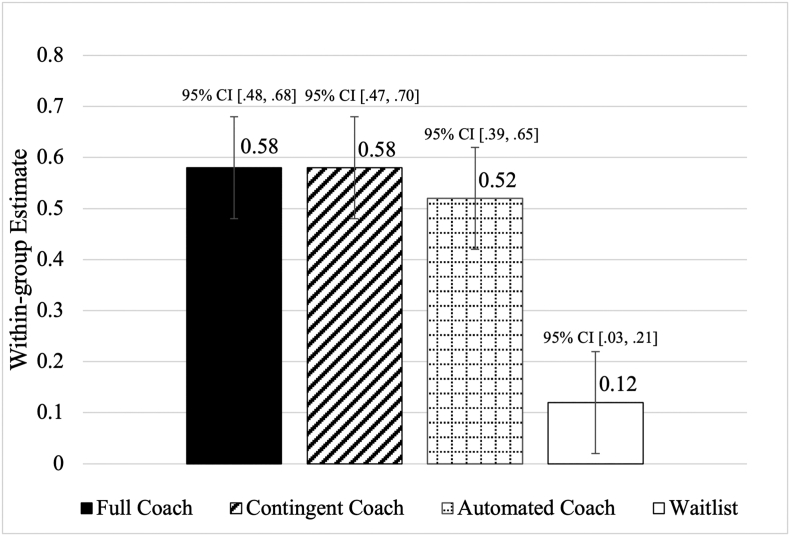
Online programs that reduce relationship distress fill a critical need; however, their scalability is limited by their reliance on coach calls. To determine the effectiveness of the online OurRelationship program with varying levels of coach support, we conducted a comparative effectiveness trial with 740 low-income couples in the United States. Couples were randomly assigned to full-coach ( = 226; program as originally designed), automated-coach ( 145; as a stand-alone program with tailored automated emails only), contingent-coach ( 145; as an adaptive program where tailored automated emails are followed by more coaching if couples did not meet progress milestones), or a waitlist control condition ( = 224). All analyses were conducted within a Bayesian framework. Completion rates were comparable across conditions (full-coach: 65 %, automated-coach: 59 %, contingent-coach: 54 %). All intervention couples reported reliable pre-post gains in relationship satisfaction compared to waitlist control couples ( = 0.46, = 0.47, and = 0.40) with no reliable differences across intervention conditions. Over four-month follow-up, couples in full- and contingent-coach conditions maintained gains in relationship satisfaction and couples in the automated-coach condition continued to improve. Given the comparable completion rates and minimal differences in effect sizes across intervention conditions, all three coaching models appear viable; therefore, the choice of model can vary depending on available resources as well as couple or stakeholder preferences. This study was preregistered (ClinicalTrials.govNCT03568565).
减少关系困扰的在线项目满足了一项关键需求;然而,它们的可扩展性受到对教练指导电话依赖的限制。为了确定不同教练支持水平的在线“我们的关系”项目的有效性,我们在美国对740对低收入夫妇进行了一项比较有效性试验。夫妇们被随机分配到全教练组(n = 226;按最初设计的项目)、自动教练组(n = 145;作为仅带有定制自动电子邮件的独立项目)、应急教练组(n = 145;作为一个适应性项目,即如果夫妇未达到进展里程碑,在定制自动电子邮件之后会有更多指导)或等待名单对照组(n = 224)。所有分析均在贝叶斯框架内进行。各条件下的完成率相当(全教练组:65%,自动教练组:59%,应急教练组:54%)。与等待名单对照组相比,所有干预组夫妇在关系满意度上均报告了可靠的前后改善(分别为d = 0.46、d = 0.47和d = 0.40),各干预条件之间无可靠差异。在四个月的随访中,全教练组和应急教练组的夫妇保持了关系满意度的改善,自动教练组的夫妇继续改善。鉴于各干预条件下相当的完成率和效应量的微小差异,所有三种教练模式似乎都是可行的;因此,模式的选择可以根据可用资源以及夫妇或利益相关者的偏好而有所不同。本研究已预先注册(ClinicalTrials.govNCT03568565)。