Swinburne University of Technology, Department of Psychological Sciences, Melbourne, Vic., Australia.
Psychol Psychother. 2022 Dec;95(4):1036-1055. doi: 10.1111/papt.12417. Epub 2022 Jul 20.
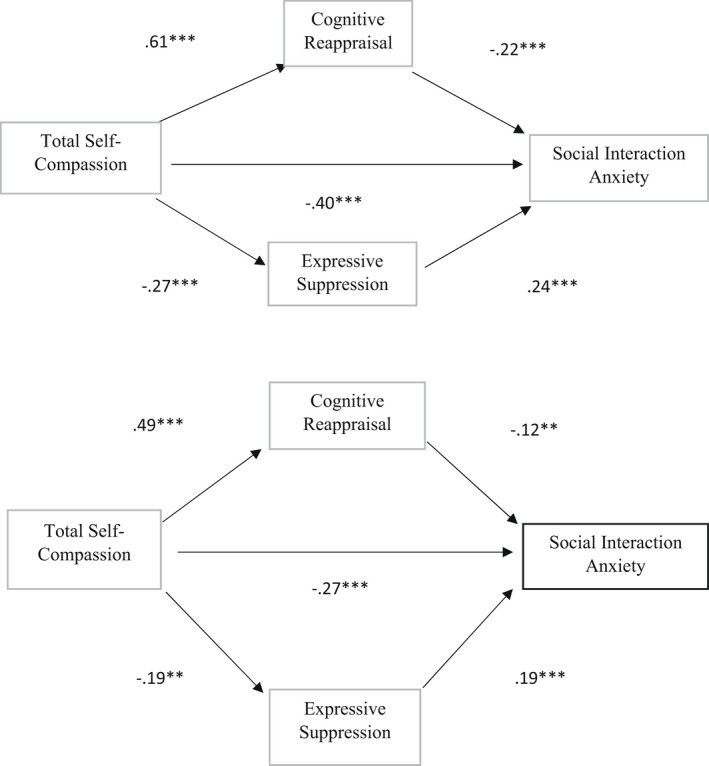
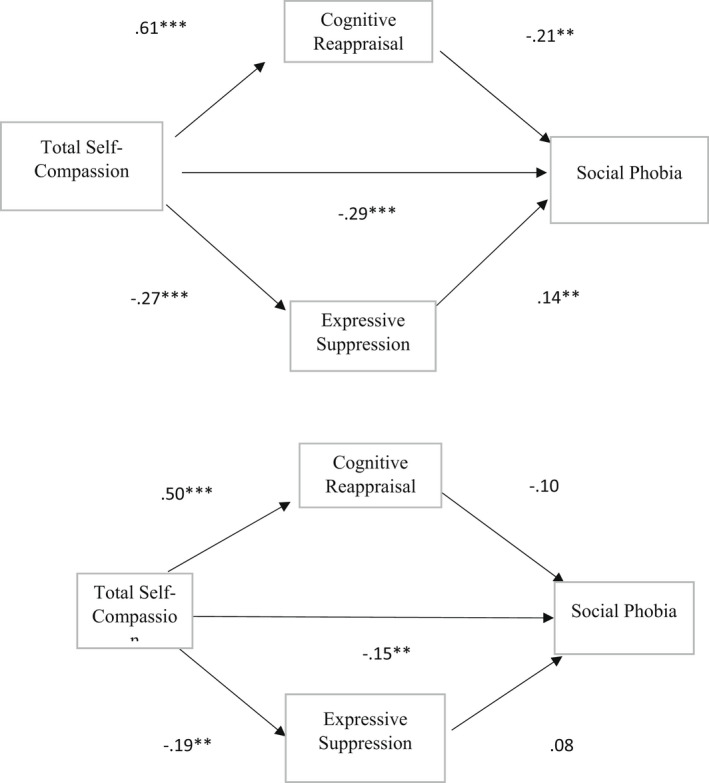
Self-compassion constitutes a positive way of relating towards the self that enables emotional regulation and reduces emotional distress. This research first explored differences among a sample of persons with social anxiety disorder (SAD) and groups of high socially anxious (HSA) and low socially anxious (LSA) students on self-compassion, emotion regulation, and social anxiety. We then investigated emotional regulation as a mediator of the prediction of social anxiety by self-compassion and the influence of depressed mood on those relationships.
Study 1 compared a SAD group to matched groups of HSA and LSA students. Study 2 utilized the total sample (n = 330 students and n = 33 SAD) to test mediation. Self-compassion and emotion regulation were predictors of social anxiety and depression a covariate.
In Study 1, the SAD group did not differ from the HSA group on most aspects of self-compassion and emotional regulation but was higher on depression. Both were lower on most measures and higher on depression than the LSA group. In Study 2, higher self-compassion predicted lower social interaction anxiety, and emotional regulation strategies mediated this effect, regardless of depression. However, for social performance anxiety, controlling for depression removed mediation. Refraining from uncompassionate responses was directly connected to social anxiety, whereas compassionate responses influenced social anxiety via emotional regulation.
Results affirm the ameliorative role of self-compassion on social anxiety and emotion regulation strategies as mechanisms of that influence. However, self-compassion's influence was affected by depression and type of social anxiety. Also, refraining from uncompassionate self-responding appears to be of prime importance in predicting social anxiety, whereas compassionate self-responding influences social anxiety via emotion regulation.
自我同情是一种积极的自我关系方式,能够促进情绪调节,减轻情绪困扰。本研究首先探讨了社交焦虑障碍(SAD)患者样本与高社交焦虑(HSA)和低社交焦虑(LSA)学生群体在自我同情、情绪调节和社交焦虑方面的差异。然后,我们研究了情绪调节作为自我同情预测社交焦虑的中介,以及抑郁情绪对这些关系的影响。
研究 1 将 SAD 组与 HSA 和 LSA 组进行比较。研究 2 利用总样本(n=330 名学生和 n=33 名 SAD 患者)测试中介效应。自我同情和情绪调节是社交焦虑和抑郁的预测因子,抑郁是协变量。
在研究 1 中,SAD 组在自我同情和情绪调节的大多数方面与 HSA 组没有差异,但在抑郁方面更高。两组在大多数测量指标上都较低,而在抑郁方面则高于 LSA 组。在研究 2 中,更高的自我同情预测了更低的社交互动焦虑,情绪调节策略中介了这种效应,而与抑郁无关。然而,对于社交表现焦虑,控制抑郁后,中介作用消失。避免不宽容的反应与社交焦虑直接相关,而同情的反应则通过情绪调节影响社交焦虑。
结果肯定了自我同情对社交焦虑和情绪调节策略的改善作用,认为这是其影响的机制。然而,自我同情的影响受到抑郁和社交焦虑类型的影响。此外,避免不宽容的自我反应似乎对预测社交焦虑至关重要,而同情的自我反应则通过情绪调节影响社交焦虑。