Ginting Johannes B, Suci Tri, Ginting Chrismis N, Girsang Ermi
Department of Bachelor of Public Health, Faculty of Medicine, Dentistry and Health Sciences, Universitas Prima Indonesia, North Sumatra, Indonesia.
J Family Community Med. 2023 Jul-Sep;30(3):171-179. doi: 10.4103/jfcm.jfcm_33_23. Epub 2023 Jul 24.
The prevalence of morbidity and mortality for type 2 diabetes mellitus (DM) is still increasing because of changing lifestyles. There needs to be a means of controlling the rise in the incidence of the disease. Many researchers have utilized technological advances such as machine learning for disease prevention and control, especially in noncommunicable conditions. Researchers are, therefore, interested in creating an early detection system for risk factors of type 2 diabetes.
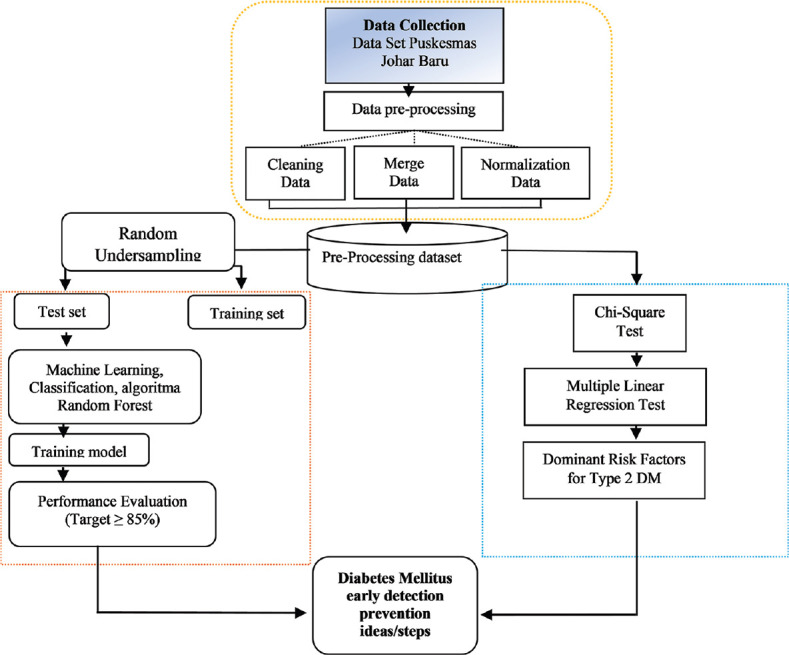
The study was conducted in February 2022, utilizing secondary surveillance data from Puskesmas Johar Baru, Jakarta, in 2019, 2020, and 2021. Data was analyzed utilizing various bivariate and multivariate statistical methods at 5% significance level and machine learning methods (random forest algorithm) with an accuracy rate of >80%. The data for the three years was cleaned, normalized, and merged.
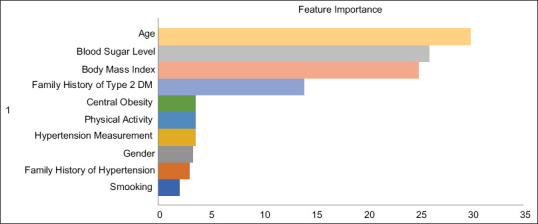
The final population was 65,533 visits out of the initial data of 196,949, and the final number of DM 2 population was 2766 out of the initial data of 9903. Age, gender, family history of DM, family history of hypertension, hypertension, high blood sugar levels, obesity, and central obesity were significantly associated with type 2 DM. Family history was the strongest risk factor of all independent variables, odds ratio of 15.101. The classification results of feature importance, with an accuracy rate of 84%, obtained in order were age, blood sugar level, and body mass index.
Blood sugar level is the most influential factor in the incidence of DM in Puskesmas Johar Baru. In other words, a person with a family history of type 2 diabetes, at unproductive age, of female gender, and of excessive weight can avoid type 2 diabetes if they can regularly maintain their blood sugar levels.
由于生活方式的改变,2型糖尿病(DM)的发病率和死亡率仍在上升。需要有一种方法来控制该疾病发病率的上升。许多研究人员利用机器学习等技术进步来预防和控制疾病,特别是在非传染性疾病方面。因此,研究人员有兴趣创建一个2型糖尿病风险因素的早期检测系统。
该研究于2022年2月进行,利用了雅加达Johar Baru社区卫生中心2019年、2020年和2021年的二次监测数据。使用各种双变量和多变量统计方法在5%显著性水平下分析数据,并使用准确率>80%的机器学习方法(随机森林算法)。对这三年的数据进行了清理、归一化和合并。
最终纳入研究的人群为65533次就诊,初始数据为196949次;2型糖尿病患者最终人数为2766人,初始数据为9903人。年龄、性别、糖尿病家族史、高血压家族史、高血压、高血糖水平、肥胖和中心性肥胖与2型糖尿病显著相关。家族史是所有自变量中最强的风险因素,比值比为15.101。特征重要性的分类结果准确率为84%,依次为年龄、血糖水平和体重指数。
血糖水平是Johar Baru社区卫生中心糖尿病发病中最具影响力的因素。换句话说,有2型糖尿病家族史、处于非生育年龄、女性且体重超重的人,如果能定期维持血糖水平,就可以避免患2型糖尿病。