Cai Yuchen, Zhang Siyi, Chen Liangbo, Fu Yao
Department of Ophthalmology, Shanghai Ninth People's Hospital, Shanghai Jiao Tong University School of Medicine, Shanghai, China.
Shanghai Key Laboratory of Orbital Diseases and Ocular Oncology, Shanghai, China.
Comput Struct Biotechnol J. 2023 Aug 28;21:4215-4227. doi: 10.1016/j.csbj.2023.08.026. eCollection 2023.
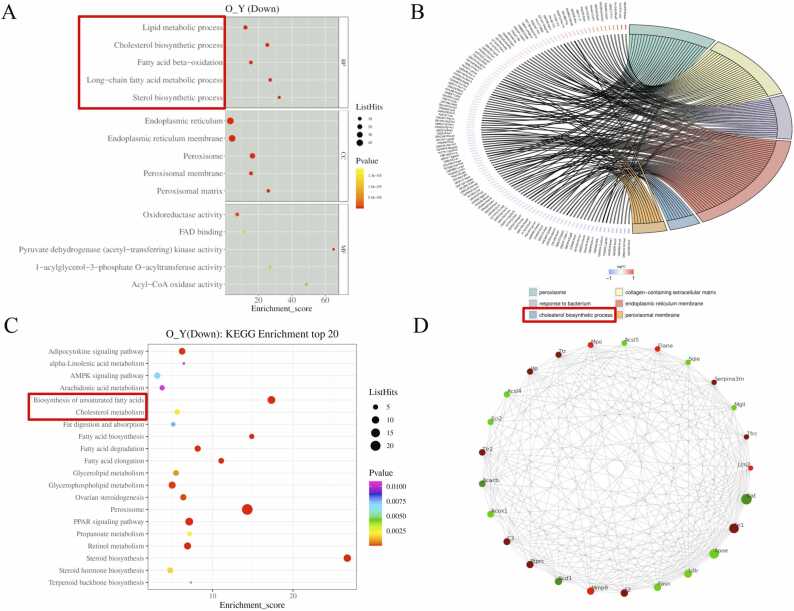
Meibomian gland dysfunction (MGD) is a prevalent inflammatory disorder of the ocular surface that significantly impacts patients' vision and quality of life. The underlying mechanism of aging and MGD remains largely uncharacterized. The aim of this work is to investigate lipid metabolic alterations in age-related MGD (ARMGD) through integrated proteomics, lipidomics and machine learning (ML) approach. For this purpose, we collected samples of female mouse meibomian glands (MGs) dissected from eyelids at age two months (n = 9) and two years (n = 9) for proteomic and lipidomic profilings using the liquid chromatography with tandem mass spectrometry (LC-MS/MS) method. To further identify ARMGD-related lipid biomarkers, ML model was established using the least absolute shrinkage and selection operator (LASSO) algorithm. For proteomic profiling, 375 differentially expressed proteins were detected. Functional analyses indicated the leading role of cholesterol biosynthesis in the aging process of MGs. Several proteins were proposed as potential biomarkers, including lanosterol synthase (Lss), 24-dehydrocholesterol reductase (Dhcr24), and farnesyl diphosphate farnesyl transferase 1 (Fdft1). Concomitantly, lipidomic analysis unveiled 47 lipid species that were differentially expressed and clustered into four classes. The most notable age-related alterations involved a decline in cholesteryl esters (ChE) levels and an increase in triradylglycerols (TG) levels, accompanied by significant differences in their lipid unsaturation patterns. Through ML construction, it was confirmed that ChE(26:0), ChE(26:1), and ChE(30:1) represent the most promising diagnostic molecules. The present study identified essential proteins, lipids, and signaling pathways in age-related MGD (ARMGD), providing a reference landscape to facilitate novel strategies for the disease transformation.
睑板腺功能障碍(MGD)是一种常见的眼表炎症性疾病,会对患者的视力和生活质量产生重大影响。衰老与MGD的潜在机制在很大程度上仍未明确。这项工作的目的是通过整合蛋白质组学、脂质组学和机器学习(ML)方法,研究年龄相关性MGD(ARMGD)中的脂质代谢变化。为此,我们收集了从两个月龄(n = 9)和两岁(n = 9)小鼠眼睑中解剖出的睑板腺(MG)样本,采用液相色谱-串联质谱(LC-MS/MS)方法进行蛋白质组学和脂质组学分析。为了进一步鉴定与ARMGD相关的脂质生物标志物,使用最小绝对收缩和选择算子(LASSO)算法建立了ML模型。在蛋白质组学分析中,检测到375种差异表达蛋白。功能分析表明胆固醇生物合成在MG衰老过程中起主导作用。提出了几种蛋白质作为潜在的生物标志物,包括羊毛甾醇合酶(Lss)、24-脱氢胆固醇还原酶(Dhcr24)和法尼基二磷酸法尼基转移酶1(Fdft1)。同时,脂质组学分析揭示了47种差异表达的脂质种类,并聚类为四类。最显著的年龄相关变化包括胆固醇酯(ChE)水平下降和三酰甘油(TG)水平升高,同时它们的脂质不饱和模式存在显著差异。通过ML构建,证实ChE(26:0)、ChE(26:1)和ChE(30:1)是最有前景的诊断分子。本研究确定了年龄相关性MGD(ARMGD)中的关键蛋白质、脂质和信号通路,为促进该疾病转化的新策略提供了参考框架。