Xu Xiaodong, Yuan Li, Xie Qiguang
State Key Laboratory of Crop Stress Adaptation and Improvement, School of Life Sciences, Henan University, Kaifeng, 475004, China.
Stress Biol. 2022 Mar 1;2(1):15. doi: 10.1007/s44154-022-00040-7.
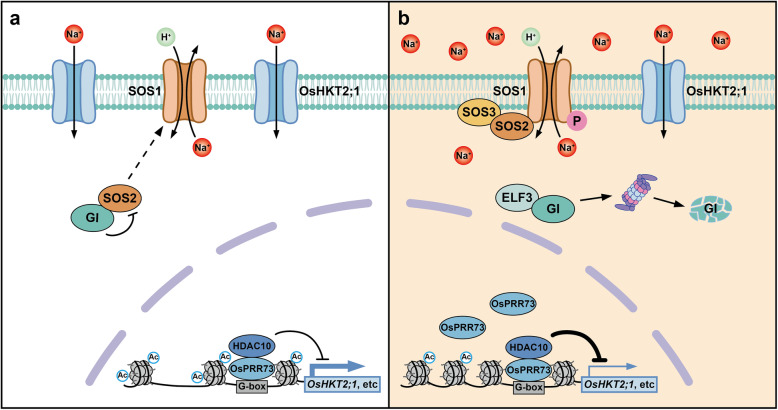
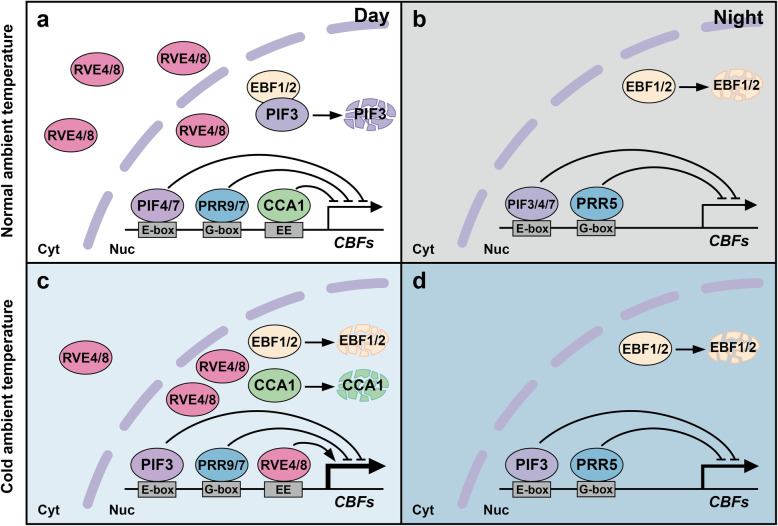
The circadian clock, a time-keeping mechanism, drives nearly 24-h self-sustaining rhythms at the physiological, cellular, and molecular levels, keeping them synchronized with the cyclic changes of environmental signals. The plant clock is sensitive to external and internal stress signals that act as timing cues to influence the circadian rhythms through input pathways of the circadian clock system. In order to cope with environmental stresses, many core oscillators are involved in defense while maintaining daily growth in various ways. Recent studies have shown that a hierarchical multi-oscillator network orchestrates the defense through rhythmic accumulation of gene transcripts, alternative splicing of mRNA precursors, modification and turnover of proteins, subcellular localization, stimuli-induced phase separation, and long-distance transport of proteins. This review summarizes the essential role of circadian core oscillators in response to stresses in Arabidopsis thaliana and crops, including daily and seasonal abiotic stresses (low or high temperature, drought, high salinity, and nutrition deficiency) and biotic stresses (pathogens and herbivorous insects). By integrating time-keeping mechanisms, circadian rhythms and stress resistance, we provide a temporal perspective for scientists to better understand plant environmental adaptation and breed high-quality crop germplasm for agricultural production.
生物钟作为一种计时机制,在生理、细胞和分子水平驱动近24小时的自我维持节律,使其与环境信号的周期性变化保持同步。植物生物钟对外部和内部应激信号敏感,这些信号作为计时线索,通过生物钟系统的输入途径影响昼夜节律。为了应对环境胁迫,许多核心振荡器在以各种方式维持日常生长的同时参与防御。最近的研究表明,一个分层的多振荡器网络通过基因转录本的节律性积累、mRNA前体的可变剪接、蛋白质的修饰和周转、亚细胞定位、刺激诱导的相分离以及蛋白质的长距离运输来协调防御。本综述总结了拟南芥和作物中生物钟核心振荡器在应对胁迫中的重要作用,包括日常和季节性非生物胁迫(低温或高温、干旱、高盐度和营养缺乏)以及生物胁迫(病原体和食草昆虫)。通过整合计时机制、昼夜节律和抗逆性,我们为科学家提供了一个时间视角,以便更好地理解植物的环境适应性,并培育用于农业生产的优质作物种质。