The Salk Institute for Biological Studies, La Jolla, CA, USA.
Department of Organismal Biology and Anatomy, University of Chicago, Chicago, IL, USA.
J Vis. 2023 Sep 1;23(10):4. doi: 10.1167/jov.23.10.4.
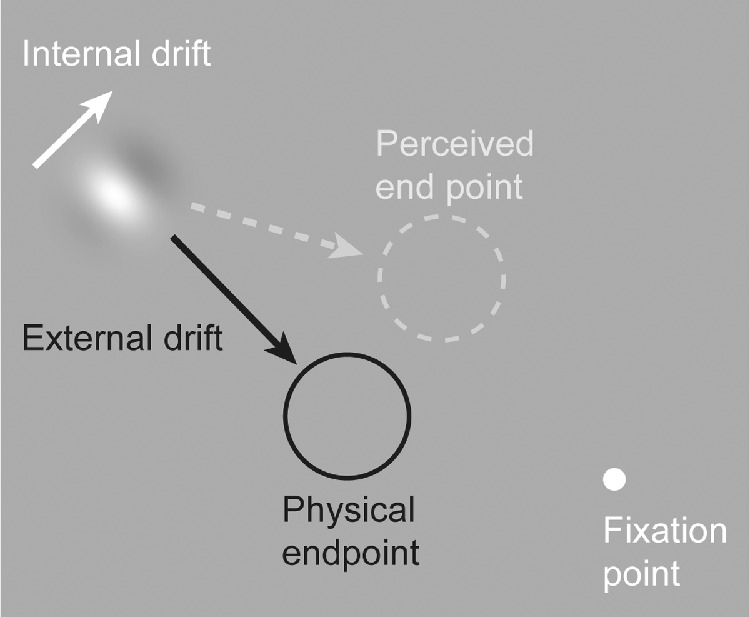
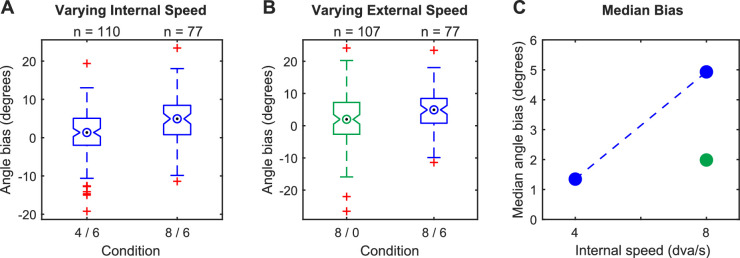
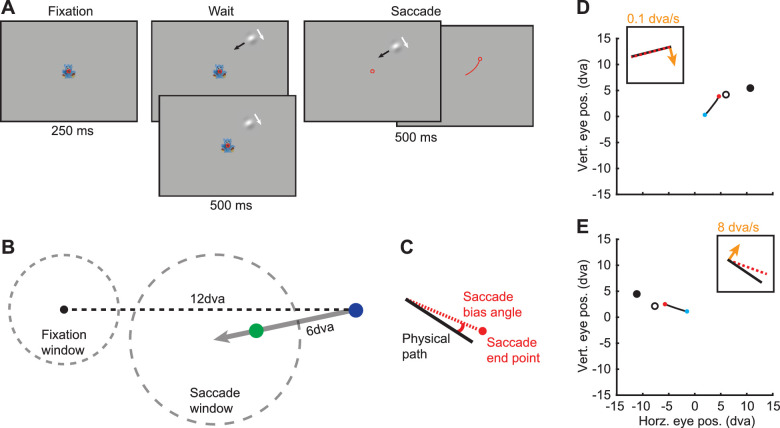
The double-drift illusion has two unique characteristics: The error between the perceived and physical position of the stimulus grows over time, and saccades to the moving target land much closer to the physical than the perceived location. These results suggest that the perceptual and saccade targeting systems integrate visual information over different time scales. Functional imaging studies in humans have revealed several potential cortical areas of interest, including the prefrontal cortex. However, we currently lack an animal model to study the neural mechanisms of location perception that underlie the double-drift illusion. To fill this gap, we trained two marmoset monkeys to fixate and then saccade to the double-drift stimulus. In line with human observers for radial double-drift trajectories with fast internal motion, we find that saccade endpoints show a significant bias that is, nevertheless, smaller than the bias seen in human perceptual reports. This bias is modulated by changes in the external and internal speeds of the stimulus. These results demonstrate that the saccade targeting system of the marmoset monkey is influenced by the double-drift illusion.
刺激的感知和物理位置之间的误差随时间增长,并且向移动目标的扫视比感知位置更接近物理位置。这些结果表明,感知和扫视目标系统在不同的时间尺度上整合视觉信息。对人类的功能成像研究揭示了几个潜在的感兴趣的皮质区域,包括前额叶皮层。然而,我们目前缺乏一种动物模型来研究双漂错觉所基于的位置感知的神经机制。为了填补这一空白,我们训练了两只狨猴来固定并扫视双漂刺激。与人类观察者对具有快速内部运动的放射状双漂轨迹的观察结果一致,我们发现扫视终点表现出显著的偏差,但比人类感知报告中观察到的偏差小。这种偏差受刺激的外部和内部速度变化的调节。这些结果表明,狨猴的扫视目标系统受到双漂错觉的影响。