Department of Complex Trait Genetics, Centre for Neurogenomics and Cognitive Research, VU University, Amsterdam, The Netherlands.
Department of Psychiatry, Amsterdam UMC, location VUmc, Amsterdam, the Netherlands.
PLoS Genet. 2023 Sep 7;19(9):e1010921. doi: 10.1371/journal.pgen.1010921. eCollection 2023 Sep.
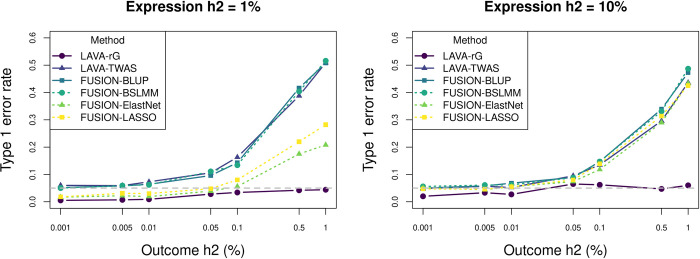
Transcriptome-wide association studies (TWAS) aim to detect relationships between gene expression and a phenotype, and are commonly used for secondary analysis of genome-wide association study (GWAS) results. Results from TWAS analyses are often interpreted as indicating a genetic relationship between gene expression and a phenotype, but this interpretation is not consistent with the null hypothesis that is evaluated in the traditional TWAS framework. In this study we provide a mathematical outline of this TWAS framework, and elucidate what interpretations are warranted given the null hypothesis it actually tests. We then use both simulations and real data analysis to assess the implications of misinterpreting TWAS results as indicative of a genetic relationship between gene expression and the phenotype. Our simulation results show considerably inflated type 1 error rates for TWAS when interpreted this way, with 41% of significant TWAS associations detected in the real data analysis found to have insufficient statistical evidence to infer such a relationship. This demonstrates that in current implementations, TWAS cannot reliably be used to investigate genetic relationships between gene expression and a phenotype, but that local genetic correlation analysis can serve as a potential alternative.
转录组关联研究(TWAS)旨在检测基因表达与表型之间的关系,常用于全基因组关联研究(GWAS)结果的二次分析。TWAS 分析的结果通常被解释为表明基因表达与表型之间存在遗传关系,但这种解释与传统 TWAS 框架中评估的零假设不一致。在这项研究中,我们提供了这个 TWAS 框架的数学概述,并阐明了在实际测试的零假设下,哪些解释是合理的。然后,我们使用模拟和实际数据分析来评估将 TWAS 结果误解为表明基因表达与表型之间存在遗传关系的后果。我们的模拟结果表明,以这种方式解释 TWAS 时,其类型 1错误率显著升高,在实际数据分析中,41%的显著 TWAS 关联被发现没有足够的统计证据来推断这种关系。这表明,在当前的实现中,TWAS 不能可靠地用于研究基因表达与表型之间的遗传关系,但局部遗传相关性分析可以作为一种潜在的替代方法。