Rammohan Rajmohan, Magam Sai Greeshma, Joy Melvin, Natt Dilman, Patel Achal, Tadikonda Abhishek, Desai Jiten, Bunting Susan, Yost Robert M, Akande Olawale, Mustacchia Paul
Gastroenterology, Nassau University Medical Center, East Meadow, USA.
Internal Medicine, Nassau University Medical Center, East Meadow, USA.
Cureus. 2023 Aug 7;15(8):e43080. doi: 10.7759/cureus.43080. eCollection 2023 Aug.
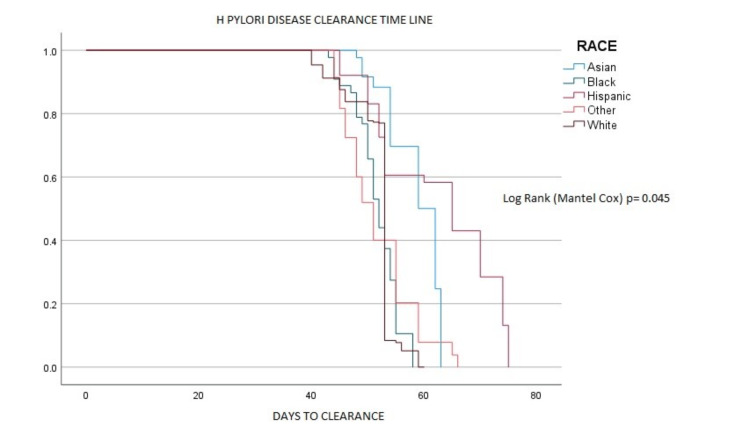
Introduction Helicobacter pylori (H. pylori) is a bacteria causing chronic stomach infections, influenced by various factors, including host traits and bacterial virulence. It uses both urease-dependent and independent mechanisms to survive acidic gastric environments. Management entails diagnosis, treatment, and eradication verification. Combining drugs is key to overcoming resistance and ensuring bacteria elimination, thus preventing recurrence and complications. H. Pylori eradication mitigates gastric cancer risk and alleviates symptoms. Racial disparities persist despite declining H. pylori and gastric cancer incidence in the United States (US). African Americans (AA) have higher gastric cancer risks than non-Hispanic Whites. Addressing these disparities is crucial to protect high-risk populations. Methods This study retrospectively compiled H. pylori infection data from 2009 to 2022, categorized by race. Propensity score matching balanced initial group characteristics before analysis. Chi-squared and odds ratio tests were used on the cohort, with Kaplan Meier and Log Rank methods evaluating disease clearance in ethnic groups. Data were extracted from the Sunrise Electronic Medical Record software, including patient demographics, health details, and treatment specifics. Patients aged 18-65 with H. pylori infection at Nassau University Medical Center, who followed their treatment, were selected. Data were processed using Statistical Package for the Social Sciences (SPSS) and RStudio software. Results The study initially included 10,040 H. pylori-diagnosed patients, with 9,288 meeting the study's criteria after attrition. Predominantly female (64.7%), the cohort was racially diverse. A longer disease clearance time was noted among Hispanics (p=0.044). Binomial logistic regression analysis identified influential factors like high school graduation rates, poverty level income, and language proficiency on disease clearance. An odds ratio analysis further emphasized language barriers (HR 0.346, p=0.043) and education status (HR 0.756, p=0.025) as primary covariates impacting disease clearance, underlining the role of socio-economic factors and language proficiency in health outcomes. Conclusion The study highlights racial disparities in H. pylori clearance rates, particularly among Hispanics, necessitating culturally sensitive interventions. It advocates for improved diagnostics, increased healthcare access, and social determinants of health-focused initiatives. It identifies socio-economic status and language proficiency as key factors impacting health outcomes, calling for actions to bridge these disparities. Addressing these differences can decrease healthcare inequalities and economic burden, improving overall health outcomes and reducing costs associated with H. pylori clearance.
引言 幽门螺杆菌(H. pylori)是一种可引发慢性胃部感染的细菌,受多种因素影响,包括宿主特征和细菌毒力。它利用尿素酶依赖性和非依赖性机制在酸性胃部环境中存活。管理措施包括诊断、治疗和根除验证。联合用药是克服耐药性并确保细菌清除的关键,从而预防复发和并发症。根除幽门螺杆菌可降低胃癌风险并缓解症状。尽管美国幽门螺杆菌和胃癌发病率有所下降,但种族差异依然存在。非裔美国人(AA)患胃癌的风险高于非西班牙裔白人。解决这些差异对于保护高危人群至关重要。
方法 本研究回顾性收集了2009年至2022年按种族分类的幽门螺杆菌感染数据。在分析前,倾向得分匹配平衡了初始组特征。对队列使用卡方检验和比值比检验,采用Kaplan Meier和对数秩检验方法评估不同种族群体的疾病清除情况。数据从Sunrise电子病历软件中提取,包括患者人口统计学信息、健康细节和治疗详情。选取了拿骚大学医学中心年龄在18至65岁且感染幽门螺杆菌并遵循治疗方案的患者。数据使用社会科学统计软件包(SPSS)和RStudio软件进行处理。
结果 该研究最初纳入了10,040例诊断为幽门螺杆菌感染的患者,剔除后有9,288例符合研究标准。该队列以女性为主(64.7%),种族多样。西班牙裔患者的疾病清除时间较长(p = 0.044)。二项逻辑回归分析确定了高中毕业率、贫困水平收入和语言能力等对疾病清除有影响的因素。比值比分析进一步强调语言障碍(HR 0.346,p = 0.043)和教育状况(HR 0.756,p = 0.025)是影响疾病清除的主要协变量,突显了社会经济因素和语言能力在健康结果中的作用。
结论 该研究突显了幽门螺杆菌清除率方面的种族差异,尤其是在西班牙裔人群中,这需要采取具有文化敏感性的干预措施。它主张改进诊断、增加医疗服务可及性以及开展以健康的社会决定因素为重点的举措。它确定社会经济地位和语言能力是影响健康结果的关键因素,呼吁采取行动弥合这些差异。解决这些差异可减少医疗保健不平等和经济负担,改善整体健康结果并降低与幽门螺杆菌清除相关的成本。
