Awoyemi Bosede Olanike, Makanju Aderonke Abisola, Mpapalika Jane, Ekpeyo Rita Samuel
Department of Economics, Afe Babalola University of Ado-Ekiti, Ekiti State.
Research Department, Lagos Business School, Lagos State.
J Public Health Afr. 2023 May 24;14(7):1409. doi: 10.4081/jphia.2023.1409. eCollection 2023 Jul 26.
Despite a significant share of Nigeria's budget in the health sector, the health status has not improved, as reflected by poor health indicators.
This study investigates the linkages between government expenditure and health outcomes in Nigeria.
The Autoregressive Distributed Lag technique was used to examine the short- and long-run effects of government health expenditure on health outcomes separately. The health outcome was captured by life expectancy at birth and mortality rate.
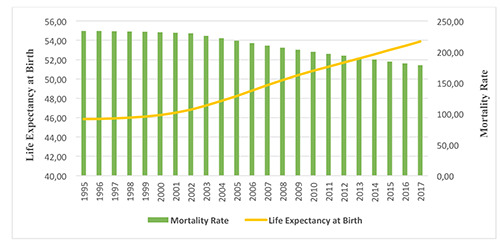
Findings show a negative relationship exists between health expenditure and mortality rate, implying that a rise in health expenditure leads to a decrease in mortality rate, while life expectancy at birth positively responds to the changes in health expenditure.
As a policy recommendation from this study, the government should pursue increasing health expenditure and partner with the private sector in the form of Public-Private Partnerships to improve the health sector and outcomes.
尽管尼日利亚卫生部门在预算中占很大份额,但健康状况并未改善,这从较差的健康指标中可见一斑。
本研究调查尼日利亚政府支出与健康结果之间的联系。
运用自回归分布滞后技术分别检验政府卫生支出对健康结果的短期和长期影响。健康结果通过出生时预期寿命和死亡率来体现。
研究结果表明,卫生支出与死亡率之间存在负相关关系,这意味着卫生支出的增加会导致死亡率下降,而出生时预期寿命对卫生支出的变化呈正向反应。
作为本研究的一项政策建议,政府应增加卫生支出,并以公私伙伴关系的形式与私营部门合作,以改善卫生部门及其成果。