Department of Pediatrics, University of Miami Miller School of Medicine, Miami, Florida.
Department of Pediatrics, Biochemistry, and Molecular Biology and Medicine, University of Miami Miller School of Medicine, Miami, Florida.
Mol Cancer Res. 2023 Dec 1;21(12):1261-1273. doi: 10.1158/1541-7786.MCR-23-0502.
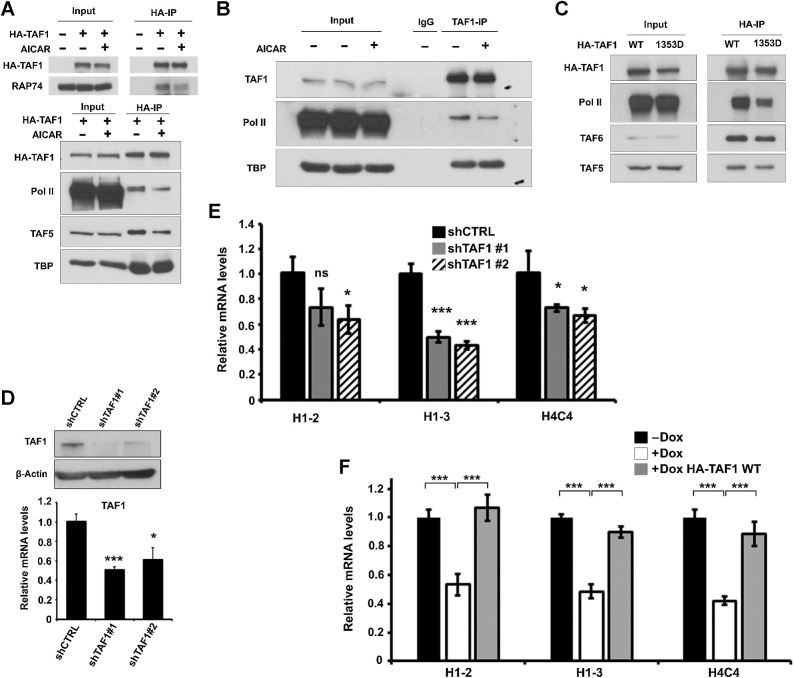
The survival rates for relapsed/refractory acute lymphoblastic leukemia (ALL) remain poor. We and others have reported that ALL cells are vulnerable to conditions inducing energy/ER-stress mediated by AMP-activated protein kinase (AMPK). To identify the target genes directly regulated by AMPKα2, we performed genome-wide RNA-seq and ChIP-seq in CCRF-CEM (T-ALL) cells expressing HA-AMPKα2 (CN2) under normal and energy/metabolic stress conditions. CN2 cells show significantly altered AMPKα2 genomic binding and transcriptomic profile under metabolic stress conditions, including reduced histone gene expression. Proteomic analysis and in vitro kinase assays identified the TATA-Box-Binding Protein-Associated Factor 1 (TAF1) as a novel AMPKα2 substrate that downregulates histone gene transcription in response to energy/metabolic stress. Knockdown and knockout studies demonstrated that both AMPKα2 and TAF1 are required for histone gene expression. Mechanistically, upon activation, AMPKα2 phosphorylates TAF1 at Ser-1353 which impairs TAF1 interaction with RNA polymerase II (Pol II), leading to a compromised state of p-AMPKα2/p-TAF1/Pol II chromatin association and suppression of transcription. This mechanism was also observed in primary ALL cells and in vivo in NSG mice. Consequently, we uncovered a non-canonical function of AMPK that phosphorylates TAF1, both members of a putative chromatin-associated transcription complex that regulate histone gene expression, among others, in response to energy/metabolic stress.
Fully delineating the protein interactome by which AMPK regulates adaptive survival responses to energy/metabolic stress, either via epigenetic gene regulation or other mechanisms, will allow the rational development of strategies to overcome de novo or acquired resistance in ALL and other cancers.
复发/难治性急性淋巴细胞白血病 (ALL) 的生存率仍然很差。我们和其他人已经报道过,ALL 细胞容易受到 AMP 激活的蛋白激酶 (AMPK) 诱导的能量/内质网应激的条件影响。为了确定 AMPKα2 直接调控的靶基因,我们在表达 HA-AMPKα2 (CN2) 的 CCRF-CEM (T-ALL) 细胞中进行了全基因组 RNA-seq 和 ChIP-seq,这些细胞在正常和能量/代谢应激条件下。在代谢应激条件下,CN2 细胞的 AMPKα2 基因组结合和转录组谱发生了显著变化,包括组蛋白基因表达减少。蛋白质组学分析和体外激酶测定将 TATA 框结合蛋白相关因子 1 (TAF1) 鉴定为一种新的 AMPKα2 底物,它响应能量/代谢应激下调组蛋白基因转录。敲低和敲除研究表明,AMPKα2 和 TAF1 都需要组蛋白基因表达。从机制上讲,在激活后,AMPKα2 在 Ser-1353 处磷酸化 TAF1,这会损害 TAF1 与 RNA 聚合酶 II (Pol II) 的相互作用,导致 p-AMPKα2/p-TAF1/Pol II 染色质结合受损和转录抑制。在原发性 ALL 细胞和 NSG 小鼠体内也观察到了这种机制。因此,我们发现了 AMPK 的一种非典型功能,即磷酸化 TAF1,它们都是假定的染色质相关转录复合物的成员,该复合物调节组蛋白基因表达等,以响应能量/代谢应激。
通过表观遗传基因调控或其他机制,充分描绘 AMPK 通过其调节对能量/代谢应激的适应性存活反应的蛋白质相互作用组,将允许合理地开发克服 ALL 和其他癌症中新发或获得性耐药的策略。