University of California San Francisco School of Medicine, San Francisco, CA, USA; Department of Internal Medicine, Stanford, CA, USA.
University of California San Francisco School of Medicine, San Francisco, CA, USA.
J Hepatol. 2023 Dec;79(6):1469-1477. doi: 10.1016/j.jhep.2023.08.020. Epub 2023 Sep 7.
BACKGROUND & AIMS: Alpha-fetoprotein (AFP) predicts hepatocellular carcinoma (HCC) recurrence after liver transplant (LT) but remains an imperfect biomarker. The role of DCP (des-gamma-carboxyprothrombin) and AFP-L3 (AFP bound to Lens culinaris agglutinin) in predicting HCC recurrence remains incompletely characterized. AFP-L3 and DCP could identify patients at high risk of post-transplant HCC recurrence and serve as liver transplant exclusion criteria to defer transplant until patients receive additional risk-reducing pre-transplant locoregional therapy.
This prospective cohort study included consecutive patients with HCC who underwent LT (within or down-staged to Milan criteria) between 2017 and 2022. Pre-transplant AFP, AFP-L3, and DCP measurements were obtained. The primary endpoint was the ability of biomarkers to predict HCC recurrence-free survival.
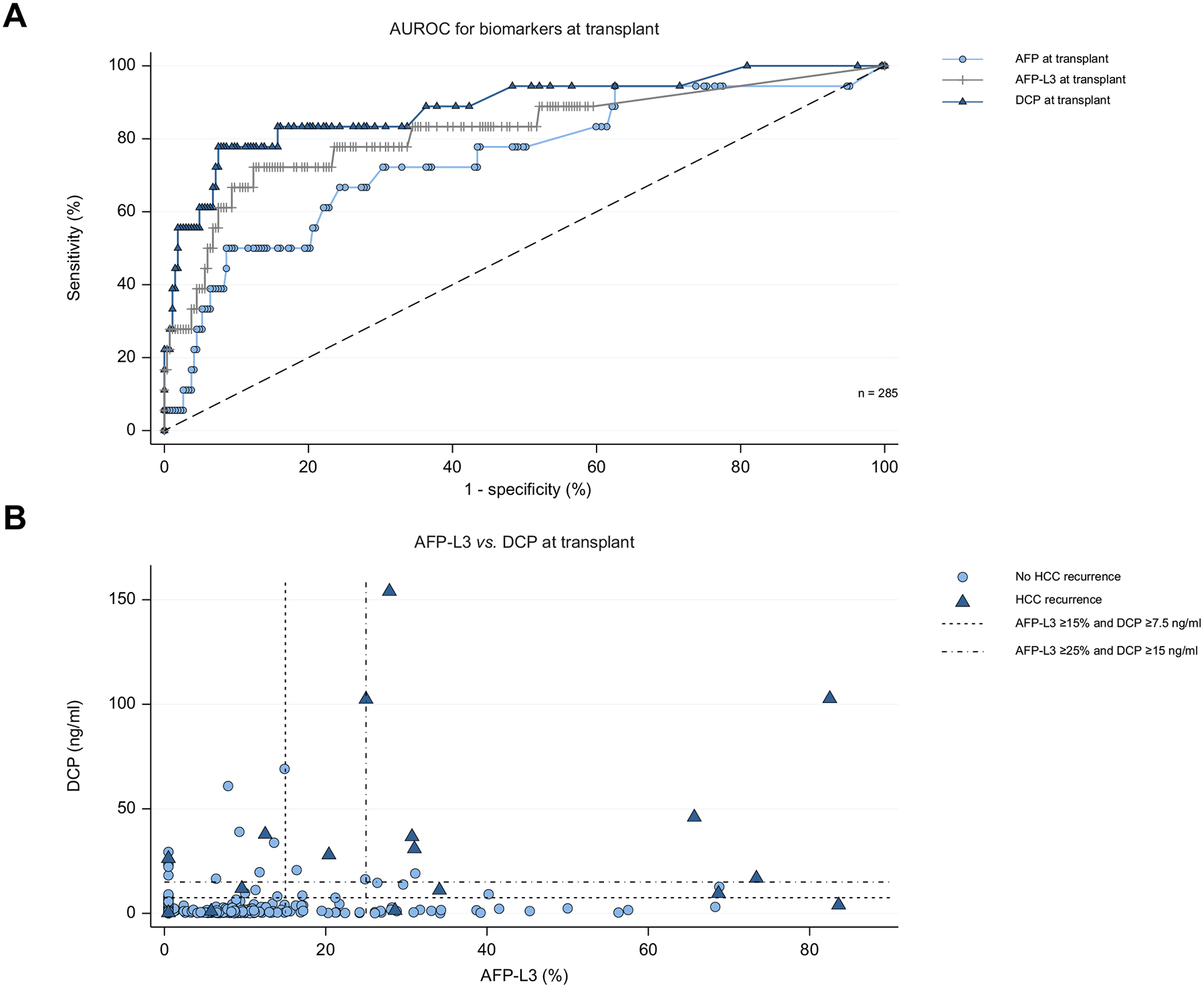
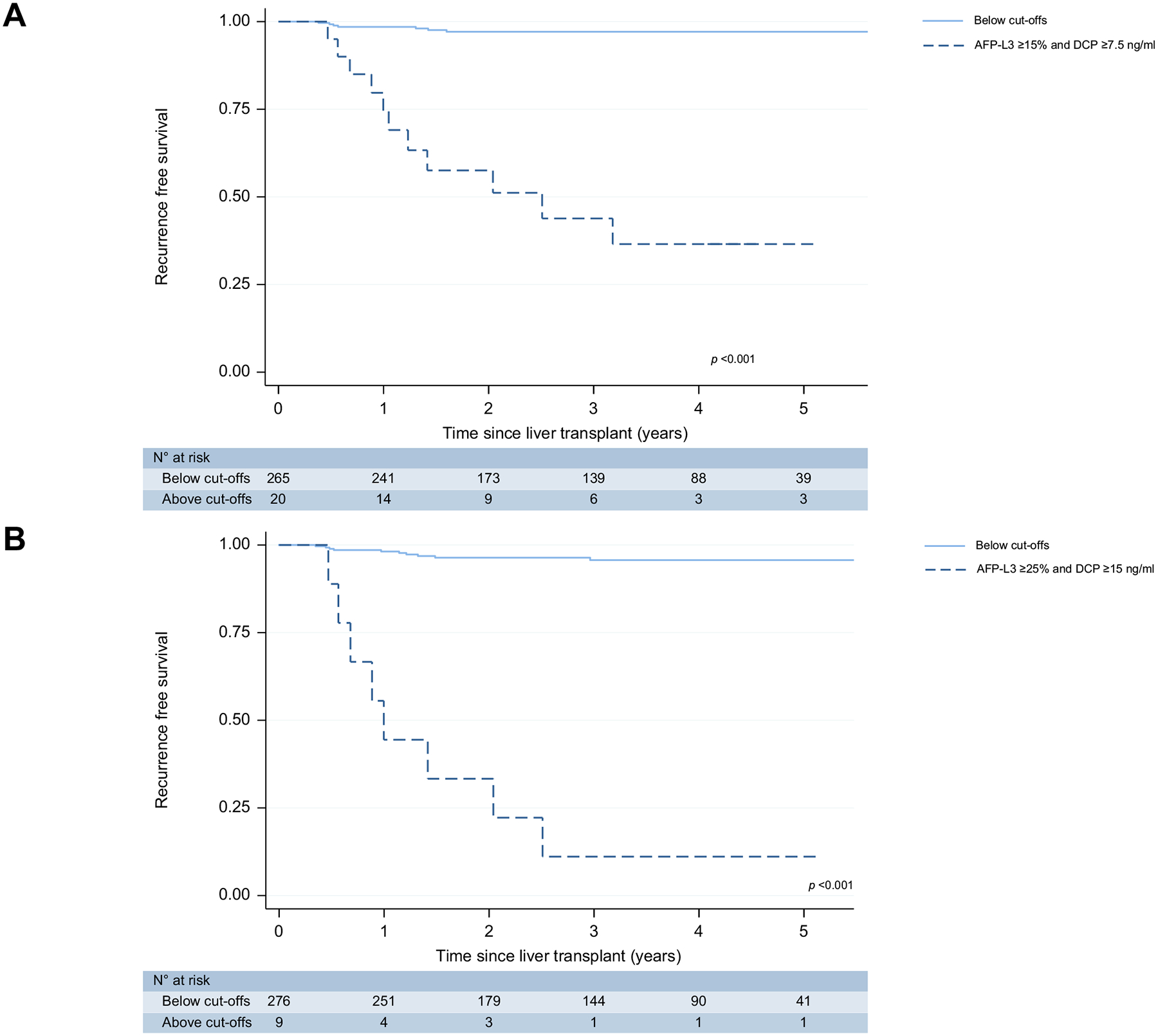
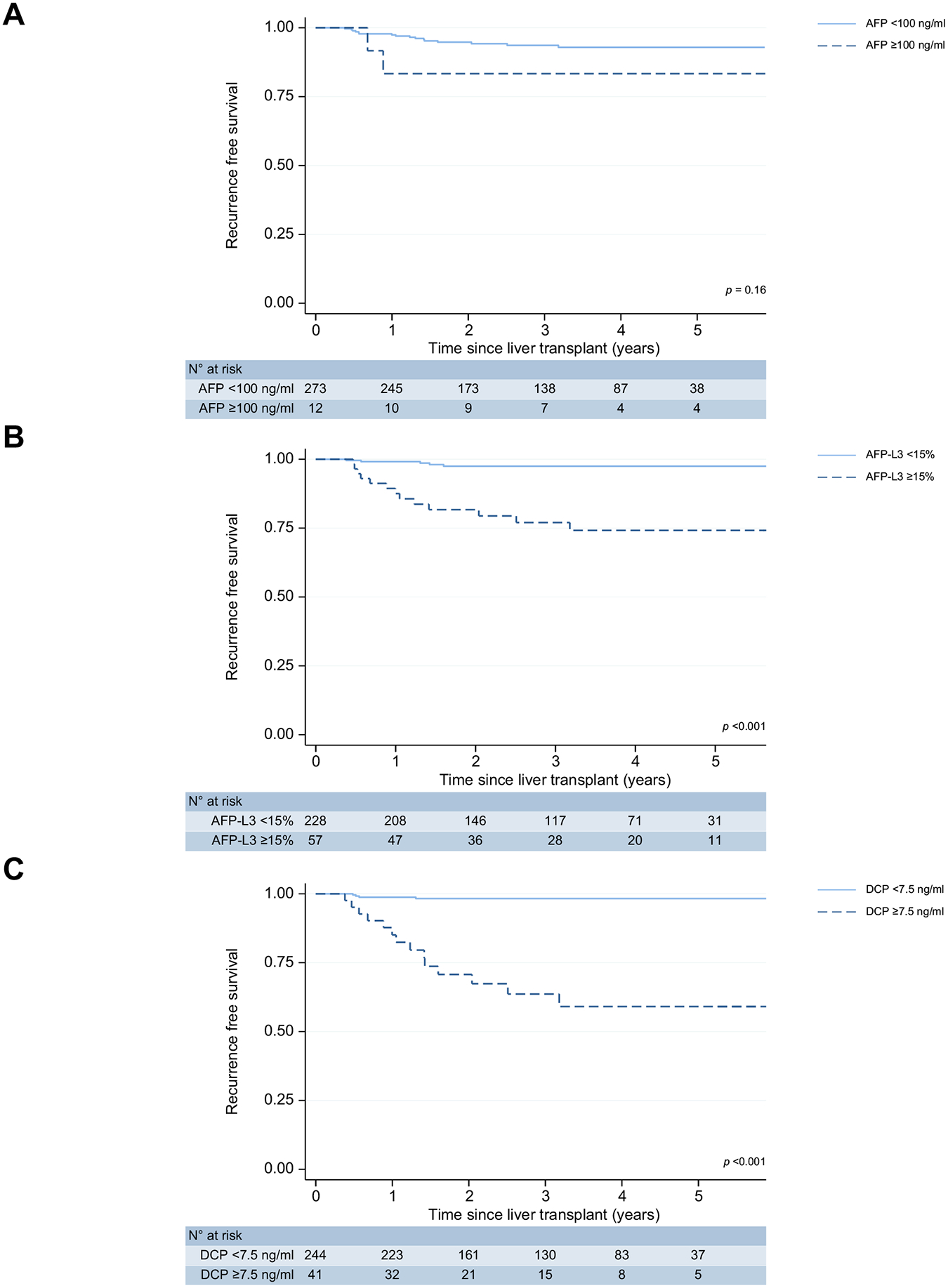
This cohort included 285 patients with a median age of 67 (IQR 63-71). At LT, median biomarker values were AFP 5.0 ng/ml (IQR 3.0-12.1), AFP-L3 6.7% (0.5-13.2), and DCP 1.0 ng/ml (0.3-2.8). Most (94.7%) patients received pre-LT locoregional therapy. After a median post-LT follow-up of 3.1 years, HCC recurrence was observed in 18 (6.3%) patients. AFP-L3 and DCP outperformed AFP with C-statistics of 0.81 and 0.86 respectively, compared with 0.74 for AFP. A dual-biomarker combination of AFP-L3 ≥15% and DCP ≥7.5 predicted 61.1% of HCC recurrences, whereas HCC only recurred in 7 of 265 (2.6%) patients not meeting this threshold. The Kaplan-Meier recurrence-free survival rate at 3 years post-LT was 43.7% for patients with dual-positive biomarkers compared to 97.0% for all others (p <0.001).
Dual-positivity for AFP-L3 ≥15% and DCP ≥7.5 strongly predicted post-LT HCC recurrence. This model could refine LT selection criteria and identify high-risk patients who require additional locoregional therapy prior to LT.
Alpha-fetoprotein (AFP) is used to predict hepatocellular carcinoma (HCC) recurrence after liver transplant, but it remains an imperfect biomarker. In this prospective study, the biomarkers DCP (des-gamma-carboxyprothrombin) and AFP-L3 (AFP bound to Lens culinaris agglutinin) strongly predicted early HCC recurrence and outperformed AFP. A dual-biomarker combination of AFP-L3 ≥15% and DCP ≥7.5 predicted the majority of recurrences and could be used to further refine liver transplant eligibility criteria.
甲胎蛋白(AFP)可预测肝移植(LT)后肝细胞癌(HCC)的复发,但仍是一种不完善的生物标志物。DCP(去γ-羧基凝血酶原)和 AFP-L3(与扁豆凝集素结合的 AFP)在预测 HCC 复发中的作用仍不完全清楚。AFP-L3 和 DCP 可识别出 HCC 复发风险较高的患者,并作为 LT 的排除标准,直到患者接受额外的降低风险的移植前局部区域治疗。
本前瞻性队列研究纳入了 2017 年至 2022 年间接受 LT(符合米兰标准或降期至米兰标准)的 HCC 连续患者。在 LT 前获得 AFP、AFP-L3 和 DCP 的测量值。主要终点是生物标志物预测 HCC 无复发生存的能力。
本队列纳入了 285 例中位年龄为 67 岁(IQR 63-71)的患者。在 LT 时,中位生物标志物值为 AFP 5.0ng/ml(IQR 3.0-12.1)、AFP-L3 6.7%(0.5-13.2)和 DCP 1.0ng/ml(0.3-2.8)。大多数(94.7%)患者在 LT 前接受了局部区域治疗。在 LT 后中位随访 3.1 年后,18 例(6.3%)患者发生 HCC 复发。与 AFP 的 C 统计量 0.74 相比,AFP-L3 和 DCP 的 C 统计量分别为 0.81 和 0.86,表现更好。AFP-L3≥15%和 DCP≥7.5 的双重生物标志物组合预测 HCC 复发的比例为 61.1%,而不符合该阈值的 265 例患者中仅 7 例(2.6%)发生 HCC 复发。LT 后 3 年的 Kaplan-Meier 无复发生存率,双阳性生物标志物患者为 43.7%,而所有其他患者为 97.0%(p<0.001)。
AFP-L3≥15%和 DCP≥7.5 的双重阳性强烈预测 LT 后 HCC 的复发。该模型可细化 LT 选择标准,并识别需要在 LT 前进行额外局部区域治疗的高危患者。
甲胎蛋白(AFP)用于预测肝移植(LT)后肝细胞癌(HCC)的复发,但仍是一种不完善的生物标志物。在这项前瞻性研究中,生物标志物 DCP(去γ-羧基凝血酶原)和 AFP-L3(与扁豆凝集素结合的 AFP)强烈预测早期 HCC 复发,且表现优于 AFP。AFP-L3≥15%和 DCP≥7.5 的双重生物标志物组合预测了大多数复发,并可进一步细化 LT 的资格标准。