Centre for Rural Health Research, Department of Family Practice, University of British Columbia, 3rd Floor David Strangway Building, 5950 University Boulevard, Vancouver, BC, V6T 1Z3, Canada.
Rural Coordination Centre of British Columbia, 1665 West Broadway, Vancouver, BC, V6J 1X1, Canada.
BMC Prim Care. 2023 Sep 8;24(1):183. doi: 10.1186/s12875-023-02128-z.
In British Columbia (BC), rural and remote areas lack proximal access to radiographic services. Poor access to radiographic services in rural settings presents a challenge to timely diagnosis and screening across many disease states and healthy pregnancies. As a solution to the lack of access to radiographic services in rural settings, the Rural Coordination Centre of BC (RCCbc) supported rural Family Physicians (FPs) wishing to use PoCUS through the Intelligent Network for PoCUS (IN PoCUS) program. This study evaluates FPs' experience and use of PoCUS in their clinical practice.
This qualitative study conducted in-depth virtual interviews with 21 FPs across rural BC. The interview asked participants' motivation to participate in the RCCbc program, the type of training they received, their current use of PoCUS, their experience with the technology, and their experience interacting with specialists in regional centres. Thematic analysis of findings was undertaken.
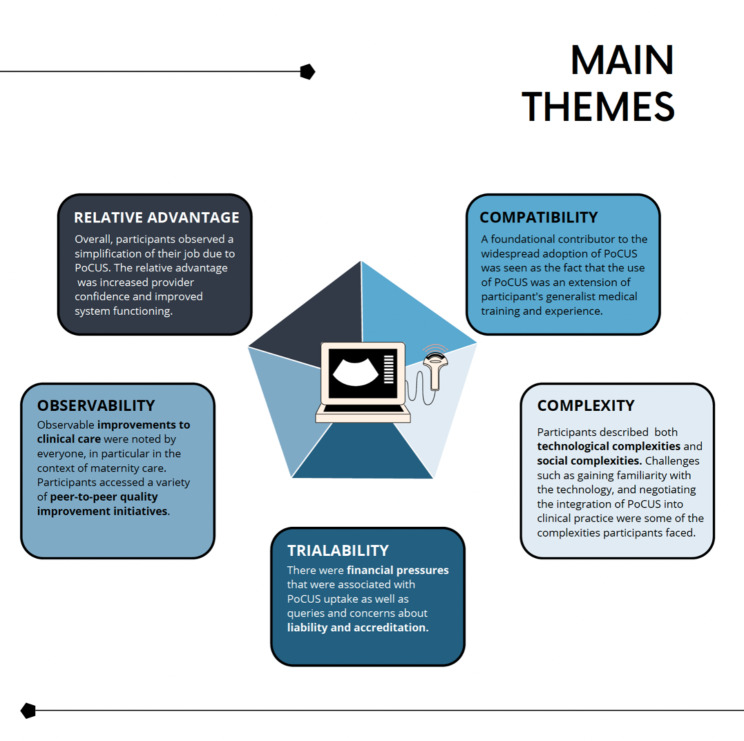
This study used Rogers' framework on the five elements of diffusion of innovation to understand the factors that impede and enable the adoption of PoCUS in rural practice. Rural FPs in this study differentiated PoCUS from formal imaging done by specialists. The adoption of PoCUS was viewed as an extension of physical exams and was compatible with their values of providing generalist care. This study found that the use of PoCUS provided additional information that led to better clinical decision-making for triage and allowed FPs to determine the urgency for patient referral and transport to tertiary hospitals. FPs also reported an increase in job satisfaction with PoCUS use. Some barriers to using PoCUS included the time needed to be acquainted with the technology and learning how to integrate it into their clinical flow in a seamless manner.
This study has demonstrated the importance of PoCUS in improving patient care and facilitating timely diagnosis and treatment. As the use of PoCUS among FPs is relatively new in Canada, larger infrastructure support such as improving billing structures, long-term subsidies, educational opportunities, and a quality improvement framework is needed to support the use of PoCUS among rural FPs.
在不列颠哥伦比亚省(BC),农村和偏远地区无法就近获得放射服务。农村地区放射服务获取不足,对许多疾病状态和健康妊娠的及时诊断和筛查构成挑战。为解决农村地区放射服务获取不足的问题,BC 农村协调中心(RCCbc)通过智能 POCUS 网络(IN PoCUS)项目,为希望使用 POCUS 的农村家庭医生(FP)提供支持。本研究评估了 FP 在临床实践中使用 POCUS 的经验和情况。
本研究在不列颠哥伦比亚省农村地区进行了一项深入的虚拟访谈,共采访了 21 名 FP。访谈询问了参与者参与 RCCbc 计划的动机、他们接受的培训类型、他们目前使用 POCUS 的情况、他们对该技术的经验以及与区域中心专家互动的经验。对研究结果进行了主题分析。
本研究使用罗杰斯创新扩散的五个要素框架来理解阻碍和促进农村实践中采用 POCUS 的因素。本研究中的农村 FP 将 POCUS 与专家进行的正式影像学检查区分开来。采用 POCUS 被视为体格检查的延伸,与他们提供全科医疗服务的价值观一致。本研究发现,POCUS 的使用提供了额外的信息,有助于更好地进行分诊决策,并使 FP 能够确定患者转诊和转往三级医院的紧迫性。FP 还报告称,使用 POCUS 后工作满意度有所提高。使用 POCUS 的一些障碍包括熟悉该技术所需的时间以及学习如何将其无缝地融入临床流程。
本研究表明 POCUS 在改善患者护理和促进及时诊断和治疗方面的重要性。由于加拿大 FP 中使用 POCUS 的情况相对较新,因此需要更大的基础设施支持,例如改善计费结构、长期补贴、教育机会和质量改进框架,以支持农村 FP 使用 POCUS。