Bellisario Flaminia, Attili Fabia, Campana Fabrizia, Borrelli de Andreis Federica, Bellesi Silvia, Maiolo Elena, Alma Eleonora, Malafronte Rosalia, Macis Giuseppe, Larocca Luigi Maria, Annunziata Salvatore, D'Alò Francesco, Hohaus Stefan
Dipartimento di Diagnostica per Immagini, Radioterapia Oncologica ed Ematologia, Fondazione Policlinico Universitario A. Gemelli IRCCS, 00168 Rome, Italy.
Sezione di Ematologia, Dipartimento di Scienze Radiologiche ed Ematologiche, Università Cattolica del Sacro Cuore, 00168 Rome, Italy.
Diagnostics (Basel). 2023 Sep 1;13(17):2839. doi: 10.3390/diagnostics13172839.
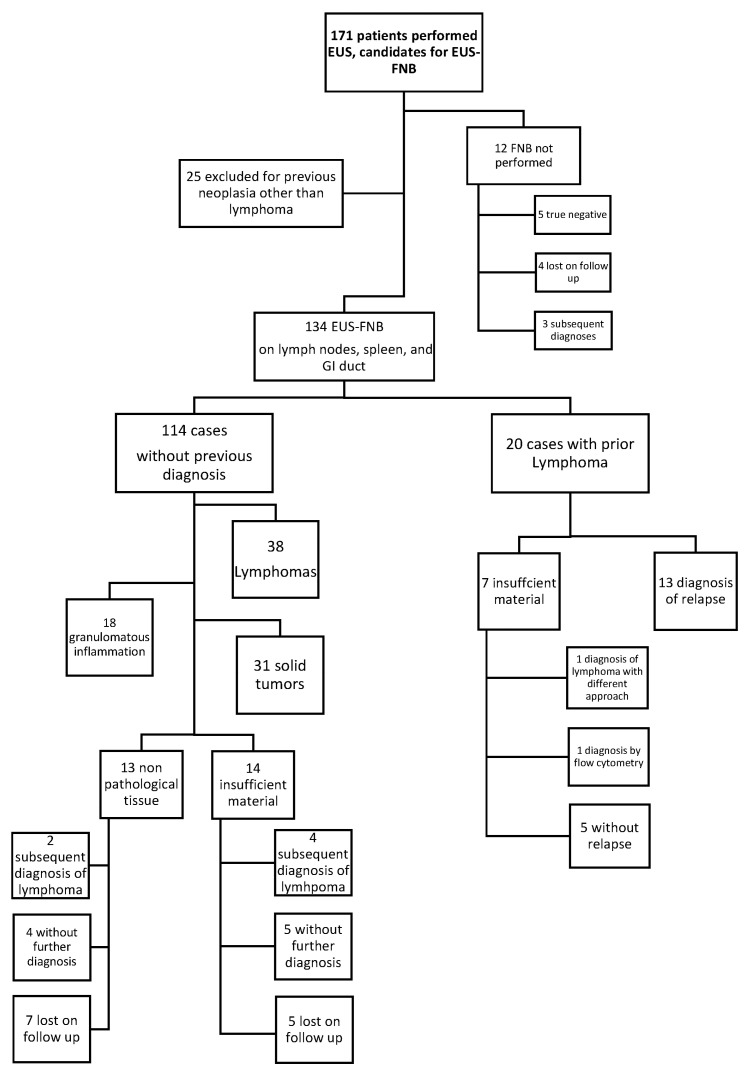
EUS-FNB has been introduced in clinical practice as a less invasive diagnostic approach with respect to surgery. We performed a single-center retrospective study on the diagnostic efficacy of EUS-guided FNB, including 171 patients with lymph nodes, splenic, and extranodal lesions that underwent EUS for FNB at our institution. Excluding 12 patients who did not undergo FNB and 25 patients with a previous diagnosis of a solid tumor, we included 134 patients with clinical/radiological suspect of a lymphoproliferative disease, including 20 patients with a previous history of lymphoma. Out of the 134 biopsies, material of diagnostic quality was obtained in 111 procedures (84.3%). Histological examination of the EUS-FNB samples produced an actionable diagnosis in 100 cases (74.6%). Among the patients without an actionable diagnosis, a second, different diagnostic procedure produced a further eight diagnoses of lymphoma. Therefore, the sensitivity of EUS-FNB for diagnosing lymphomas was calculated to be 86.4% (51/59). Assignment of lymphomas to WHO classification subtypes was possible in 47/51 (92%) of the cases. In conclusion, EUS-FNB is an effective procedure for the histological characterization of lesions that are suspected to be lymphoproliferative disease, allowing for an actionable diagnosis in 75% of cases.
与手术相比,超声内镜引导下细针穿刺活检(EUS-FNB)已作为一种侵入性较小的诊断方法引入临床实践。我们进行了一项关于EUS引导下FNB诊断效能的单中心回顾性研究,纳入了171例在我院接受EUS-FNB检查的有淋巴结、脾脏及结外病变的患者。排除12例未进行FNB的患者以及25例既往诊断为实体瘤的患者后,我们纳入了134例临床/影像学怀疑为淋巴增殖性疾病的患者,其中20例有淋巴瘤病史。在134例活检中,111例(84.3%)获得了具有诊断质量的标本。EUS-FNB样本的组织学检查在100例(74.6%)中得出了可指导治疗的诊断结果。在未得出可指导治疗诊断结果的患者中,另一种不同的诊断方法又确诊了8例淋巴瘤。因此,EUS-FNB诊断淋巴瘤的敏感性计算为86.4%(51/59)。47/51(92%)的病例能够将淋巴瘤分类为世界卫生组织(WHO)分类亚型。总之,EUS-FNB是对疑似淋巴增殖性疾病病变进行组织学特征分析的有效方法,75%的病例可得出可指导治疗的诊断结果。