Institute of Chemistry, Saint Petersburg State University, Universitetskaya Nab. 7/9, 199034 Saint Petersburg, Russia.
Laboratory of Crystal Engineering of Functional Materials, South Ural State University, 76, Lenin Av., 454080 Chelyabinsk, Russia.
Int J Mol Sci. 2023 Aug 28;24(17):13324. doi: 10.3390/ijms241713324.
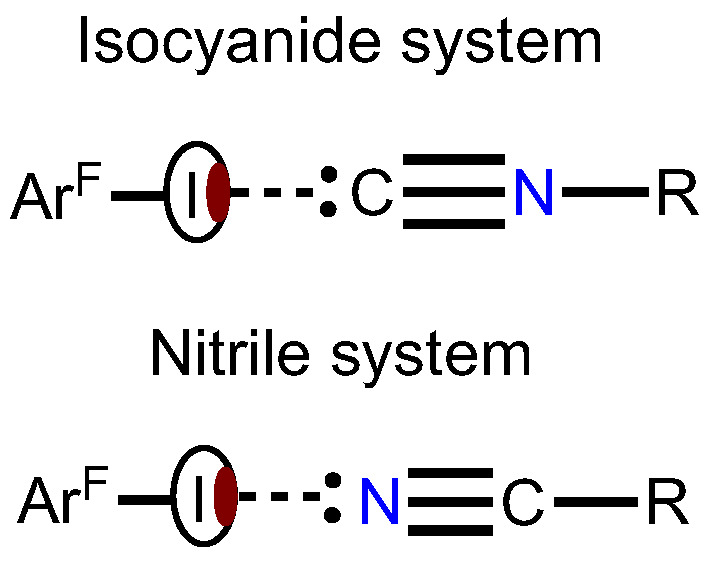
2,3,5,6-Tetramethyl-1,4-diisocyanobenzene (), 1,4-diisocyanobenzene (), and 1,4-dicyanobenzene () were co-crystallized with 1,3,5-triiodotrifluorobenzene (1,3,5-FIB) to give three cocrystals, ·1,3,5-FIB, ·2(1,3,5-FIB), and ·2(1,3,5-FIB), which were studied by X-ray diffraction. A common feature of the three structures is the presence of I···C or I···N halogen bonds (HaBs), which occurs between an iodine σ-hole and the isocyanide C-(or the nitrile N-) atom. The diisocyanide and dinitrile cocrystals ·2(1,3,5-FIB) and ·2(1,3,5-FIB) are isostructural, thus providing a basis for accurate comparison of the two types of noncovalent linkages of C≡N/N≡C groups in the composition of structurally similar entities and in one crystal environment. The bonding situation was studied by a set of theoretical methods. Diisocyanides are more nucleophilic than the dinitrile and they exhibit stronger binding to 1,3,5-FIB. In all structures, the HaBs are mostly determined by the electrostatic interactions, but the dispersion and induction components also provide a noticeable contribution and make the HaBs attractive. Charge transfer has a small contribution (<5%) to the HaB and it is higher for the diisocyanide than for the dinitrile systems. At the same time, diisocyanide and dinitrile structures exhibit typical electron-donor and π-acceptor properties in relation to the HaB donor.
2,3,5,6-四甲基-1,4-二异氰基苯()、1,4-二异氰基苯()和 1,4-二氰基苯()与 1,3,5-三碘三氟苯(1,3,5-FIB)共结晶,得到三个共晶物:·1,3,5-FIB、·2(1,3,5-FIB)和·2(1,3,5-FIB),通过 X 射线衍射进行了研究。这三个结构的一个共同特点是存在 I···C 或 I···N 卤键(HaBs),它们发生在碘 σ 空穴和异氰基 C-(或氰基 N-)原子之间。两种二异氰基化合物和二氰基化合物共晶·2(1,3,5-FIB)和·2(1,3,5-FIB)是同构的,因此为准确比较结构相似实体和同一晶体环境中 C≡N/N≡C 基团的两种类型的非共价键提供了基础。通过一组理论方法研究了键合情况。二异氰基化合物比二氰基化合物更具亲核性,它们与 1,3,5-FIB 结合更强。在所有结构中,HaBs 主要由静电相互作用决定,但色散和诱导分量也提供了显著的贡献,使 HaBs 具有吸引力。电荷转移对 HaB 的贡献较小(<5%),对于二异氰基化合物体系比二氰基体系更高。同时,二异氰基化合物和二氰基化合物结构在与 HaB 供体有关的关系中表现出典型的电子供体和π-受体性质。