Department of Ophthalmology, Clinical Hospital Dubrava, School of Medicine, University of Zagreb, 10000 Zagreb, Croatia.
Centre for Palliative Medicine, Medical Ethics and Communication Skills, School of Medicine, University of Zagreb, 10000 Zagreb, Croatia.
Int J Mol Sci. 2023 Aug 30;24(17):13429. doi: 10.3390/ijms241713429.
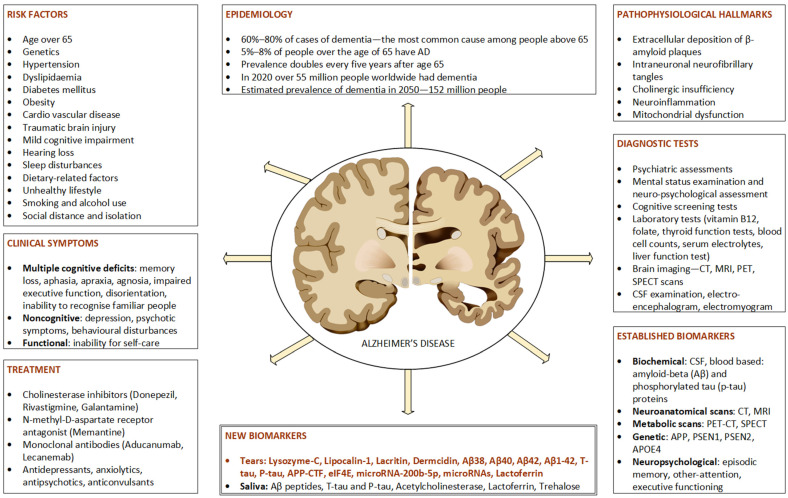
Alzheimer's disease (AD) is an age-related progressive neurodegenerative brain disorder that represents the most common type of dementia. It poses a significant diagnostic challenge that requires timely recognition and treatment. Currently, there is no effective therapy for AD; however, certain medications may slow down its progression. The discovery of AD biomarkers, namely, magnetic resonance imaging, positron emission tomography and cerebrospinal fluid molecules (amyloid-β and tau) has advanced our understanding of this disease and has been crucial for identifying early neuropathologic changes prior to clinical changes and cognitive decline. The close interrelationship between the eye and the brain suggests that tears could be an interesting source of biomarkers for AD; however, studies in this area are limited. The identification of biomarkers in tears will enable the development of cost-effective, non-invasive methods of screening, diagnosis and disease monitoring. In order to use tears as a standard method for early and non-invasive diagnosis of AD, future studies need to be conducted on a larger scale.
阿尔茨海默病(AD)是一种与年龄相关的进行性神经退行性脑疾病,是最常见的痴呆类型。它是一个重大的诊断挑战,需要及时识别和治疗。目前,AD 没有有效的治疗方法;然而,某些药物可以减缓其进展。AD 生物标志物的发现,即磁共振成像、正电子发射断层扫描和脑脊液分子(淀粉样蛋白-β 和 tau),加深了我们对这种疾病的认识,并对在临床变化和认知能力下降之前识别早期神经病理学变化至关重要。眼睛和大脑之间的密切关系表明,眼泪可能是 AD 生物标志物的一个有趣来源;然而,这方面的研究有限。在眼泪中识别生物标志物将使开发具有成本效益、非侵入性的筛查、诊断和疾病监测方法成为可能。为了将眼泪用作 AD 早期和非侵入性诊断的标准方法,需要在更大规模上进行未来的研究。