Department of Drug Sciences, University of Pavia, Viale T. Taramelli 12, 27100 Pavia, Italy.
Unit of Cellular and Molecular Neurobiology, IRCCS Mondino Foundation, Via Mondino 2, 27100 Pavia, Italy.
Int J Mol Sci. 2023 Aug 31;24(17):13542. doi: 10.3390/ijms241713542.
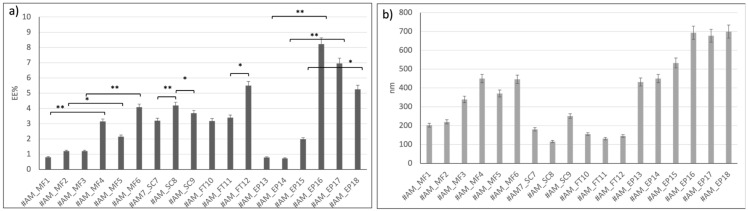
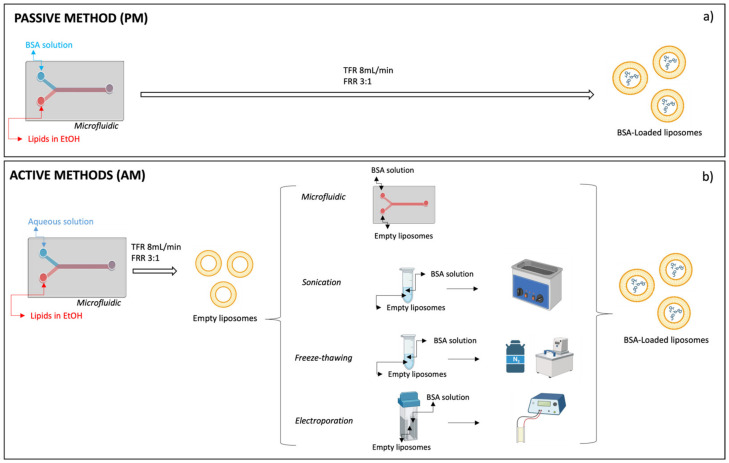
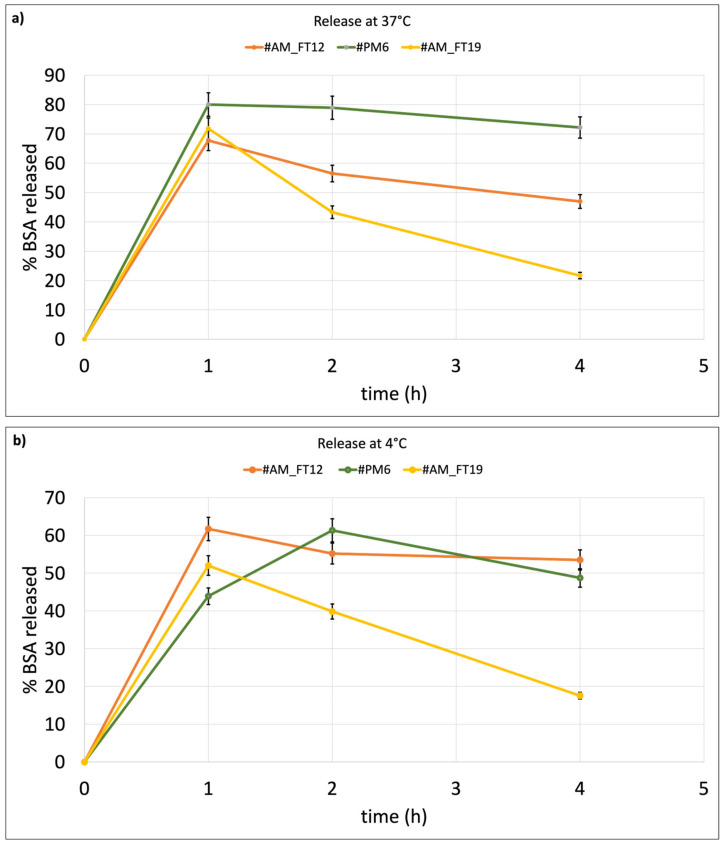
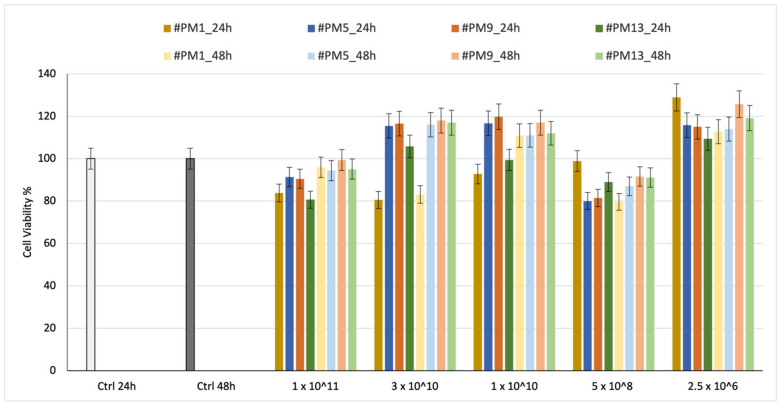
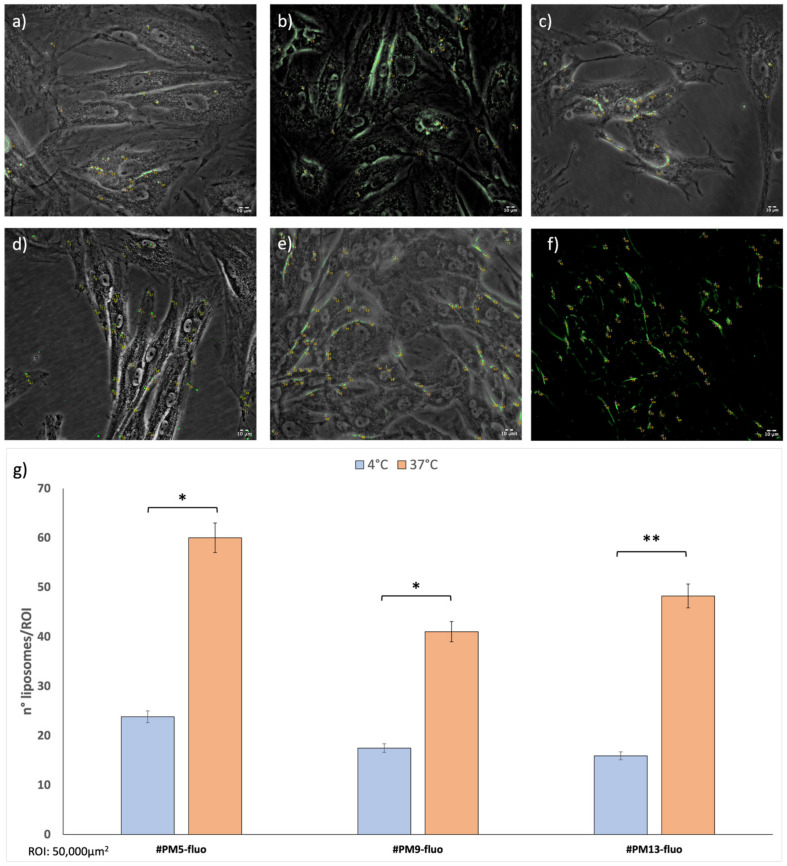
In this work, four different active encapsulation methods, microfluidic (MF), sonication (SC), freeze-thawing (FT), and electroporation (EP), were investigated to load a model protein (bovine serum albumin-BSA) into neutral liposomes made from 1,2-distearoyl-sn-glycero-3-phosphocholine (DSPC):cholesterol (Chol) and charged liposomes made from DSPC:Chol:Dioleoyl-3-trimethylammonium propane (DOTAP), DSPC:Chol:1,2-dioleoyl-sn-glycero-3-phospho-L-serine (DOPS), and DSPC:Chol:phosphatidylethanolamine (PE). The aim was to increase the protein encapsulation efficiency (EE%) by keeping the liposome size below 200 nm and the PDI value below 0.7, which warrants a nearly monodisperse preparation. Electroporation (100 V) yielded the best results in terms of EE%, with a dramatic increase in liposome size (>600 nm). The FT active-loading method, either applied to neutral or charged liposomes, allowed for obtaining suitable EE%, keeping the liposome size range below 200 nm with a suitable PDI index. Cationic liposomes (DSPC:Chol:DOTAP) loaded with the FT active method showed the best results in terms of EE% (7.2 ± 0.8%) and size (131.2 ± 11.4 nm, 0.140 PDI). In vitro release of BSA from AM neutral and charged liposomes resulted slower compared to PM liposomes and was affected by incubation temperature (37 °C, 4 °C). The empty charged liposomes tested for cell viability on Human Normal Dermal Fibroblast (HNDF) confirmed their cytocompatibility also at high concentrations (10 particles/mL) and cellular uptake at 4 °C and 37 °C. It can be concluded that even if both microfluidic passive and active methods are more easily transferable to an industrial scale, the FT active-loading method turned out to be the best in terms of BSA encapsulation efficiencies, keeping liposome size below 200 nm.
在这项工作中,研究了四种不同的主动包封方法,即微流控(MF)、超声处理(SC)、冻融(FT)和电穿孔(EP),以将模型蛋白(牛血清白蛋白-BSA)加载到由 1,2-二硬脂酰-sn-甘油-3-磷酸胆碱(DSPC):胆固醇(Chol)制成的中性脂质体中:胆固醇(Chol)和由 DSPC:Chol:二油酰基-3-三甲铵丙烷(DOTAP)、DSPC:Chol:1,2-二油酰基-sn-甘油-3-磷酸-L-丝氨酸(DOPS)和 DSPC:Chol:磷脂酰乙醇胺(PE)制成的带电脂质体中。目的是通过将脂质体大小保持在 200nm 以下和 PD 值低于 0.7 来提高蛋白质包封效率(EE%),这保证了近单分散的制备。电穿孔(100V)在 EE%方面取得了最佳结果,脂质体尺寸显着增加(>600nm)。FT 主动加载方法,无论是应用于中性还是带电脂质体,都可以获得合适的 EE%,同时将脂质体尺寸范围保持在 200nm 以下,并具有合适的 PD 指数。用 FT 主动方法负载的阳离子脂质体(DSPC:Chol:DOTAP)在 EE%(7.2±0.8%)和大小(131.2±11.4nm,0.140PDI)方面表现出最佳结果。BSA 从 AM 中性和带电脂质体中的体外释放速度比 PM 脂质体慢,并且受孵育温度(37°C、4°C)的影响。在人正常皮肤成纤维细胞(HNDF)上测试的空带电荷脂质体对细胞活力的影响证实了它们在高浓度(10 个颗粒/mL)下的细胞相容性,并且在 4°C 和 37°C 时具有细胞摄取能力。可以得出结论,即使微流控被动和主动方法都更容易转移到工业规模,FT 主动加载方法在 BSA 包封效率方面表现最佳,同时将脂质体大小保持在 200nm 以下。