Department of Medical Genetics, Clinical Center, Medical School, University of Pécs, 7624 Pécs, Hungary.
HCEMM-SE Molecular Oncohematology Research Group, Department of Pathology and Experimental Cancer Research, Semmelweis University, 1085 Budapest, Hungary.
Int J Mol Sci. 2023 Sep 1;24(17):13580. doi: 10.3390/ijms241713580.
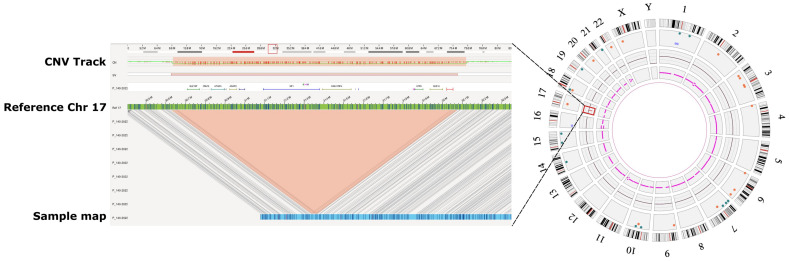
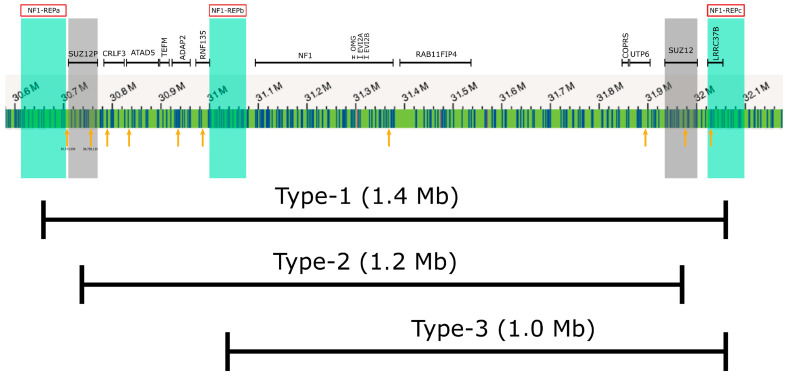
Neurofibromatosis type 1 (NF1) is a clinically heterogeneous neurocutaneous disorder inherited in autosomal dominant manner. Approximately 5-10% of the cases are caused by microdeletions involving the gene and its flanking regions. Microdeletions, which lead to more severe clinical manifestations, can be subclassified into four different types (type 1, 2, 3 and atypical) according to their size, the genomic location of the breakpoints and the number of genes included within the deletion. Besides the prominent hallmarks of NF1, patients with microdeletions frequently exhibit specific additional clinical manifestations like dysmorphic facial features, macrocephaly, overgrowth, global developmental delay, cognitive disability and an increased risk of malignancies. It is important to identify the genes co-deleted with , because they are likely to have an effect on the clinical manifestation. Multiplex ligation-dependent probe amplification (MLPA) and microarray analysis are the primary techniques for the investigation of microdeletions. However, based on previous research, optical genome mapping (OGM) could also serve as an alternative method to identify copy number variations (CNVs). Here, we present a case with microdeletion identified by means of OGM and demonstrate that this novel technology is a suitable tool for the identification and classification of the microdeletions.
神经纤维瘤病 1 型(NF1)是一种临床异质性的神经皮肤疾病,以常染色体显性遗传方式遗传。大约 5-10%的病例是由涉及 基因及其侧翼区域的微缺失引起的。微缺失会导致更严重的临床表现,根据其大小、断裂点的基因组位置以及缺失中包含的基因数量,可分为四种不同类型(1 型、2 型、3 型和非典型型)。除了 NF1 的明显特征外,携带 微缺失的患者还经常表现出特定的额外临床表现,如面部畸形、大头畸形、过度生长、全面发育迟缓、认知障碍和恶性肿瘤风险增加。识别与 共同缺失的基因很重要,因为它们可能对临床表现有影响。多重连接依赖性探针扩增(MLPA)和微阵列分析是研究 微缺失的主要技术。然而,根据之前的研究,光学基因组图谱(OGM)也可以作为识别拷贝数变异(CNVs)的替代方法。在这里,我们通过 OGM 鉴定了一个携带 微缺失的病例,并证明这种新技术是鉴定和分类 微缺失的合适工具。