Vamvasakis Ioannis, Andreou Evangelos K, Armatas Gerasimos S
Department of Materials Science and Technology, University of Crete, 70013 Heraklion, Greece.
Nanomaterials (Basel). 2023 Aug 26;13(17):2426. doi: 10.3390/nano13172426.
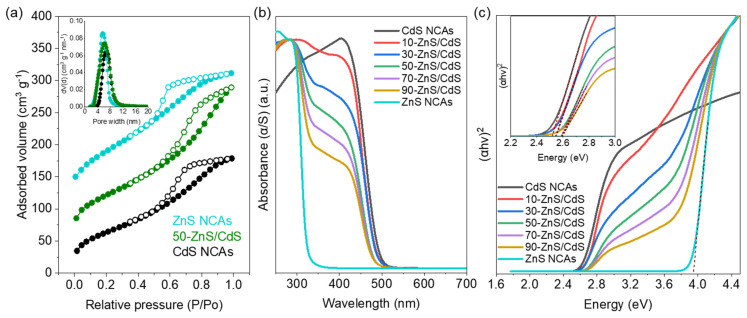
The development of functional catalysts for the photogeneration of hydrogen (H) via water-splitting is crucial in the pursuit of sustainable energy solutions. To that end, metal-sulfide semiconductors, such as CdS and ZnS, can play a significant role in the process due to their interesting optoelectronic and catalytic properties. However, inefficient charge-carrier dissociation and poor photochemical stability remain significant limitations to photocatalytic efficiency. Herein, dual-semiconductor nanocomposites of ZnS/CdS nanocrystal assemblies (NCAs) are developed as efficient visible light photocatalysts for H generation. The resultant materials, synthesized via a polymer-templated self-polymerization method, comprise a unique combination of 5-7 nm-sized metal-sulfide nanoparticles that are interlinked to form a 3D open-pore structure with large internal surface area (up to 285 m g) and uniform pores (circa 6-7 nm). By adjusting the ratio of constituent nanoparticles, the optimized ZnS/CdS catalyst with 50 wt.% ZnS content demonstrates a remarkable stability and visible light H-evolution activity (29 mmol g h mass activity) with an apparent quantum yield (AQY) of 60% at 420 nm. Photocatalytic evaluation experiments combined with electrochemical and spectroscopic studies suggest that the superior photocatalytic performance of these materials stems from the accessible 3D open-pore structure and the efficient defect-mediated charge transfer mechanism at the ZnS/CdS nanointerfaces. Overall, this work provides a new perspective for designing functional and stable photocatalytic materials for sustainable H production.
开发用于通过水分解光生氢(H)的功能催化剂对于寻求可持续能源解决方案至关重要。为此,金属硫化物半导体,如硫化镉(CdS)和硫化锌(ZnS),由于其有趣的光电和催化性能,在该过程中可发挥重要作用。然而,电荷载流子解离效率低下和光化学稳定性差仍然是光催化效率的重大限制。在此,硫化锌/硫化镉纳米晶组装体(NCA)的双半导体纳米复合材料被开发为用于光生氢的高效可见光光催化剂。通过聚合物模板自聚合方法合成的所得材料,包含约5-7纳米大小的金属硫化物纳米颗粒的独特组合,这些纳米颗粒相互连接形成具有大内部表面积(高达285 m²/g)和均匀孔隙(约6-7纳米)的三维开孔结构。通过调整组成纳米颗粒的比例,硫化锌含量为50 wt.%的优化硫化锌/硫化镉催化剂表现出显著的稳定性和可见光析氢活性(约29 mmol g⁻¹ h⁻¹质量活性),在420 nm处的表观量子产率(AQY)为60%。结合电化学和光谱研究的光催化评估实验表明,这些材料优异的光催化性能源于可及的三维开孔结构以及硫化锌/硫化镉纳米界面处高效的缺陷介导电荷转移机制。总体而言,这项工作为设计用于可持续制氢的功能稳定光催化材料提供了新的视角。