Bloise Ermelinda, Lazzoi Maria Rosaria, Mergola Lucia, Del Sole Roberta, Mele Giuseppe
Department of Engineering for Innovation, University of Salento, Via Monteroni, 73100 Lecce, Italy.
Institute of Atmospheric Sciences and Climate, ISAC-CNR, Str. Prv. Lecce-Monteroni km 1.2, 73100 Lecce, Italy.
Nanomaterials (Basel). 2023 Sep 4;13(17):2486. doi: 10.3390/nano13172486.
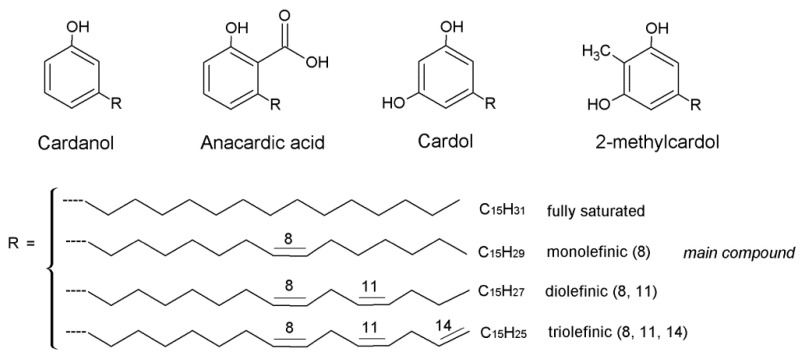
Cashew nut shell liquid (CNSL), obtained as a byproduct of the cashew industry, represents an important natural source of phenolic compounds, with important environmental benefits due to the large availability and low cost of the unique renewable starting material, that can be used as an alternative to synthetic substances in many industrial applications. The peculiarity of the functional groups of CNSL components, such as phenolic hydroxyl, the aromatic ring, acid functionality, and unsaturation(s) in the C alkyl side chain, permitted the design of interesting nanostructures. Cardanol (CA), anacardic acid (AA), and cardol (CD), opportunely isolated from CNSL, served as building blocks for generating an amazing class of nanomaterials with chemical, physical, and morphological properties that can be tuned in view of their applications, particularly focused on their bioactive properties.
腰果壳液(CNSL)是腰果产业的副产品,是酚类化合物的重要天然来源,由于这种独特的可再生起始原料来源广泛且成本低廉,具有重要的环境效益,在许多工业应用中可用作合成物质的替代品。CNSL成分的官能团具有独特性,如酚羟基、芳环、酸官能团以及C烷基侧链中的不饱和键,这使得设计有趣的纳米结构成为可能。从CNSL中适当分离出的腰果酚(CA)、漆树酸(AA)和腰果醇(CD),作为构建单元用于生成一类令人惊叹的纳米材料,这些纳米材料的化学、物理和形态特性可根据其应用进行调整,尤其关注其生物活性特性。