Department of Otolaryngology, Jiangxi Hospital of Integrated Traditional Chinese and Western Medicine, 90 Bayi Avenue, Xihu District, Nanchang, 330003, Jiangxi, China.
Department of Neurology, Pinghu Hospital of Traditional Chinese Medicine, Jiaxing, 314200, China.
Eur Arch Otorhinolaryngol. 2024 Jan;281(1):427-440. doi: 10.1007/s00405-023-08213-4. Epub 2023 Sep 9.
To investigate Src-like adaptor 2 gene (SLA2) expression in head and neck squamous cell carcinoma (HNSCC), its potential prognostic value, and its effect on immune cell infiltration.
Through a variety of bioinformatics analyses, we extracted and analyzed data sets from the Cancer Genome Atlas (TCGA), Tumor Immune Estimation Resource (TIMER), and Gene Expression Profile Interaction Analysis (GEPIA) to analyze the correlation between SLA2 and the prognosis, immune checkpoint, tumor microenvironment (TME) and immune cell infiltration of HNSCC, and to explore its potential oncogenic mechanism. To further explore the potential role of SLA2 in HNSCC by Gene ontology (GO) functional annotation and Kyoto Encyclopedia of Genes and Genomes (KEGG) pathway analysis.
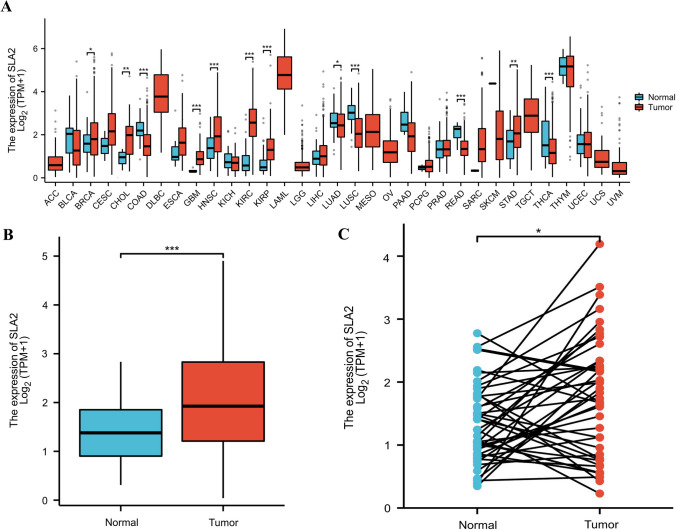
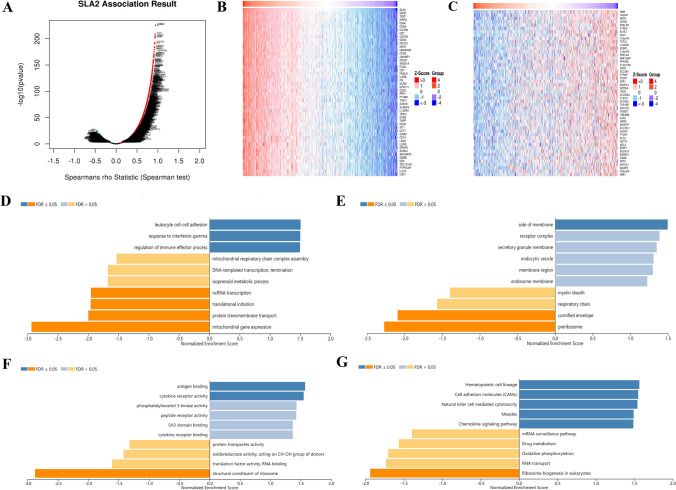
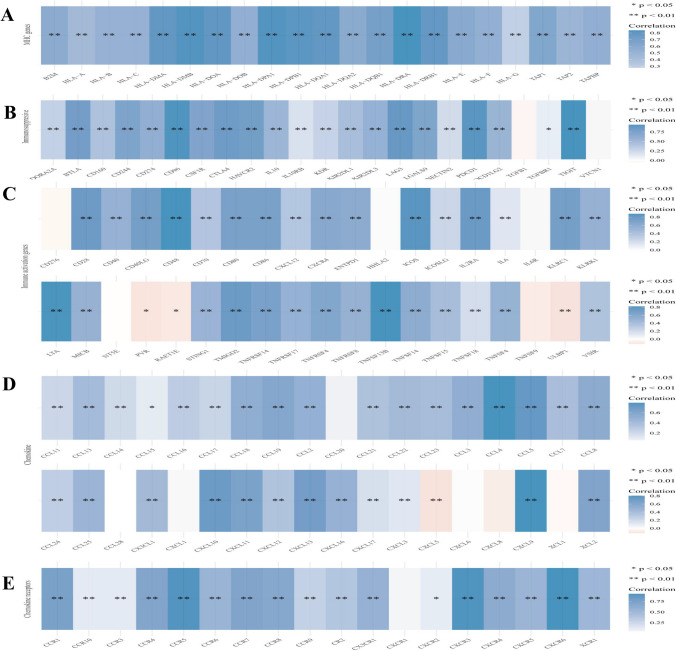
SLA2 messenger ribonucleic acid (mRNA) levels were increased in HNSCC tumor tissues compared with normal tissues. In addition, we found that SLA2 may be an independent prognostic factor for HNSCC, and high SLA2 expression is associated with favorable prognosis in HNSCC. SLA2 expression was positively correlated with B cells, cluster of differentiation 8-positive T cells (CD8 + T cells), cluster of differentiation 4-positive T cells (CD4 + T cells), macrophages, neutrophil and dendritic cells infiltration. SLA2 has also been shown to co-express immune-related genes and immune checkpoints. Significant GO term analysis by Gene Set Enrichment Analysis (GSEA) indicated that genes correlated with SLA2 were located mainly in the side of membrane, receptor complex, secretory granule membrane, endocytic vesicle, membrane region, and endosome membrane, where they were involved in leukocyte cell-cell adhesion, response to interferon-gamma, and regulation of immune effector process. These related genes also served as antigen binding, cytokine receptor activity, phosphatidylinositol 3-kinase activity, peptide receptor activity, Src homology domain 3 (SH3) domain binding, and cytokine receptor binding. KEGG pathway analysis demonstrated that these genes related to SLA2 were mainly enriched in signal pathways, such as hematopoietic cell lineage, cell adhesion molecules (CAMs), natural killer cell mediated cytotoxicity, measles, and chemokine signaling pathway.
SLA2 is increased in HNSCC, and high SLA2 expression is associated with favorable prognosis. SLA2 may affect tumor development by regulating tumor infiltrating cells in TME. SLA2 may be a potential target for immunotherapy.
研究Src 样衔接蛋白 2 基因(SLA2)在头颈部鳞状细胞癌(HNSCC)中的表达及其潜在的预后价值,并分析其对免疫细胞浸润的影响。
通过多种生物信息学分析,我们从癌症基因组图谱(TCGA)、肿瘤免疫估计资源(TIMER)和基因表达谱交互分析(GEPIA)中提取和分析数据集,分析 SLA2 与 HNSCC 预后、免疫检查点、肿瘤微环境(TME)和免疫细胞浸润的相关性,并探讨其潜在的致癌机制。通过基因本体(GO)功能注释和京都基因与基因组百科全书(KEGG)通路分析进一步探讨 SLA2 在 HNSCC 中的潜在作用。
与正常组织相比,HNSCC 肿瘤组织中 SLA2 信使 RNA(mRNA)水平升高。此外,我们发现 SLA2 可能是 HNSCC 的一个独立预后因素,高 SLA2 表达与 HNSCC 的良好预后相关。SLA2 表达与 B 细胞、CD8+T 细胞(CD8+T 细胞)、CD4+T 细胞、巨噬细胞、中性粒细胞和树突状细胞浸润呈正相关。SLA2 还与免疫相关基因和免疫检查点共同表达。通过基因集富集分析(GSEA)进行的显著 GO 术语分析表明,与 SLA2 相关的基因主要位于膜的侧面、受体复合物、分泌颗粒膜、内吞小泡、膜区和内体膜,涉及白细胞细胞-细胞黏附、对干扰素-γ的反应以及免疫效应过程的调节。这些相关基因还作为抗原结合、细胞因子受体活性、磷脂酰肌醇 3-激酶活性、肽受体活性、Src 同源结构域 3(SH3)结构域结合和细胞因子受体结合。KEGG 通路分析表明,与 SLA2 相关的这些基因主要富集在信号通路中,如造血细胞谱系、细胞黏附分子(CAMs)、自然杀伤细胞介导的细胞毒性、麻疹和趋化因子信号通路。
SLA2 在 HNSCC 中增加,高 SLA2 表达与良好的预后相关。SLA2 可能通过调节 TME 中的肿瘤浸润细胞影响肿瘤的发生发展。SLA2 可能是免疫治疗的潜在靶点。