Department of Otorhinolaryngology, Union Hospital, Ongji Medical College, Huazhong University of Science and Technology, Wuhan, 430022, China.
Department of Otorhinolaryngology, The Central Hospital of Wuhan, Huazhong University of Science and Technology, Wuhan, 430000, China.
BMC Cancer. 2021 Apr 17;21(1):424. doi: 10.1186/s12885-021-08170-3.
Survivin has been recently identified as a promising novel therapeutic target and prognostic marker in different types of cancer. Here we conducted a comprehensive meta-analysis to better clarify they the precise prognostic and diagnostic value of survivin in head and neck squamous cell carcinoma (HNSCC).
Database of PubMed (Medline), Embase, and Web of Science were systematically searched for related published literature up to September 2020. Pooled hazards ratios (HR) and related 95% confidence intervals (CI) were used to estimate the association of survivin expression and survival outcomes in HNSCC patients.
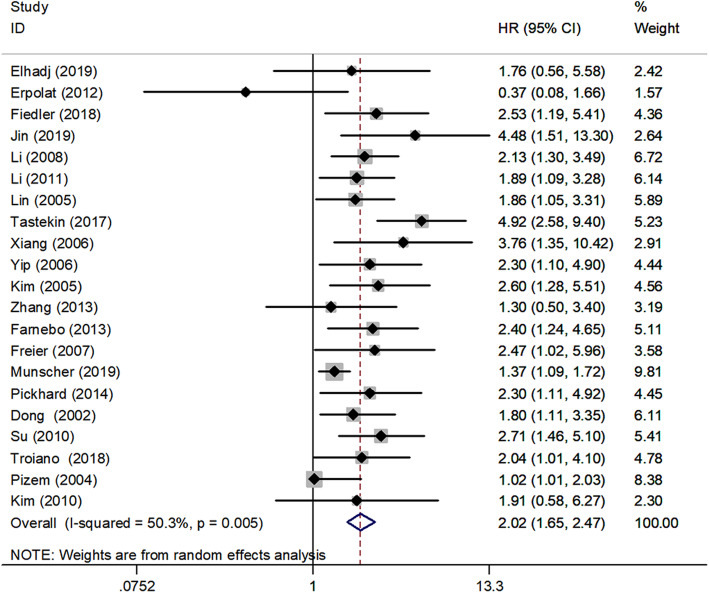
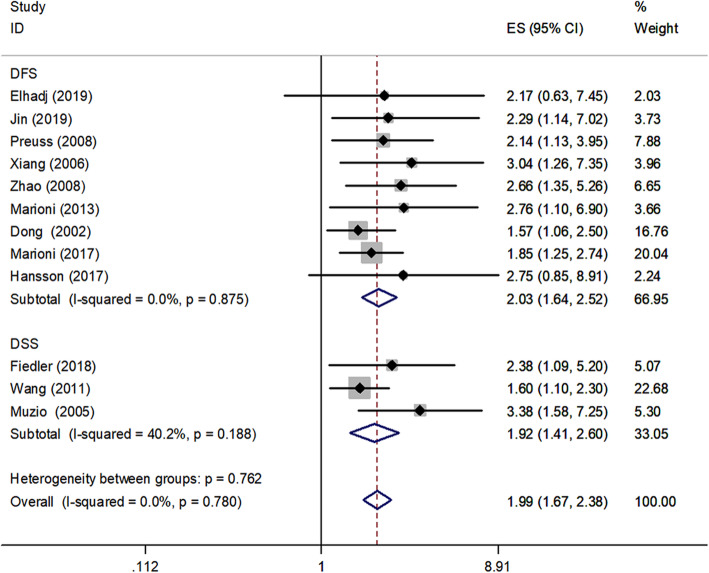
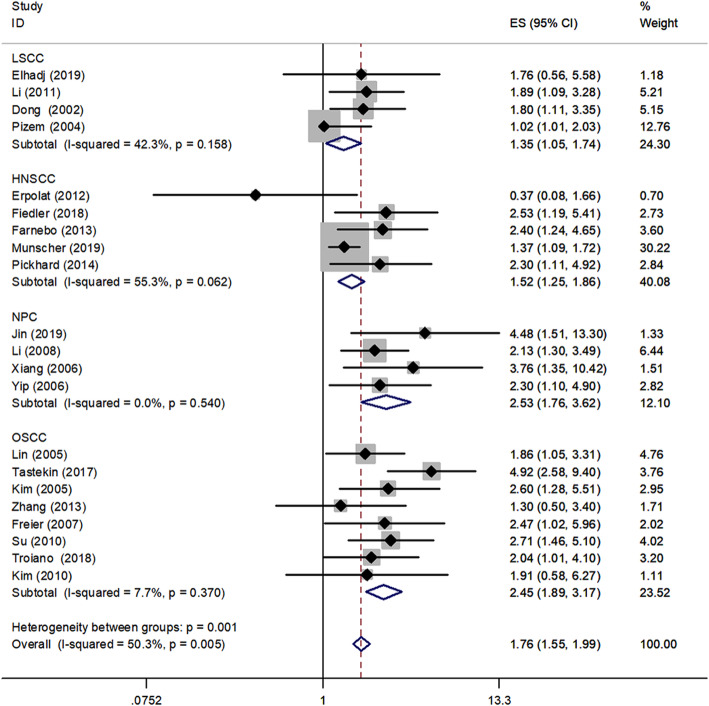
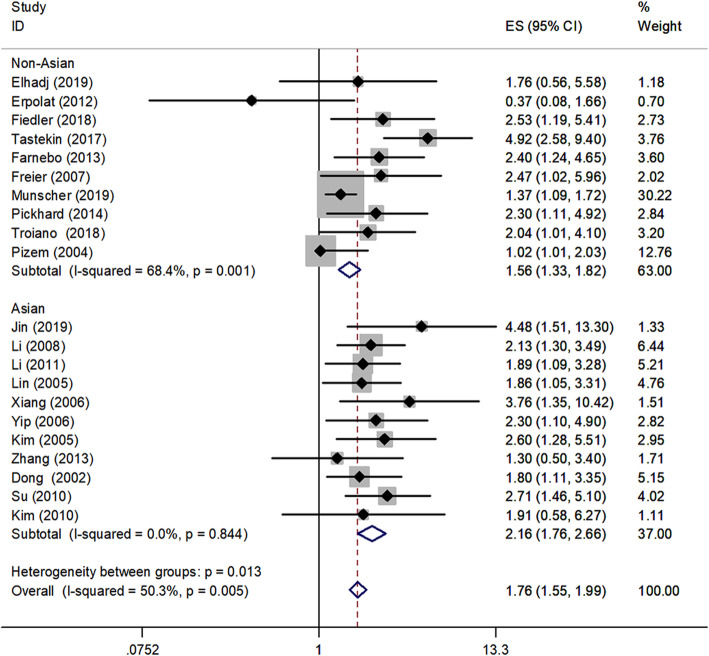
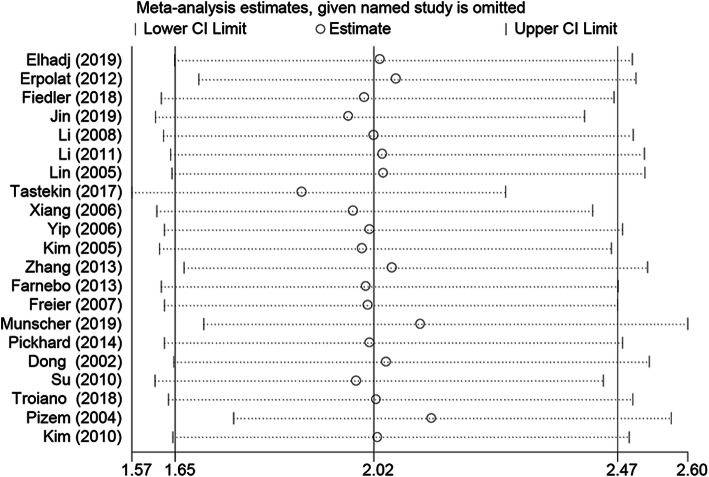
Twenty eight studies with 4891 patients were finally included in this meta-analysis, the pooled analysis indicated that the survivin expression was significantly correlated with poorer overall survival (OS) (HR, 2.02; 95% CI, 1.65-2.47, P < 0.001), and poorer disease-free survival (DFS)/ disease-specific survival (DSS) (HR = 2.03, 95%CI: 1.64-2.52, P < 0.001; HR = 1.92, 95%CI: 1.41-2.60, P < 0.001, receptively). Similar results were observed in subgroup analysis stratified by different cancer types, such as laryngeal squamous cell carcinoma (LSCC) (HR = 1.35, 95%CI: 1.05-1.74, P < 0.001), oral squamous cell carcinomas (OSCC) (HR = 2.45, 95%CI: 1.89-3.17, P < 0.001), nasopharyngeal carcinoma (NPC) (HR = 2.53, 95%CI: 1.76-3.62, P < 0.001) and HNSCC (HR = 1.52, 95%CI: 1.25-1.86, P < 0.001). Furthermore, ethnicity-stratified analysis indicated that survivin was significantly associated with poorer OS among both Asian and Non- Asian HNSCC patients (HR = 2.16, 95%CI: 1.76-2.66; HR = 1.56, 95%CI: 1.33-1.82, respectively).
Our results suggested that survivin is predictors of worse prognosis in HNSCC patients. Hence, survivin is a potential therapeutic target for HNSCC.
Survivin 最近被确定为不同类型癌症中一种有前途的新型治疗靶点和预后标志物。在这里,我们进行了一项全面的荟萃分析,以更好地阐明 survivin 在头颈部鳞状细胞癌(HNSCC)中的精确预后和诊断价值。
系统地检索了 PubMed(Medline)、Embase 和 Web of Science 数据库中截至 2020 年 9 月的相关已发表文献。使用合并风险比(HR)和相关 95%置信区间(CI)来估计 survivin 表达与 HNSCC 患者生存结局之间的关联。
最终纳入了 28 项研究,共 4891 例患者,荟萃分析表明 survivin 表达与总体生存率(OS)较差显著相关(HR,2.02;95%CI,1.65-2.47,P<0.001),无病生存率(DFS)/疾病特异性生存率(DSS)较差(HR=2.03,95%CI:1.64-2.52,P<0.001;HR=1.92,95%CI:1.41-2.60,P<0.001)。在按不同癌症类型分层的亚组分析中也观察到了类似的结果,例如喉鳞状细胞癌(LSCC)(HR=1.35,95%CI:1.05-1.74,P<0.001)、口腔鳞状细胞癌(OSCC)(HR=2.45,95%CI:1.89-3.17,P<0.001)、鼻咽癌(NPC)(HR=2.53,95%CI:1.76-3.62,P<0.001)和 HNSCC(HR=1.52,95%CI:1.25-1.86,P<0.001)。此外,种族分层分析表明,在亚洲和非亚洲 HNSCC 患者中,survivin 与较差的 OS 显著相关(HR=2.16,95%CI:1.76-2.66;HR=1.56,95%CI:1.33-1.82)。
我们的结果表明,survivin 是 HNSCC 患者预后不良的预测因子。因此,survivin 是 HNSCC 的一个潜在治疗靶点。