Jiangsu Provincial Key Laboratory of Critical Care Medicine, Department of Critical Care Medicine, Zhongda Hospital, School of Medicine, Southeast University, Nanjing, 210009, China.
Department of Emergency Intensive Care Unit, The Affiliated Huaian NO. 1 People's Hospital of Nanjing Medical University, Huai'an, 223300, China.
Eur J Med Res. 2023 Sep 9;28(1):329. doi: 10.1186/s40001-023-01315-z.
Although the mean arterial pressure (MAP) target of 65 mmHg was achieved, diastolic blood pressure (DBP) was still low in some septic shock patients. The effects of DBP on the prognosis and optimal target for patients with septic shock are unclear. We sought to investigate the relationship between DBP and 28-day mortality in septic shock patients.
In this retrospective observational study, we obtained data from the Chinese Database in Intensive Care (CDIC). We included patients with an admission diagnosis of septic shock and shock was controlled. DBP was measured every 1 h, and the mean DBP during the first 24 h (mDBP) was recorded. The primary outcome was 28-day mortality. Multivariable logistic regression determined the relationship between mDBP and 28-day mortality.
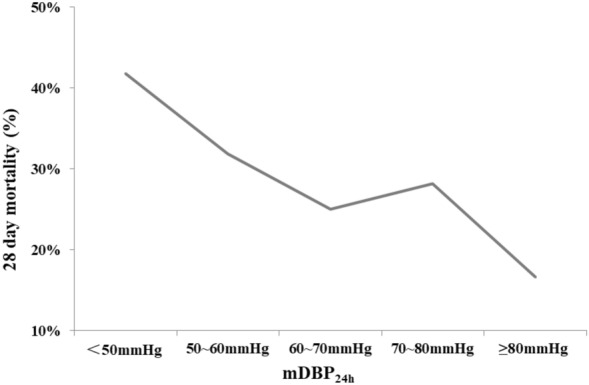
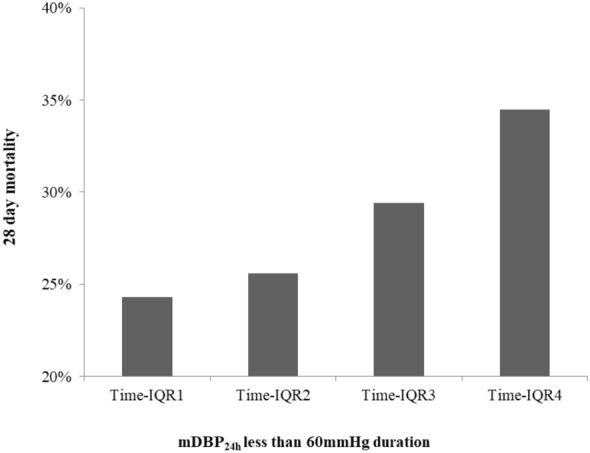
In total, 1251 patients were finally included. The 28-day mortality of included septic shock patients was 28.3%. The mDBP, not mSBP, was higher among 28-day survivors compared with non-survivors. 28-day mortality was inversely associated with mDBP (unadjusted OR 0.814 per 10 mmHg higher mDBP, P = 0.003), with a stepwise increase in 28-day mortality at lower mDBP. The 28-day mortality of patients with mDBP < 59 mmHg had an absolute risk reduction of 9.4% (P = 0.001). And mDBP < 59 mmHg was the remaining high risk factor inversely associated with 28-day mortality after multivariable adjustment (adjusted OR 1.915, 95% CI 1.037-3.536, P = 0.038), while mMAP and mSBP were not.
In patients with septic shock after initial resuscitation, we observed an inverse association between mDBP and 28-day mortality. The poor outcomes in patients with mDBP < 59 mmHg provide indirect evidence supporting a further DBP goal of 59 mmHg for patients with septic shock after MAP of 65 mmHg was achieved.
虽然平均动脉压(MAP)目标达到了 65mmHg,但一些脓毒性休克患者的舒张压(DBP)仍然较低。DBP 对脓毒性休克患者预后的影响以及最佳目标尚不清楚。我们旨在探讨 DBP 与脓毒性休克患者 28 天死亡率之间的关系。
在这项回顾性观察性研究中,我们从中国重症监护数据库(CDIC)中获取数据。我们纳入了入院诊断为脓毒性休克且休克得到控制的患者。每 1 小时测量一次 DBP,并记录前 24 小时的平均 DBP(mDBP)。主要结局为 28 天死亡率。多变量逻辑回归确定了 mDBP 与 28 天死亡率之间的关系。
总共纳入了 1251 名患者。纳入的脓毒性休克患者 28 天死亡率为 28.3%。与幸存者相比,非幸存者的 mDBP 更高,而非 mSBP。28 天死亡率与 mDBP 呈反比(未调整的 OR 每 10mmHg 更高的 mDBP 为 0.814,P=0.003),mDBP 越低,28 天死亡率呈阶梯式上升。mDBP<59mmHg 的患者 28 天死亡率绝对风险降低 9.4%(P=0.001)。并且 mDBP<59mmHg 是在多变量调整后与 28 天死亡率呈反比的剩余高危因素(调整后的 OR 为 1.915,95%CI 为 1.037-3.536,P=0.038),而 mMAP 和 mSBP 则不是。
在初始复苏后患有脓毒性休克的患者中,我们观察到 mDBP 与 28 天死亡率之间存在反比关系。mDBP<59mmHg 的患者预后较差,为 MAP 达到 65mmHg 后脓毒性休克患者的 DBP 目标达到 59mmHg 提供了间接证据。