Cooper Edward S, Silverstein Deborah C
Department of Veterinary Clinical Sciences, Ohio State University College of Veterinary Medicine, Columbus, OH, United States.
Department of Clinical Studies and Advanced Medicine, University of Pennsylvania School of Veterinary Medicine, Philadelphia, PA, United States.
Front Vet Sci. 2021 May 13;8:625708. doi: 10.3389/fvets.2021.625708. eCollection 2021.
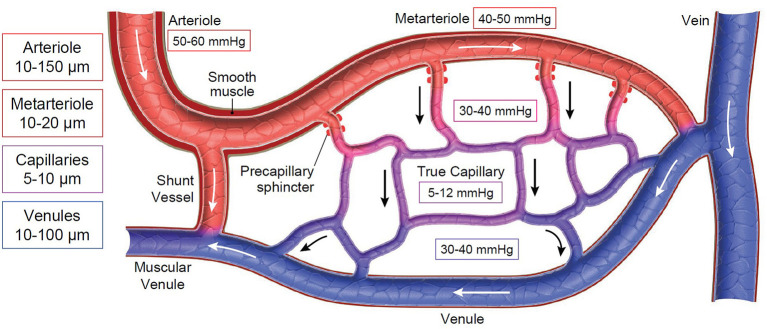
Fluid selection and administration during shock is typically guided by consideration of macrovascular abnormalities and resuscitative targets (perfusion parameters, heart rate, blood pressure, cardiac output). However, the microcirculatory unit (comprised of arterioles, true capillaries, and venules) is vital for the effective delivery of oxygen and nutrients to cells and removal of waste products from the tissue beds. Given that the microcirculation is subject to both systemic and local control, there is potential for functional changes and impacts on tissue perfusion that are not reflected by macrocirculatory parameters. This chapter will present an overview of the structure, function and regulation of the microcirculation and endothelial surface layer in health and shock states such as trauma, hemorrhage and sepsis. This will set the stage for consideration of how these microcirculatory characteristics, and the potential disconnect between micro- and macrovascular perfusion, may affect decisions related to acute fluid therapy (fluid type, amount, and rate) and monitoring of resuscitative efforts. Available evidence for the impact of various fluids and resuscitative strategies on the microcirculation will also be reviewed.
休克期间的液体选择与管理通常依据对大血管异常情况及复苏目标(灌注参数、心率、血压、心输出量)的考量来进行。然而,微循环单元(由小动脉、真毛细血管和小静脉组成)对于向细胞有效输送氧气和营养物质以及从组织床清除代谢废物至关重要。鉴于微循环受全身和局部控制,存在功能改变以及对组织灌注产生影响的可能性,而这些并未在大循环参数中体现出来。本章将概述健康状态以及创伤、出血和脓毒症等休克状态下微循环和内皮表面层的结构、功能及调节。这将为思考这些微循环特征以及微血管灌注与大血管灌注之间可能存在的脱节如何影响急性液体治疗(液体类型、量和速率)决策以及复苏效果监测奠定基础。还将综述各种液体和复苏策略对微循环影响的现有证据。