Nephrology Department, Hospital das Clínicas, Faculdade de Medicina da Universidade de São Paulo, São Paulo, SP, Brazil.
Nephrology Department, Hospital das Clínicas, Faculdade de Medicina da Universidade de São Paulo, São Paulo, SP, Brazil; Nephrology Department, Prince of Wales Clinical School ‒ UNSW Medicine & Health, Sydney, Australia.
Clinics (Sao Paulo). 2023 Sep 8;78:100280. doi: 10.1016/j.clinsp.2023.100280. eCollection 2023.
Ideal timing of Renal Replacement Therapy (RRT) discontinuation in Acute Kidney Injury (AKI) is still unknown. We aimed to study the role of creatinine-related variables in predicting RRT successful discontinuation and to propose a clinical predictive score.
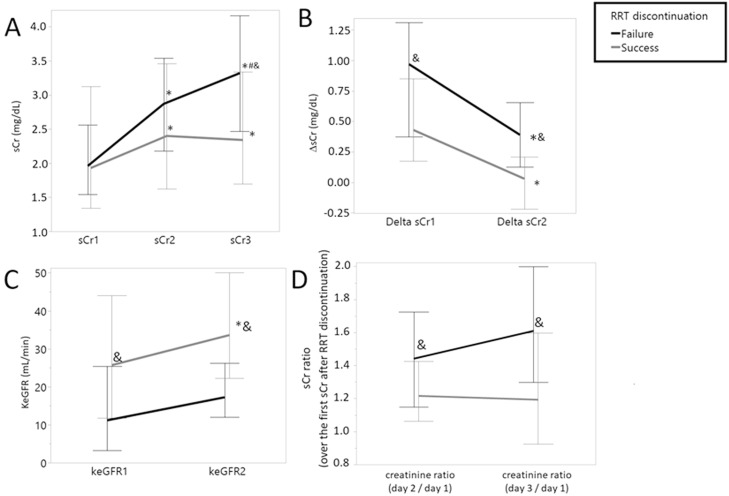
In this single-centre retrospective study, we evaluated all AKI patients in whom RRT was interrupted for at least 48 hours. Patients who were still RRT-independent 7 days after initial RRT cessation were included in the "Success" group and opposed to the "Failure" group. We evaluated baseline characteristics and variables collected at the time of RRT interruption, as well as the Kinetic estimated Glomerular Filtration Rate (KeGFR), the simple variation in serum Creatinine (ΔsCr), and the incremental creatinine ratio on the first three days after RRT interruption. Multivariable analysis was performed to evaluate prediction of success. Internal validation using a simple binomial generalized regression model with Lasso estimation and 5-fold cross validation method was performed.
We included 124 patients, 49 in the "Failure" group and 75 in the "Success" group. All creatinine-related variables predicted success in simple and multiple logistic regression models. The best model generated a clinical score based on the odds ratio obtained for each variable and included urine output, non-renal SOFA score, fluid balance, serum urea, serum potassium, blood pH, and the variation in sCr values after RRT discontinuation. The score presented an area under the ROC of 0.86 (95% CI 0.76‒1.00).
Creatinine variation between the first 2 consecutive days after RRT discontinuation might predict success in RRT discontinuation. The developed clinical score based on these variables might be a useful clinical decision tool to guide hemodialysis catheter safe removal.
急性肾损伤(AKI)中肾脏替代治疗(RRT)停止的理想时机仍不清楚。我们旨在研究肌酐相关变量在预测 RRT 成功停止中的作用,并提出一个临床预测评分。
在这项单中心回顾性研究中,我们评估了所有中断 RRT 至少 48 小时的 AKI 患者。在初始 RRT 停止后 7 天仍无需 RRT 的患者被纳入“成功”组,与“失败”组相对。我们评估了 RRT 中断时的基线特征和变量,以及 Kinetic 估计肾小球滤过率(KeGFR)、血清肌酐的简单变化(ΔsCr)和 RRT 中断后前三天的肌酐增量比。进行多变量分析以评估成功的预测。使用带有 Lasso 估计和 5 折交叉验证方法的简单二项式广义回归模型进行内部验证。
我们纳入了 124 名患者,其中 49 名在“失败”组,75 名在“成功”组。所有与肌酐相关的变量在简单和多变量逻辑回归模型中均预测了成功。最佳模型基于每个变量的优势比生成了一个临床评分,并包括尿量、非肾 SOFA 评分、液体平衡、血清尿素、血清钾、血液 pH 值以及 RRT 停止后 sCr 值的变化。该评分的 ROC 曲线下面积为 0.86(95%CI 0.76-1.00)。
RRT 停止后前 2 天肌酐的变化可能预测 RRT 停止的成功。基于这些变量开发的临床评分可能是指导血液透析导管安全移除的有用临床决策工具。