Department of Pharmacy, University of Salerno, 84084, Fisciano, SA, Italy.
PhD Program in Drug Discovery and Development, University of Salerno, Fisciano, SA, Italy.
Sci Rep. 2023 Sep 10;13(1):14923. doi: 10.1038/s41598-023-42303-x.
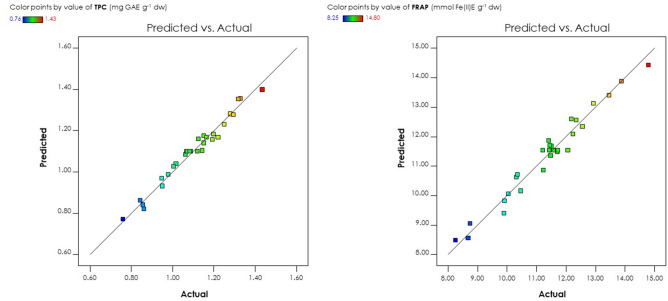
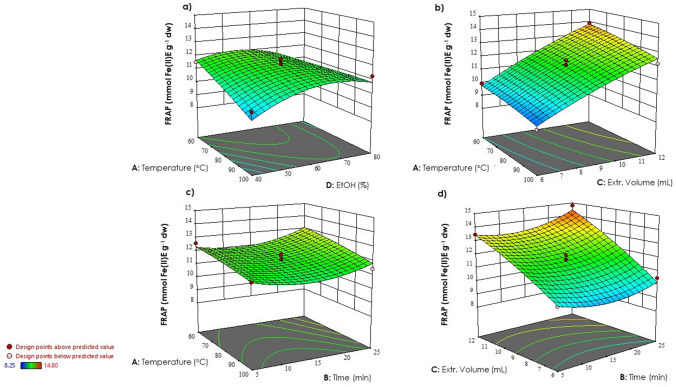
Many studies have explored the extraction of bioactive compounds from different onion solid wastes, such as bulb, skin, and peel. However, onion leaves have received limited attention despite their potential as a valuable source of nutraceutical compounds. This study aimed to valorise, for the first time, the agricultural waste in the form of spring onion leaves (CN, Cipollotto Nocerino) to obtain antioxidant-rich polyphenolic extracts. A Box-Behnken design (BBD) was used to assess the impact of microwave-assisted extraction (MAE) variables (temperature, time, extraction volume, and ethanol concentration) on total polyphenol content (TPC) measured by Folin-Ciocalteu method and the antioxidant power determined by FRAP assay. Response surface methodology (RSM) was applied, and regression equations, analysis of variance, and 3D response curves were developed. Our results highlighted that the TPC values range from 0.76 to 1.43 mg GAE g dw, while the FRAP values range from 8.25 to 14.80 mmol Fe(II)E g dw. The optimal extraction conditions predicted by the model were 60 °C, 22 min, ethanol concentration 51% (v/v), and solvent volume 11 mL. These conditions resulted in TPC and FRAP values of 1.35 mg GAE g dw and 14.02 mmol Fe(II)E g dw, respectively. Furthermore, the extract obtained under optimized conditions was characterized by UHPLC-ESI-Orbitrap-MS analysis. LC/MS-MS platform allowed us to tentatively identify various compounds belonging to the class of flavonoids, saponins, fatty acids, and lipids. Finally, the ability of CN optimal extract to inhibit the intracellular reactive oxygen species (ROS) release in a hepatocarcinoma cell line using an HO-induced oxidative stress model, was evaluated. The results highlighted the potential of CN extract as a valuable source of polyphenols with significant antioxidant properties, suitable for various applications in the food and pharmaceutical industries.
许多研究都探索了从不同洋葱固体废弃物(如鳞茎、皮和皮)中提取生物活性化合物。然而,尽管洋葱叶具有作为营养化合物的有价值来源的潜力,但它们受到的关注有限。本研究旨在首次利用春葱叶(CN,Cipollotto Nocerino)这种农业废弃物,获得富含抗氧化剂的多酚提取物。采用 Box-Behnken 设计(BBD)评估微波辅助提取(MAE)变量(温度、时间、提取体积和乙醇浓度)对 Folin-Ciocalteu 法测定的总多酚含量(TPC)和 FRAP 测定的抗氧化能力的影响。应用响应面法(RSM),并建立回归方程、方差分析和 3D 响应曲线。结果表明,TPC 值范围为 0.76 至 1.43 mg GAE g dw,而 FRAP 值范围为 8.25 至 14.80 mmol Fe(II)E g dw。模型预测的最佳提取条件为 60°C、22 分钟、乙醇浓度 51%(v/v)和溶剂体积 11 mL。在此条件下,TPC 和 FRAP 值分别为 1.35 mg GAE g dw 和 14.02 mmol Fe(II)E g dw。此外,在优化条件下获得的提取物通过 UHPLC-ESI-Orbitrap-MS 分析进行了表征。LC/MS-MS 平台使我们能够初步鉴定属于类黄酮、皂苷、脂肪酸和脂质类的各种化合物。最后,使用 HO 诱导的氧化应激模型评估了 CN 最佳提取物抑制肝癌细胞系中细胞内活性氧(ROS)释放的能力。结果表明,CN 提取物作为具有显著抗氧化特性的多酚的有价值来源,适用于食品和制药行业的各种应用。