Biabani Nazanin, Birdseye Adam, Higgins Sean, Delogu Alessio, Rosenzweig Jan, Cvetkovic Zoran, Nesbitt Alexander, Drakatos Panagis, Steier Joerg, Kumari Veena, O'Regan David, Rosenzweig Ivana
Sleep and Brain Plasticity Centre, Department of Neuroimaging, Institute of Psychiatry, Psychology and Neuroscience (IoPPN), King's College London, London, UK.
Sleep Disorders Centre, Guy's and St Thomas' NHS Foundation Trust, London, UK.
J Thorac Dis. 2023 Aug 31;15(8):4530-4543. doi: 10.21037/jtd-23-325. Epub 2023 Aug 14.
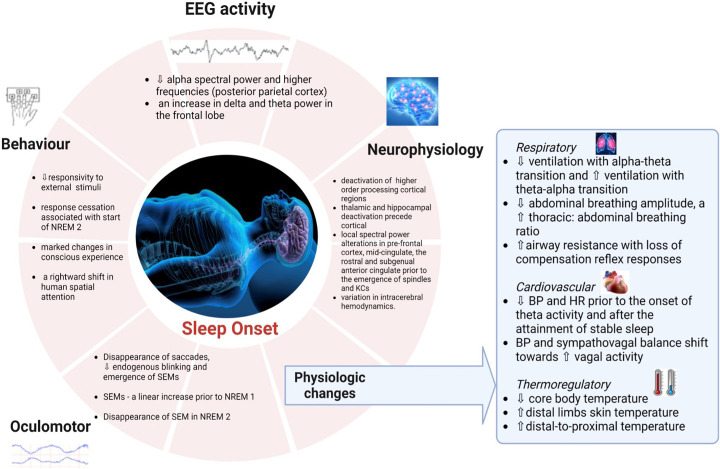
The sleep onset process is an ill-defined complex process of transition from wakefulness to sleep, characterized by progressive modifications at the subjective, behavioural, cognitive, and physiological levels. To this date, there is no international consensus which could aid a principled characterisation of this process for clinical research purposes. The current review aims to systemise the current knowledge about the underlying mechanisms of the natural heterogeneity of this process.
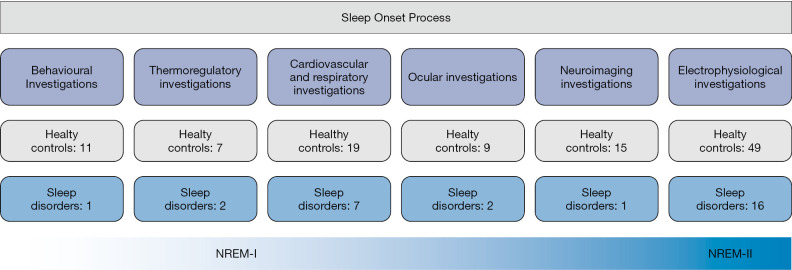
In this systematic review, studies investigating the process of the sleep onset from 1970 to 2022 were identified using electronic database searches of PsychINFO, MEDLINE, and Embase.
A total of 139 studies were included; 110 studies in healthy participants and 29 studies in participants with sleep disorders. Overall, there is a limited consensus across a body of research about what distinct biomarkers of the sleep onset constitute. Only sparse data exists on the physiology, neurophysiology and behavioural mechanisms of the sleep onset, with majority of studies concentrating on the non-rapid eye movement stage 2 (NREM 2) as a potentially better defined and a more reliable time point that separates sleep from the wake, on the sleep wake continuum.
The neurophysiologic landscape of sleep onset bears a complex pattern associated with a multitude of behavioural and physiological markers and remains poorly understood. The methodological variation and a heterogenous definition of the wake-sleep transition in various studies to date is understandable, given that sleep onset is a process that has fluctuating and ill-defined boundaries. Nonetheless, the principled characterisation of the sleep onset process is needed which will allow for a greater conceptualisation of the mechanisms underlying this process, further influencing the efficacy of current treatments for sleep disorders.
睡眠起始过程是一个从清醒到睡眠的界限不明的复杂过渡过程,其特征是在主观、行为、认知和生理层面上的渐进性变化。迄今为止,尚无国际共识可有助于从临床研究角度对这一过程进行原则性描述。本综述旨在梳理关于这一过程自然异质性潜在机制的现有知识。
在本系统综述中,通过对PsychINFO、MEDLINE和Embase进行电子数据库检索,确定了1970年至2022年期间研究睡眠起始过程的研究。
共纳入139项研究;其中110项研究的参与者为健康人,29项研究的参与者患有睡眠障碍。总体而言,关于构成睡眠起始的独特生物标志物,众多研究之间的共识有限。关于睡眠起始的生理学、神经生理学和行为机制,仅有稀少的数据,大多数研究集中在非快速眼动睡眠2期(NREM 2),认为这是睡眠 - 清醒连续体上一个可能定义更明确、更可靠的将睡眠与清醒区分开的时间点。
睡眠起始的神经生理学状况呈现出与多种行为和生理标志物相关的复杂模式,目前仍知之甚少。鉴于睡眠起始是一个界限波动且不明确的过程,迄今为止各项研究中方法学的差异以及对清醒 - 睡眠转换的异质性定义是可以理解的。尽管如此,仍需要对睡眠起始过程进行原则性描述,这将有助于更深入地理解该过程的潜在机制,进而影响当前睡眠障碍治疗方法的疗效。