Pan Rong, Zhang Guimei, Deng Fangyi, Lin Weifeng, Pan Jiyang
Department of Psychology, The Third People's Hospital of Zhaoqing, Zhaoqing, Guangdong Province, China.
Department of Psychiatry, Sleep Medicine Center, First Affiliated Hospital of Jinan University, Guangzhou, Guangdong Province, China.
Front Psychiatry. 2023 Aug 24;14:1200350. doi: 10.3389/fpsyt.2023.1200350. eCollection 2023.
This study aimed to determine the influence of red light on objective sleep and the relationship between mood and sleep among individuals with insomnia disorder (ID).
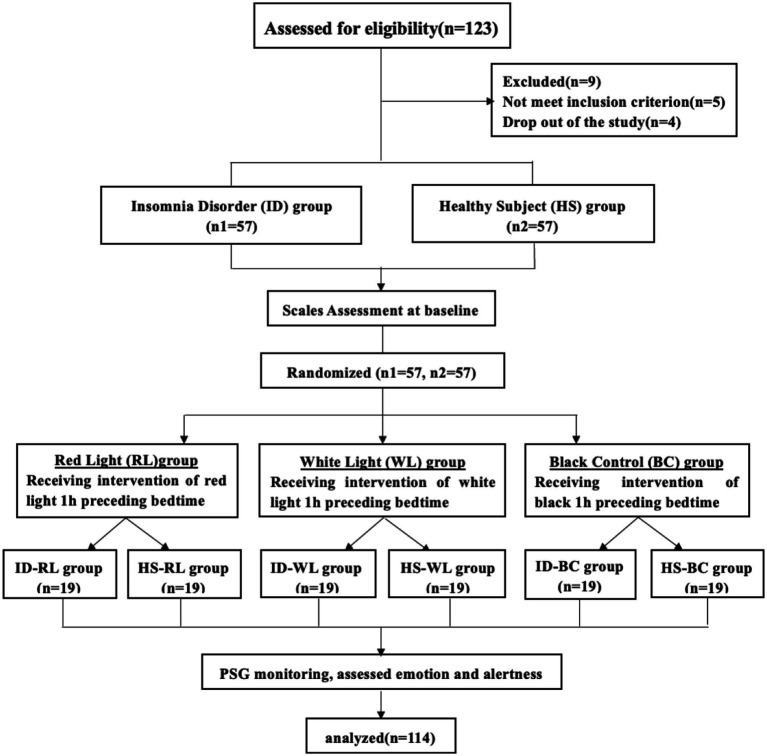
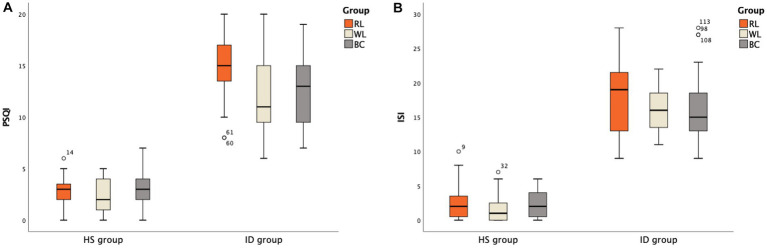
57 individuals with insomnia symptoms and 57 healthy participants were randomly divided into three groups (red- and white-light groups, and the black control group), which received different light treatments for 1 h before bedtime. The emotions and subjective alertness of participants were evaluated using Positive and Negative Affect Schedule scales (PANAS) and Karolinska Sleepiness Scale (KSS), their sleeping data were recorded using polysomnography (PSG).
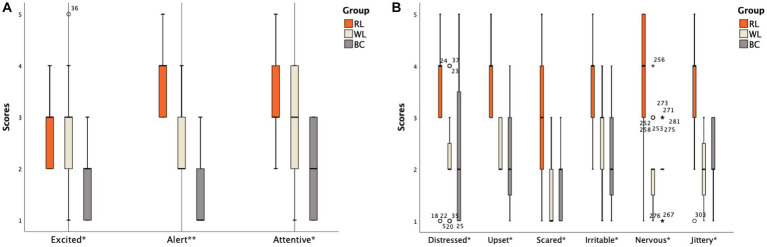
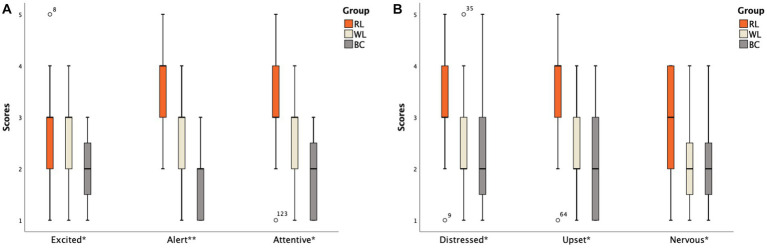
The negative emotion scores were higher in the healthy subject-red light (HS-RL) group than in the HS-white light (WL) and HS-black control (BC) groups ( < 0.001). The anxiety and negative emotion scores were higher in the ID-RL group than in the ID-WL and ID-BC groups ( = 0.007 and < 0.001, respectively). The KSS scores were lower in the RL group than in the WL and BC groups for both HS and ID group (both < 0.001). The SOL was shorter in the HS-RL group than in HS-WL group ( = 0.019). Compared with the HS-BC group, the HS-RL group had an increase in microarousal index (MAI) and N1% ( = 0.034 and = 0.021, respectively), while the total sleep time (TST) and sleep efficiency (SE) decreased ( = 0.001 and < 0.001, respectively). Compared with the ID-WL group, the SOL was shorter in the ID-RL group ( = 0.043), while TST, SE, number of microarousals (NMA), and numbers of cycles of REM period were increased ( = 0.016, = 0.046, = 0.001, and = 0.041, respectively). Compared with the ID-BC group, the ID-RL group had increases in the SOL, WASO, and the numbers of cycles and NMA in REM period ( = 0.038, = 0.005, = 0.045, and = 0.033, respectively), and a decrease in SE ( = 0.014). The effects of ID-WL (vs. ID-RL group) and ID-BC (vs. ID-RL group) on SOL were mediated by negative emotions (mediating effects were - 37.626 and - 33.768, respectively).
Red light can increase subjective alertness, anxiety, and negative emotions in both healthy subjects and people with ID, which can affect sleep directly or indirectly via the mediating effect of negative emotions.
本研究旨在确定红光对失眠症(ID)患者客观睡眠的影响以及情绪与睡眠之间的关系。
57名有失眠症状的个体和57名健康参与者被随机分为三组(红光和白光组以及黑色对照组),在睡前接受不同的光照治疗1小时。使用正负情绪量表(PANAS)和卡罗林斯卡嗜睡量表(KSS)评估参与者的情绪和主观警觉性,使用多导睡眠图(PSG)记录他们的睡眠数据。
健康受试者红光(HS-RL)组的负面情绪得分高于健康受试者白光(WL)组和健康受试者黑色对照(BC)组(<0.001)。ID-RL组的焦虑和负面情绪得分高于ID-WL组和ID-BC组(分别为=0.007和<0.001)。对于HS组和ID组,RL组的KSS得分均低于WL组和BC组(均<0.001)。HS-RL组的入睡潜伏期(SOL)比HS-WL组短(=0.019)。与HS-BC组相比,HS-RL组的微觉醒指数(MAI)和N1%增加(分别为=0.034和=0.021),而总睡眠时间(TST)和睡眠效率(SE)降低(分别为=0.001和<0.001)。与ID-WL组相比,ID-RL组的SOL更短(=0.043),而TST、SE、微觉醒次数(NMA)和快速眼动(REM)期的周期数增加(分别为=0.016、=0.046、=0.001和=0.041)。与ID-BC组相比,ID-RL组的SOL、清醒时间占总睡眠时间的比例(WASO)以及REM期的周期数和NMA增加(分别为=0.038、=0.005、=0.045和=0.033),SE降低(=0.014)。ID-WL(与ID-RL组相比)和ID-BC(与ID-RL组相比)对SOL的影响通过负面情绪介导(中介效应分别为-37.626和-33.768)。
红光可增加健康受试者和ID患者的主观警觉性、焦虑和负面情绪,这可直接或通过负面情绪的中介作用间接影响睡眠。