Gong Xianda, Zhang Jiaoshi, Croft Betty, Yang Xin, Frey Markus M, Bergner Nora, Chang Rachel Y-W, Creamean Jessie M, Kuang Chongai, Martin Randall V, Ranjithkumar Ananth, Sedlacek Arthur J, Uin Janek, Willmes Sascha, Zawadowicz Maria A, Pierce Jeffrey R, Shupe Matthew D, Schmale Julia, Wang Jian
Center for Aerosol Science and Engineering, Department of Energy, Environmental and Chemical Engineering, Washington University in St. Louis, St. Louis, MO USA.
Department of Physics and Atmospheric Science, Dalhousie University, Halifax, Nova Scotia Canada.
Nat Geosci. 2023;16(9):768-774. doi: 10.1038/s41561-023-01254-8. Epub 2023 Sep 4.
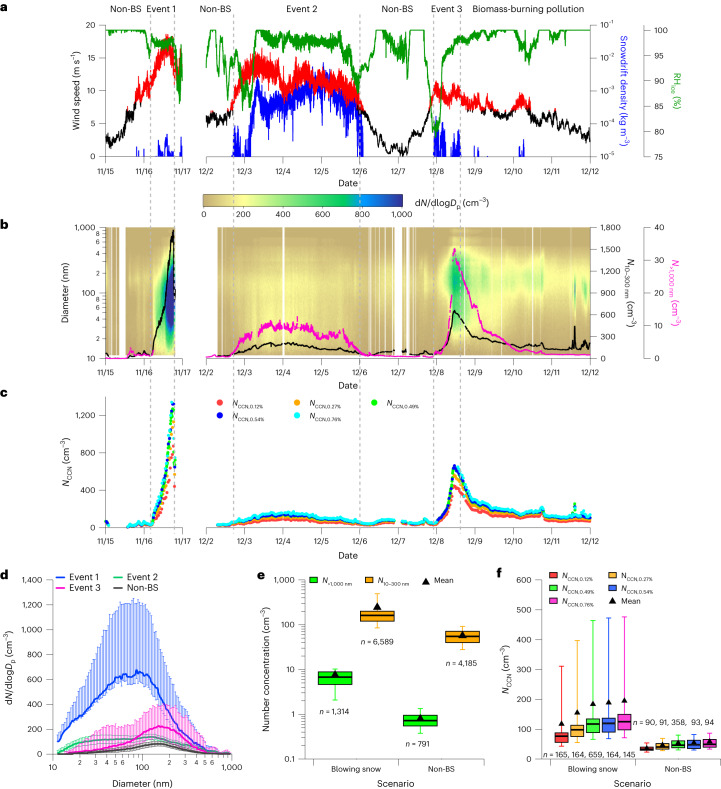
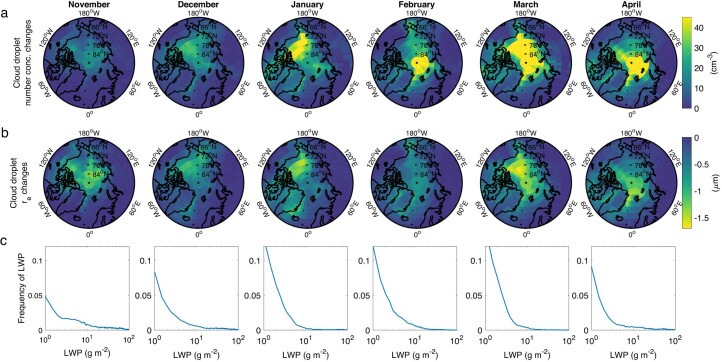
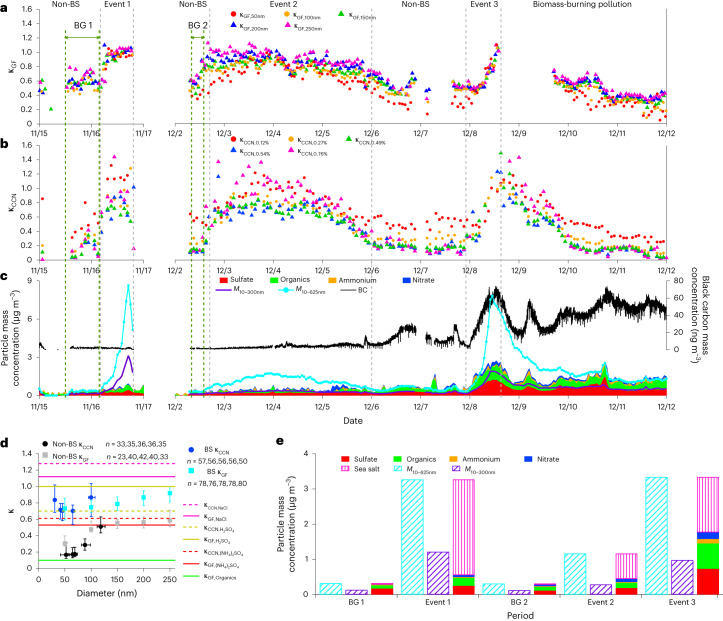
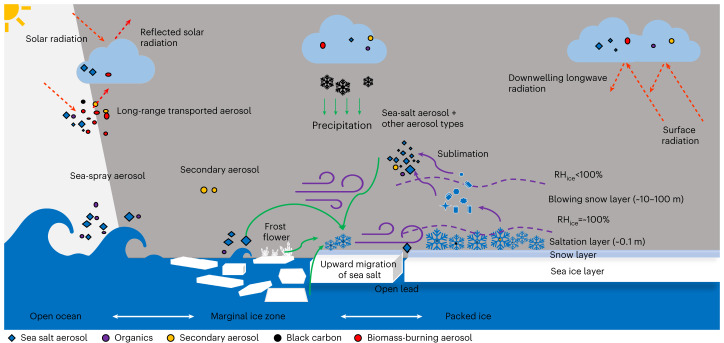
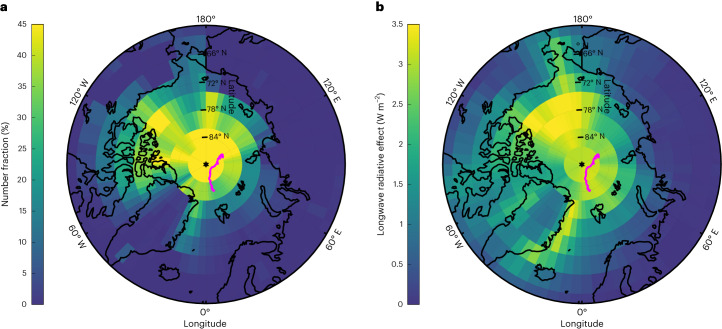
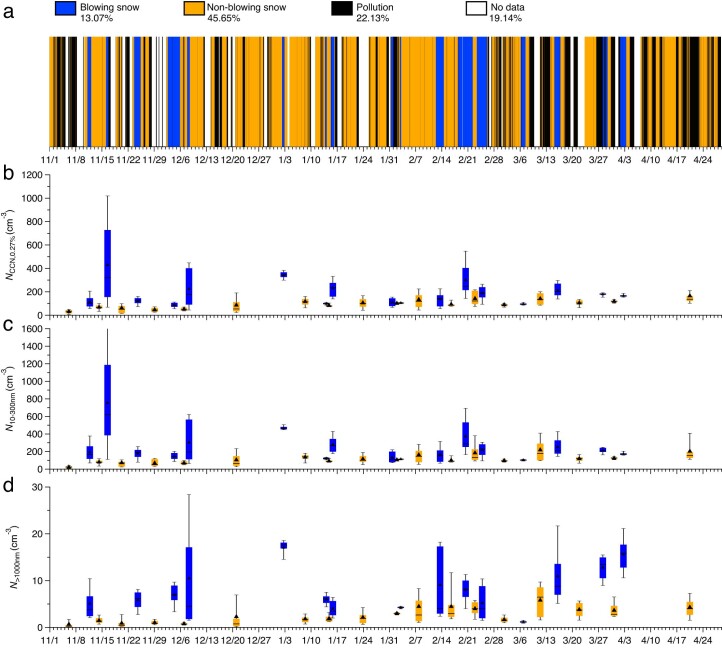
The Arctic warms nearly four times faster than the global average, and aerosols play an increasingly important role in Arctic climate change. In the Arctic, sea salt is a major aerosol component in terms of mass concentration during winter and spring. However, the mechanisms of sea salt aerosol production remain unclear. Sea salt aerosols are typically thought to be relatively large in size but low in number concentration, implying that their influence on cloud condensation nuclei population and cloud properties is generally minor. Here we present observational evidence of abundant sea salt aerosol production from blowing snow in the central Arctic. Blowing snow was observed more than 20% of the time from November to April. The sublimation of blowing snow generates high concentrations of fine-mode sea salt aerosol (diameter below 300 nm), enhancing cloud condensation nuclei concentrations up to tenfold above background levels. Using a global chemical transport model, we estimate that from November to April north of 70° N, sea salt aerosol produced from blowing snow accounts for about 27.6% of the total particle number, and the sea salt aerosol increases the longwave emissivity of clouds, leading to a calculated surface warming of +2.30 W m under cloudy sky conditions.
北极变暖速度几乎是全球平均速度的四倍,气溶胶在北极气候变化中发挥着越来越重要的作用。在北极,就冬春季节的质量浓度而言,海盐是主要的气溶胶成分。然而,海盐气溶胶的产生机制仍不清楚。通常认为海盐气溶胶粒径相对较大但数浓度较低,这意味着它们对云凝结核数量和云特性的影响一般较小。在此,我们展示了北极中部吹雪产生大量海盐气溶胶的观测证据。从11月至4月,超过20%的时间观测到了吹雪。吹雪的升华产生了高浓度的细模态海盐气溶胶(直径低于300纳米),使云凝结核浓度提高到背景水平的十倍以上。利用全球化学传输模型,我们估计在北纬70°以北,从11月至4月,吹雪产生的海盐气溶胶约占总粒子数的27.6%,并且海盐气溶胶增加了云的长波发射率,在多云天空条件下导致计算得出的地表变暖为+2.30瓦每平方米。