Tinsley Grant M, Park Kyung-Shin, Saenz Catherine, Mehra Ayush, Esco Michael R, Czerwinski Stefan A, Nickerson Brett S
Department of Kinesiology & Sport Management, Texas Tech University, Lubbock, TX, United States.
College of Nursing and Health Sciences, Texas A&M International University, Laredo, TX, United States.
Front Nutr. 2023 Aug 24;10:1221774. doi: 10.3389/fnut.2023.1221774. eCollection 2023.
To date, body composition assessments in Hispanics, computed via bioimpedance devices, have primarily focused on body fat percent, fat mass, and fat-free mass instead of total body water (TBW). Additionally, virtually no information is available on which type of bioimpedance device is preferred for TBW assessments in Hispanic populations.
The purpose of this study was to validate two bioimpedance devices for the estimate of TBW in Hispanics adults when using a criterion deuterium oxide (DO) technique.
One-hundred thirty individuals (males: = 70; females: = 60) of Hispanic descent had TBW estimated via DO, single-frequency bioimpedance analysis ([SF-BIA] Quantum V, RJL Systems) and bioimpedance spectroscopy ([BIS] SFB7 Impedimed).
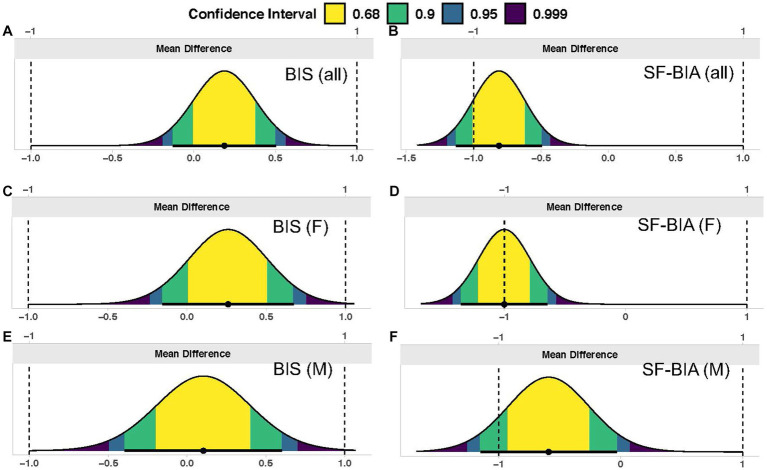
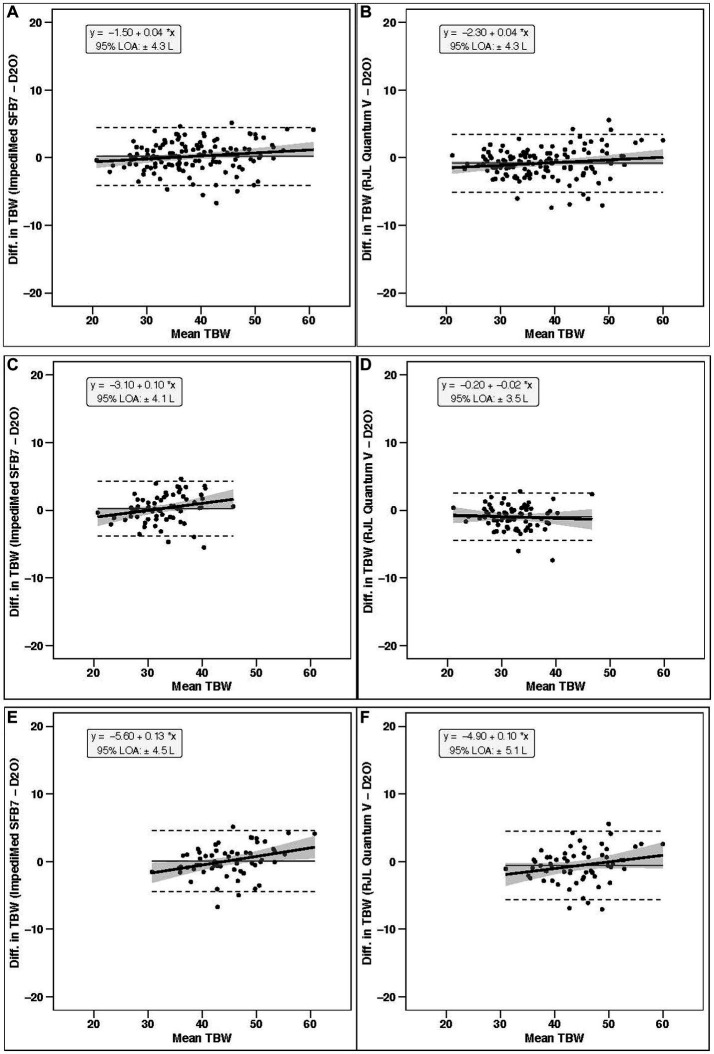
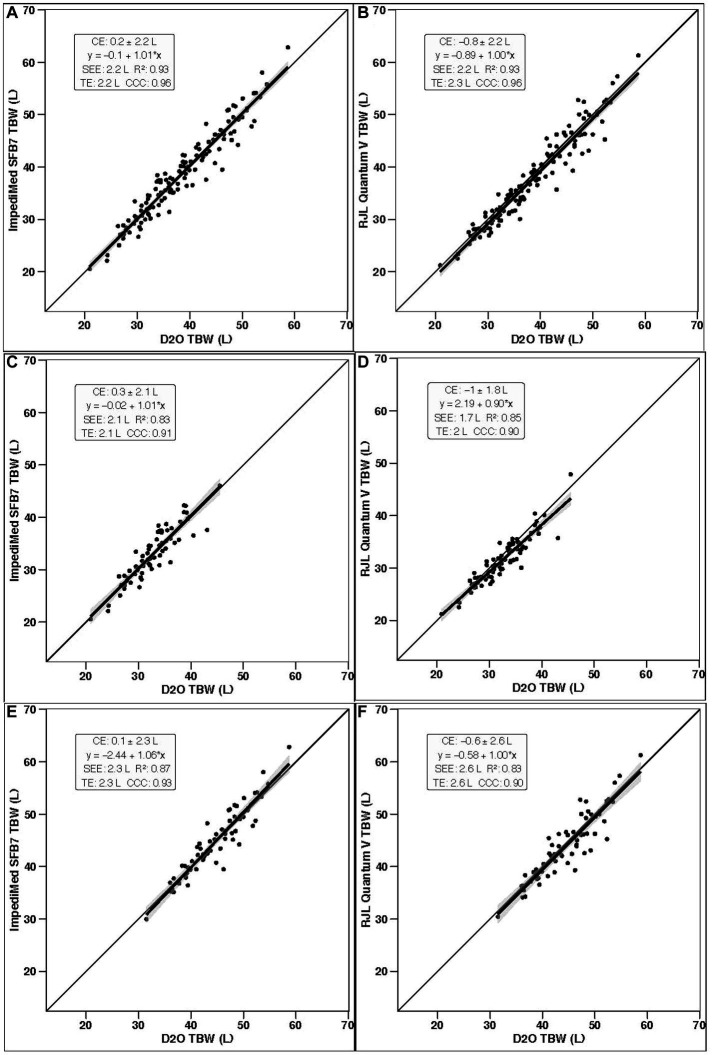
The mean values for SF-BIA were significantly lower than DO when evaluating the entire sample (37.4 L and 38.2 L, respectively; < 0.05). In contrast, TBW values were not statistically significant when comparing DO against BIS (38.4 L, > 0.05). Bland-Altman analysis indicated no proportional bias when evaluating the entire sample for SF-BIA or BIS. The standard error of estimate and total error values were ≤ 2.3 L and Lin's concordance correlation coefficient were ≥ 0.96 for all comparisons.
The SF-BIA and BIS devices evaluated in the current study hold promise for accurate estimation of TBW in Hispanic adults. While both methods demonstrated relatively low errors relative to the DO criterion, BIS exhibited a more consistent performance, particularly at the group level. These findings provide essential information for researchers and clinical nutrition practitioners assessing TBW in Hispanic adults.
迄今为止,通过生物电阻抗设备对西班牙裔人群进行的身体成分评估主要集中在体脂百分比、脂肪量和去脂体重上,而非总体水(TBW)。此外,几乎没有关于西班牙裔人群中哪种生物电阻抗设备更适合用于TBW评估的信息。
本研究的目的是在使用标准氧化氘(DO)技术时,验证两种生物电阻抗设备对西班牙裔成年人TBW的估计。
130名西班牙裔血统的个体(男性=70名;女性=60名)通过DO、单频生物电阻抗分析([SF-BIA]Quantum V,RJL Systems)和生物电阻抗光谱法([BIS]SFB7 Impedimed)对TBW进行估计。
在评估整个样本时,SF-BIA的平均值显著低于DO(分别为37.4L和38.2L;P<0.05)。相比之下,DO与BIS比较时,TBW值无统计学意义(38.4L,P>0.05)。Bland-Altman分析表明,在评估整个样本的SF-BIA或BIS时,没有比例偏差。所有比较的估计标准误差和总误差值≤2.3L,Lin一致性相关系数≥0.96。
本研究中评估的SF-BIA和BIS设备有望准确估计西班牙裔成年人的TBW。虽然两种方法相对于DO标准都显示出相对较低的误差,但BIS表现出更一致的性能,尤其是在组水平上。这些发现为评估西班牙裔成年人TBW的研究人员和临床营养从业者提供了重要信息。