Carrera Jean-Paul, Galué Josefrancisco, de Souza William M, Torres-Cosme Rolando, Lezcano-Coba Carlos, Cumbrera Alberto, Vasilakis Nikos, Tesh Robert B, Guzman Hilda, Weaver Scott C, Vittor Amy Y, Samudio Rafael, Miguel Pascale Juan, Valderrama Anayansi, Cáceres Carrera Lorenzo, Donnelly Christl A, Faria Nuno R
Department of Biology, University of Oxford, Oxford, United Kingdom.
Pandemic Sciences Institute, University of Oxford, Oxford United Kingdom.
bioRxiv. 2023 Aug 29:2023.08.28.555226. doi: 10.1101/2023.08.28.555226.
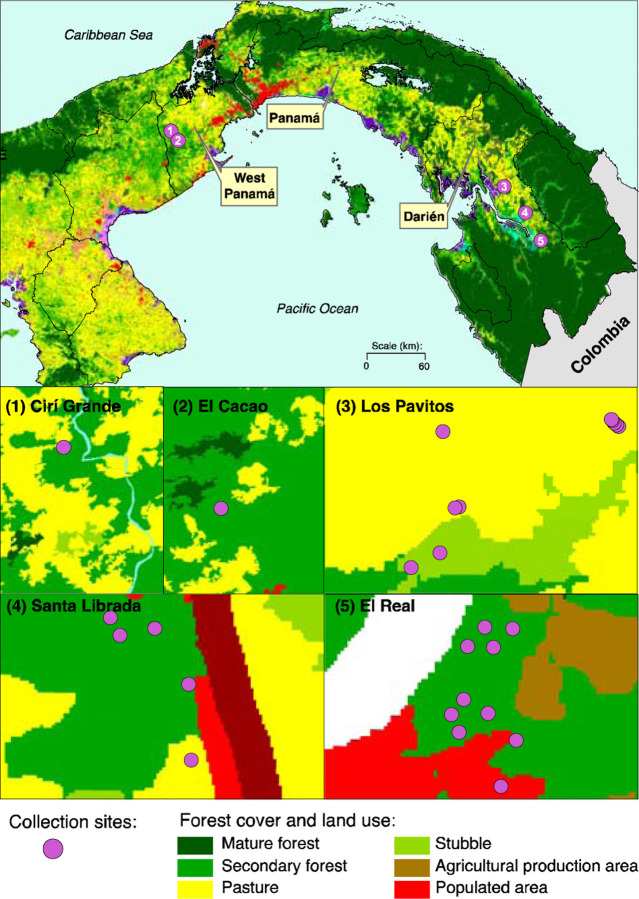
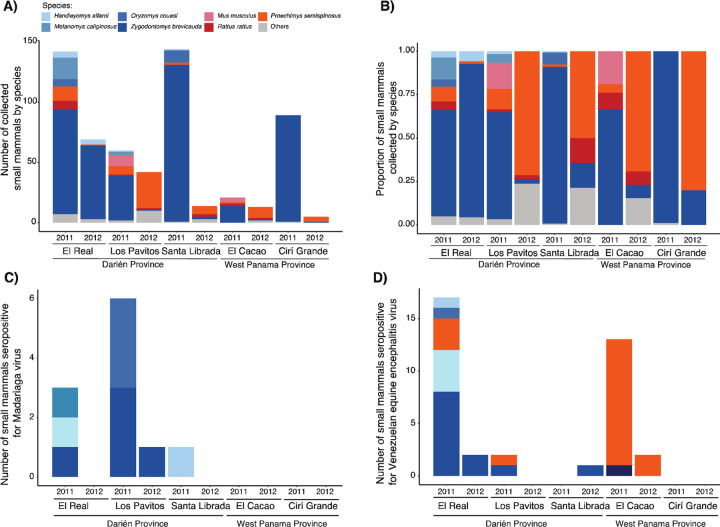
While rodents are primary reservoirs of Venezuelan equine encephalitis virus (VEEV), their role in Madariaga virus (MADV) transmission remains uncertain, particularly given their overlapping geographic distribution. This study explores the interplay of alphavirus prevalence, rodent diversity, and land use within Darien and Western Panama provinces. A total of three locations were selected for rodent sampling in Darien province: Los Pavitos, El Real de Santa Maria and Santa Librada. Two sites were selected in Western Panama province: El Cacao and Cirí Grande. We used plaque reduction neutralization tests to assess MADV and VEEV seroprevalences in 599 rodents of 16 species across five study sites. MADV seroprevalence was observed at higher rates in Los Pavitos (Darien province), 9.0%, 95% CI: 3.6-17.6, while VEEV seroprevalence was elevated in El Cacao (Western Panama province), 27.3%, 95% CI: 16.1-40.9, and El Real de Santa María (Darien province), 20.4%, 95% CI: 12.6-29.7. Species like , 23.1%, 95% CI: 5.0-53.8, and 20.0%, 95% CI: 0.5-71.6 displayed higher MADV seroprevalences than other species, whereas , 80.0%, 95% CI: 28.3-99.4, and , 27.3%, 95% CI: 17.0-39.6, exhibited higher VEEV seroprevalences. Our findings provide support to the notion that rodents are vertebrate reservoirs of MADV and reveal spatial variations in alphavirus seropositivity among rodent species, with different provinces exhibiting distinct rates for MADV and VEEV. Moreover, specific rodent species are linked to unique seroprevalence patterns for these viruses, suggesting that rodent diversity and environmental conditions might play a significant role in shaping alphavirus distribution.
虽然啮齿动物是委内瑞拉马脑炎病毒(VEEV)的主要宿主,但它们在马达里亚加病毒(MADV)传播中的作用仍不确定,特别是考虑到它们重叠的地理分布。本研究探讨了达连省和巴拿马西部省份中甲型病毒流行率、啮齿动物多样性和土地利用之间的相互作用。在达连省总共选择了三个地点进行啮齿动物采样:洛斯帕维托斯、圣玛丽亚皇家镇和圣利布拉达。在巴拿马西部省份选择了两个地点:埃尔可可和西里格兰德。我们使用蚀斑减少中和试验评估了五个研究地点16种599只啮齿动物中的MADV和VEEV血清阳性率。在洛斯帕维托斯(达连省)观察到较高的MADV血清阳性率,为9.0%,95%置信区间:3.6 - 17.6,而在埃尔可可(巴拿马西部省份)VEEV血清阳性率升高,为27.3%,95%置信区间:16.1 - 40.9,在圣玛丽亚皇家镇(达连省)为20.4%,95%置信区间:12.6 - 29.7。诸如[此处原文缺失具体物种名],23.1%,95%置信区间:5.0 - 53.8,和[此处原文缺失具体物种名],20.0%,95%置信区间:0.5 - 71.6等物种显示出比其他物种更高的MADV血清阳性率,而[此处原文缺失具体物种名],80.0%,95%置信区间:28.3 - 99.4,和[此处原文缺失具体物种名],27.3%,95%置信区间:17.0 - 39.6,表现出更高的VEEV血清阳性率。我们的研究结果支持了啮齿动物是MADV脊椎动物宿主这一观点,并揭示了啮齿动物物种间甲型病毒血清阳性的空间差异,不同省份的MADV和VEEV呈现出不同的比率。此外,特定的啮齿动物物种与这些病毒独特的血清阳性模式相关联,这表明啮齿动物多样性和环境条件可能在塑造甲型病毒分布方面发挥重要作用。