Xu Yao, Yang Jianhong, Gao Xiang, Sun Jie, Shang Qing, Han Qing, Wu Yuefei, Li Jichuan, Xu Tianqi, Huang Yi, Pan Yuning, Parson Mark W, Lin Longting
Department of Neurology, The First Affiliated Hospital of Ningbo University, Ningbo, Zhejiang, China.
Department of Neurosurgery, The First Affiliated Hospital of Ningbo University, Ningbo, Zhejiang, China.
Front Neurol. 2023 Aug 24;14:1230697. doi: 10.3389/fneur.2023.1230697. eCollection 2023.
Good collateral circulation is recognized to maintain perfusion and contribute to favorable clinical outcomes in acute ischemic stroke. This study aimed to derive and validate an optimal collateral time measurement on perfusion computed tomography imaging for patients with acute ischemic stroke.
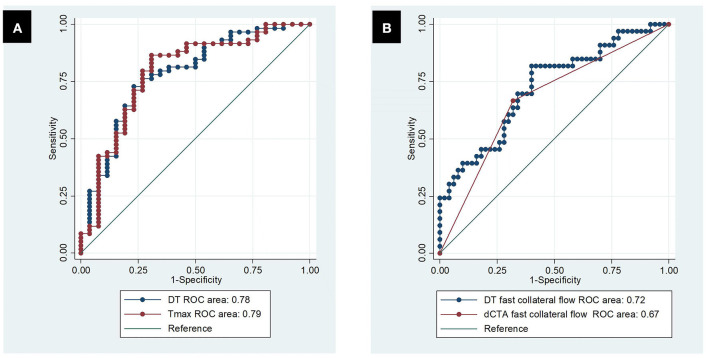
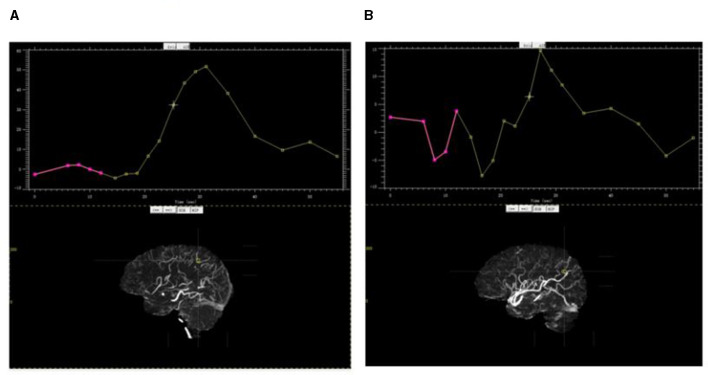
This study included 106 acute ischemic stroke patients with complete large vessel occlusions. In deriving cohort of 23 patients, the parasagittal region of the ischemic hemisphere was divided into six pial arterial zones according to pial branches of the middle cerebral artery. Within the 85 arterial zones with collateral vessels, the receiver operating characteristic analysis was performed to derive the optimal collateral time threshold for fast collateral flow on perfusion computed tomography. The reference for fast collateral flow was the peak contrast delay on the collateral vessels within each ischemic arterial zone compared to its contralateral normal arterial zone on dynamic computed tomography angiography. The optimal perfusion collateral time threshold was then tested in predicting poor clinical outcomes (modified Rankin score of 5-6) and final infarct volume in the validation cohort of 83 patients.
For the derivation cohort of 85 arterial zones, the optimal collateral time threshold for fast collateral flow on perfusion computed tomography was a delay time of 4.04 s [area under the curve = 0.78 (0.67, 0.89), sensitivity = 73%, and specificity = 77%]. Therefore, the delay time of 4 s was used to define the perfusion collateral time. In the validation cohort, the perfusion collateral time showed a slightly higher predicting power than dynamic computed tomography angiography collateral time in poor clinical outcomes (area under the curve = 0.72 vs. 0.67; < 0.001). Compared to dynamic computed tomography angiography collateral time, the perfusion collateral time also had better performance in predicting final infarct volume (R-squared values = 0.55 vs. 0.23; < 0.001).
Our results indicate that perfusion computed tomography can accurately quantify the collateral time after acute ischemic stroke.
良好的侧支循环被认为可维持灌注,并有助于急性缺血性卒中取得良好的临床结局。本研究旨在推导并验证急性缺血性卒中患者灌注计算机断层扫描成像上的最佳侧支循环时间测量方法。
本研究纳入106例存在大血管完全闭塞的急性缺血性卒中患者。在由23例患者组成的推导队列中,根据大脑中动脉的软脑膜分支,将缺血半球的矢状旁区分为6个软脑膜动脉区。在85个存在侧支血管的动脉区中,进行受试者工作特征分析,以推导灌注计算机断层扫描上快速侧支循环的最佳侧支循环时间阈值。快速侧支循环的参考标准是动态计算机断层血管造影上每个缺血动脉区内侧支血管与对侧正常动脉区相比的对比剂峰值延迟。然后在由83例患者组成的验证队列中,测试最佳灌注侧支循环时间阈值预测不良临床结局(改良Rankin量表评分5 - 6分)和最终梗死体积的能力。
对于85个动脉区的推导队列,灌注计算机断层扫描上快速侧支循环的最佳侧支循环时间阈值为延迟时间4.04秒[曲线下面积 = 0.78(0.67,0.89),灵敏度 = 73%,特异度 = 77%]。因此,4秒的延迟时间用于定义灌注侧支循环时间。在验证队列中,灌注侧支循环时间在预测不良临床结局方面显示出比动态计算机断层血管造影侧支循环时间略高的预测能力(曲线下面积 = 0.72对0.67;P < 0.001)。与动态计算机断层血管造影侧支循环时间相比,灌注侧支循环时间在预测最终梗死体积方面也具有更好的性能(决定系数值 = 0.55对0.23;P < 0.001)。
我们的结果表明,灌注计算机断层扫描能够准确量化急性缺血性卒中后的侧支循环时间。