Nagot Nicolas, Binh Nguyen Thanh, Hong Tran Thi, Vinh Vu Hai, Quillet Catherine, Vallo Roselyne, Huong Duong Thi, Hai Oanh Khuat Thi, Thanh Nham Thi Tuyet, Rapoud Delphine, Quynh Bach Thi Nhu, Nguyen Duc Quang, Feelemyer Jonathan, Michel Laurent, Vickerman Peter, Fraser Hannah, Weiss Laurence, Lemoine Maud, Lacombe Karine, Des Jarlais Don, Khue Pham Minh, Moles Jean Pierre, Laureillard Didier
Pathogenesis and Control of Chronic and Emerging Infections, Université de Montpellier, Inserm, Etablissement Français du Sang, Montpellier, France.
Faculty of Public Health, Hai Phong University of Medicine and Pharmacy, Hai Phong, Vietnam.
Lancet Reg Health West Pac. 2023 May 27;37:100801. doi: 10.1016/j.lanwpc.2023.100801. eCollection 2023 Aug.
Towards hepatitis C elimination among people who inject drugs (PWID), we assessed the effectiveness of a strategy consisting of a community-based respondent-driven sampling (RDS) as wide screening, a simplified and integrated hospital-based care, and prevention of reinfection supported by community-based organisations (CBO), in Hai Phong, Vietnam.
Adults who injected heroin were enrolled in a RDS survey implemented in two CBO premises. Rapid HIV and HCV tests were done on site, and blood was taken for HCV RNA testing. Those with detectable HCV RNA were referred with CBO support to three public hospitals for 12-week sofosbuvir/daclatasvir, plus ribavirin for patients with cirrhosis. Participants were followed-up 12 weeks post-treatment (SVR12) and 48 weeks after enrolment. The primary endpoint was the rate of undetectable HCV RNA participants at 48 weeks.
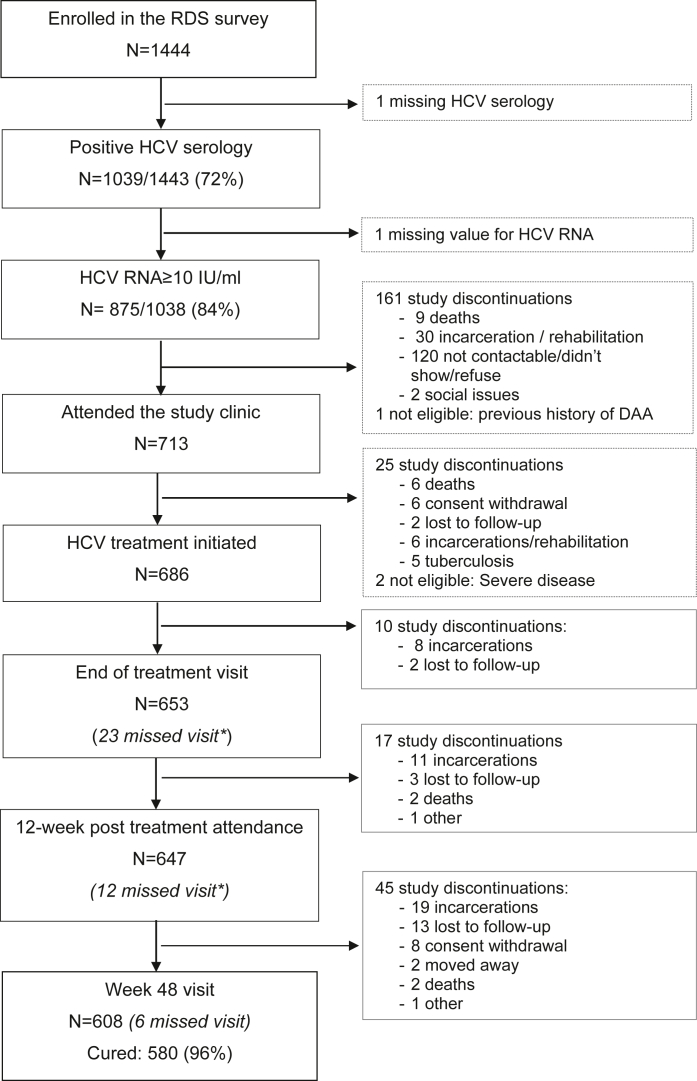
Among the 1444 RDS survey participants, 875 had hepatitis C. Their median age was 41 years (IQR 36-47), 96% were males, 36% were HIV-coinfected. Overall, 686 (78.4%) started sofosbuvir/daclatasvirs, and 629 of the 647 (97.2%) patients tested at SVR12 were cured. At week 48 (581/608) 95.6% had undetectable HCV RNA, representing 66.4% of all PWID identified with hepatitis C. The reinfection rate after SVR12 was 4/100 person-years (95% CI: 2-7).
Our strategy, involving CBO and addressing all steps from wide HCV screening to prevention of reinfection, stands as a promising approach to eliminate HCV among PWID in low and middle-income countries.
France ANRS|MIE (#ANRS12380). The RDS survey was implemented with grants from the NIDA (#R01DA041978) and ANRS|MIE (#ANRS12353).
为了在注射吸毒者(PWID)中消除丙型肝炎,我们在越南海防市评估了一项策略的有效性,该策略包括以社区为基础的应答驱动抽样(RDS)进行广泛筛查、简化和综合的医院护理以及由社区组织(CBO)支持的预防再感染。
注射海洛因的成年人参加了在两个CBO场所实施的RDS调查。现场进行快速艾滋病毒和丙型肝炎病毒检测,并采集血液进行丙型肝炎病毒RNA检测。丙型肝炎病毒RNA检测呈阳性的患者在CBO的支持下被转诊至三家公立医院,接受为期12周的索磷布韦/达卡他韦治疗,肝硬化患者加用利巴韦林。对参与者进行治疗后12周(SVR12)和入组后48周的随访。主要终点是48周时丙型肝炎病毒RNA检测不到的参与者比例。
在1444名RDS调查参与者中,875人患有丙型肝炎。他们的中位年龄为41岁(四分位间距36 - 47岁),96%为男性,36%合并感染艾滋病毒。总体而言,686人(78.4%)开始使用索磷布韦/达卡他韦治疗,在SVR12检测的647名患者中有629人(97.2%)治愈。在第48周时(581/608),95.6%的患者丙型肝炎病毒RNA检测不到,占所有确诊丙型肝炎的PWID的66.4%。SVR12后的再感染率为4/100人年(95%置信区间:2 - 7)。
我们的策略涉及CBO,并涵盖从广泛的丙型肝炎病毒筛查到预防再感染的所有步骤,是在低收入和中等收入国家的PWID中消除丙型肝炎的一种有前景的方法。
法国国家艾滋病研究机构|MIE(#ANRS12380)。RDS调查由美国国立药物滥用研究所(#R01DA041978)和法国国家艾滋病研究机构|MIE(#ANRS12353)的资助实施。