Jiang Xianan, Su Hui, Jiang Jonathan H, Neelin J David, Wu Longtao, Tsushima Yoko, Elsaesser Gregory
Joint Institute for Regional Earth System Science and Engineering, University of California, Los Angeles, Los Angeles, CA, USA.
Jet Propulsion Laboratory, California Institute of Technology, Pasadena, CA, USA.
Nat Commun. 2023 Sep 11;14(1):5586. doi: 10.1038/s41467-023-41360-0.
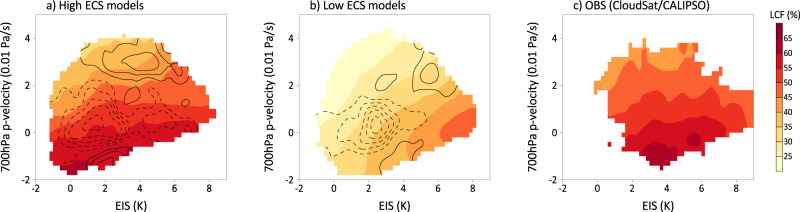
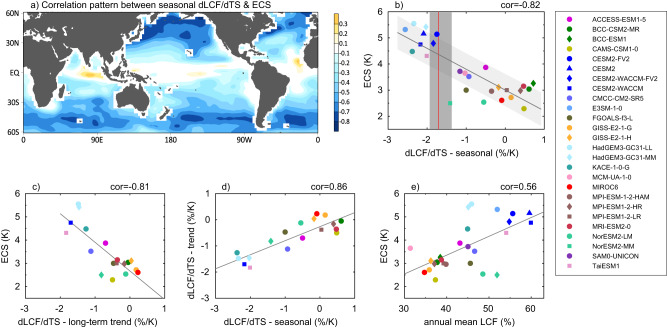
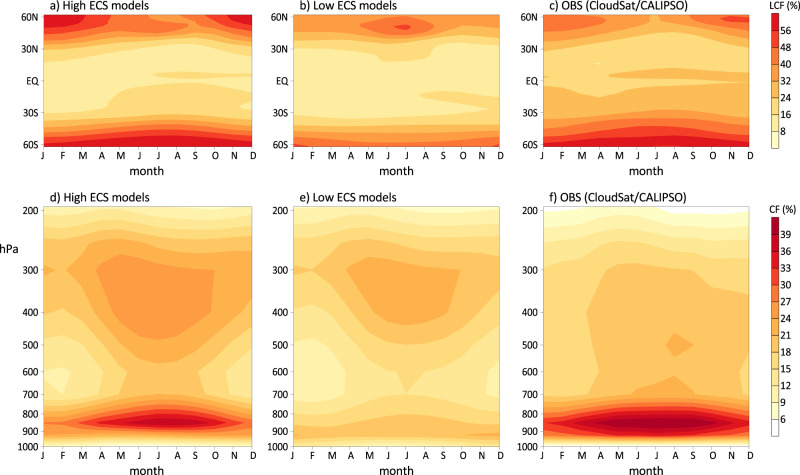
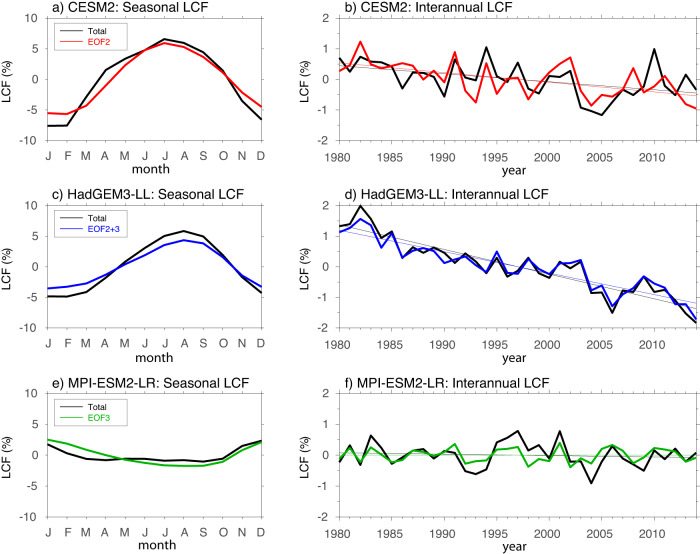
A large spread in model estimates of the equilibrium climate sensitivity (ECS), defined as the global mean near-surface air-temperature increase following a doubling of atmospheric CO concentration, leaves us greatly disadvantaged in guiding policy-making for climate change adaptation and mitigation. In this study, we show that the projected ECS in the latest generation of climate models is highly related to seasonal variations of extratropical low-cloud fraction (LCF) in historical simulations. Marked reduction of extratropical LCF from winter to summer is found in models with ECS > 4.75 K, in accordance with the significant reduction of extratropical LCF under a warming climate in these models. In contrast, a pronounced seasonal cycle of extratropical LCF, as supported by satellite observations, is largely absent in models with ECS < 3.3 K. The distinct seasonality in extratropical LCF in climate models is ascribed to their different prevailing cloud regimes governing the extratropical LCF variability.
平衡气候敏感度(ECS)的模型估计值存在很大差异,ECS定义为大气CO浓度翻倍后全球近地表空气温度的升高,这使我们在指导气候变化适应和缓解的政策制定方面处于极为不利的地位。在本研究中,我们表明,最新一代气候模型中预测的ECS与历史模拟中温带低云分数(LCF)的季节变化高度相关。在ECS>4.75 K的模型中,发现从冬季到夏季温带LCF显著减少,这与这些模型中气候变暖下温带LCF的显著减少一致。相反,在ECS<3.3 K的模型中,卫星观测所支持的温带LCF明显的季节周期在很大程度上并不存在。气候模型中温带LCF明显的季节性归因于控制温带LCF变率的不同主要云态。