Wollesen Bettina, Schott Nadja, Klotzbier Thomas, Bischoff Laura Luise, Cordes Thomas, Rudisch Julian, Otto Ann-Kathrin, Zwingmann Katharina, Hildebrand Claudia, Joellenbeck Thomas, Vogt Lutz, Schoene Daniel, Weigelt Matthias, Voelcker-Rehage Claudia
Department of Human Movement Science, University of Hamburg, Turmweg 2, 20148, Hamburg, Germany.
Department of Sports and Movement Science, University of Stuttgart, Stuttgart, Germany.
Eur Rev Aging Phys Act. 2023 Sep 11;20(1):17. doi: 10.1186/s11556-023-00327-2.
Interdependencies of health, fitness, cognition, and emotion can promote or inhibit mobility. This study aimed to analyse pathways and interactions between individual subjective and objective physical performance, cognition, and emotions with activities of daily living (ADLs) as mobility indicators in multimorbid nursing home residents.
The study included n = 448 (77.1% females, age = 84.1 ± 7.8 years) nursing home residents. To describe the participant's demographics, frailty, number of falls, and participating institutions' socioeconomic status (SES) were assessed. ADLs were measured with the Barthel Index (BI; dependent variable). Independent variables included objective physical performance, subjective physical performance, cognition, and emotions. A structural equation model (SEM) with maximum likelihood estimation was conducted with AMOS. Direct and indirect effects were estimated using standardized coefficients (significance level of 0.05).
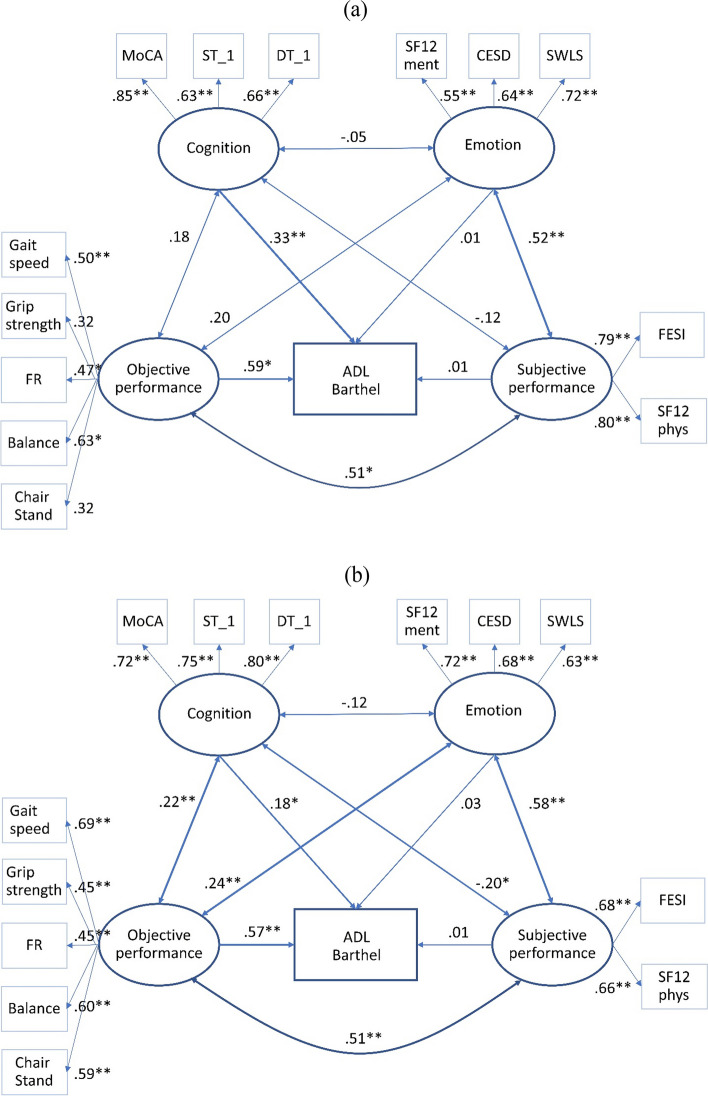
Indices showed (Chi(148) = 217, PCMIN/DF = 1.47; p < .001; Comparative Fit Index = .940; Tucker Lewes Index = .902, RMSEA = .033) that the model fitted the data adequately. While there was no direct association between emotions, subjective physical performance, and ADLs, objective physical performance and cognition predicted higher ADLs (p < .01). Emotions had a strong relationship with subjective physical performance, and cognition had a moderate relationship with objective physical performance.
Objective performance and cognition predicted higher functional status, as expressed by higher BI scores. ADLs, such as mobility, dressing, or handling tasks, require motor and cognitive performance. Subjective performance is an important predictor of ADLs and is only partly explained by objective performance, but to a large extent also by emotions. Therefore, future interventions for nursing home residents should take a holistic approach that focuses not only on promoting objective physical and cognitive performance but also on emotions and perceived physical performance.
Trial registration number: DRKS00014957.
健康、体能、认知和情绪之间的相互依存关系可促进或抑制活动能力。本研究旨在分析多疾病养老院居民中个体主观和客观身体表现、认知及情绪与作为活动能力指标的日常生活活动(ADL)之间的途径和相互作用。
该研究纳入了n = 448名养老院居民(77.1%为女性,年龄 = 84.1 ± 7.8岁)。为描述参与者的人口统计学特征、虚弱程度、跌倒次数以及参与机构的社会经济地位(SES)进行了评估。使用巴氏指数(BI;因变量)测量ADL。自变量包括客观身体表现、主观身体表现、认知和情绪。使用AMOS进行了具有最大似然估计的结构方程模型(SEM)。使用标准化系数估计直接和间接效应(显著性水平为0.05)。
指标显示(卡方(148) = 217,PCMIN/DF = 1.47;p <.001;比较拟合指数 =.940;塔克 - 刘易斯指数 =.902,RMSEA =.033)该模型对数据拟合良好。虽然情绪、主观身体表现和ADL之间没有直接关联,但客观身体表现和认知预测了更高的ADL(p <.01)。情绪与主观身体表现有很强的关系,认知与客观身体表现有中等关系。
如较高的BI分数所示,客观表现和认知预测了更高的功能状态。ADL,如活动能力、穿衣或处理任务,需要运动和认知表现。主观表现是ADL的重要预测因素,部分由客观表现解释,但在很大程度上也由情绪解释。因此,未来针对养老院居民的干预措施应采取整体方法,不仅关注促进客观身体和认知表现,还应关注情绪和感知到的身体表现。
试验注册号:DRKS00014957。