School of Stomatology, Hainan Medical College, Haikou, 571199, China.
Department of Oral and Maxillofacial-Head and Neck Oncology, Shanghai Ninth People's Hospital, Shanghai Jiao Tong University School of Medicine, Shanghai, 200011, China.
BMC Oral Health. 2023 Sep 12;23(1):659. doi: 10.1186/s12903-023-03316-0.
Recently, a systematic review and meta-analysis demonstrated that overexpression of p53 immunoprotein was significantly associated with progression risk of oral potentially malignant disorders (OPMD). However, the results of investigations on TP53 genetic typing in OPMD were inconsistent and inconclusive.
A systematic evaluation was conducted to identify all eligible case-control studies on the association of TP53 codon 72 polymorphism with both onset and progression of OPMD.
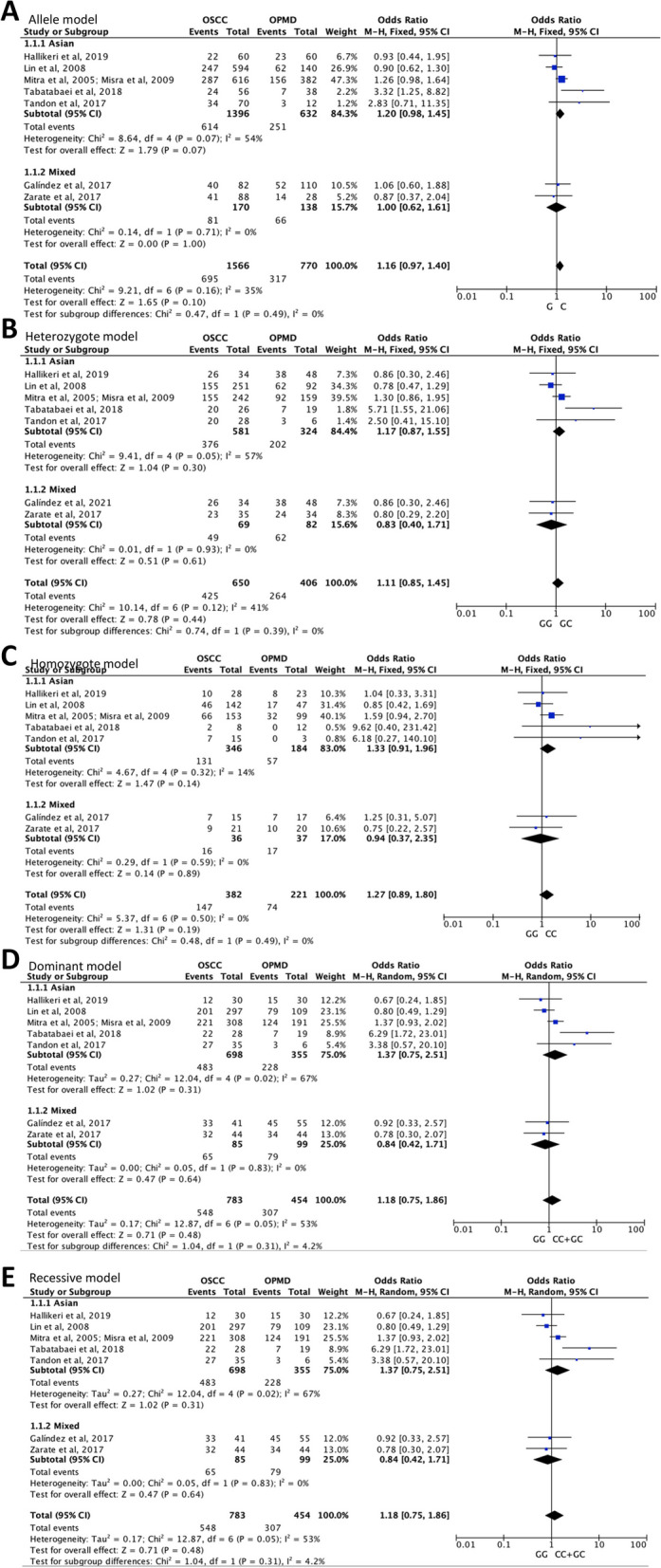
A total of 768 OPMD patients and 1173 healthy individuals were identified from 12 eligible case-control studies on TP53 codon 72 polymorphism OPMD onset. In overall and subgroup analyses, no significantly risk of OPMD onset was observed in the cases for genetic models including allele C vs. G, homozygote CC vs. GG, heterozygote GC vs. GG, dominant GC + CC vs. GG, and recessive CC vs. GG + GC (all P-value of association test > 0.05). Further, a total of 465 OPMD patients and 775 oral squamous cell carcinoma (OSCC) ones were identified from 8 eligible case-control studies on this polymorphism in OPMD progression to OSCC. The analyses revealed that there was also no significantly risk of OPMD progression in the cases for the genetic models (all P-value of association test > 0.05).
Our data of a pooled-analysis indicates that TP53 codon 72 polymorphism may not act as genetic factor for the risk of OPMD onset and progression. Combined with the conclusion by a systematic review and meta-analysis, we put forward a new opinion that TP53 genetic typing cloud not influence p53 protein expression in OPMD.
最近,一项系统评价和荟萃分析表明,p53 免疫蛋白的过度表达与口腔潜在恶性疾病(OPMD)的进展风险显著相关。然而,关于 OPMD 中 TP53 基因分型的研究结果不一致,尚无定论。
进行了系统评价,以确定所有关于 TP53 密码子 72 多态性与 OPMD 发病和进展相关的合格病例对照研究。
从 12 项关于 TP53 密码子 72 多态性 OPMD 发病的合格病例对照研究中,共确定了 768 名 OPMD 患者和 1173 名健康个体。在总体和亚组分析中,未观察到遗传模型包括等位基因 C 与 G、纯合子 CC 与 GG、杂合子 GC 与 GG、显性 GC+CC 与 GG 和隐性 CC 与 GG+GC 中 OPMD 发病的显著风险(所有关联检验 P 值均>0.05)。此外,从 8 项关于该多态性在 OPMD 进展为口腔鳞状细胞癌(OSCC)的合格病例对照研究中,共确定了 465 名 OPMD 患者和 775 名 OSCC 患者。分析表明,遗传模型也未观察到 OPMD 进展的显著风险(所有关联检验 P 值均>0.05)。
我们的荟萃分析数据表明,TP53 密码子 72 多态性可能不是 OPMD 发病和进展的遗传因素。结合系统评价和荟萃分析的结论,我们提出了一个新观点,即 TP53 基因分型不会影响 OPMD 中 p53 蛋白的表达。