Indraprastha Apollo Hospital, New Delhi, India.
DIBIC "L. Sacco", Università degli Studi di Milano, Milano, Italy.
Nephrology (Carlton). 2023 Dec;28(12):672-681. doi: 10.1111/nep.14236. Epub 2023 Sep 11.
This cross-sectional survey aimed to determine the prevalence of Interventional Nephrology (IN) practice amongst nephrologists in the Asia-Pacific Region (APR), specifically related to dialysis access (DA).
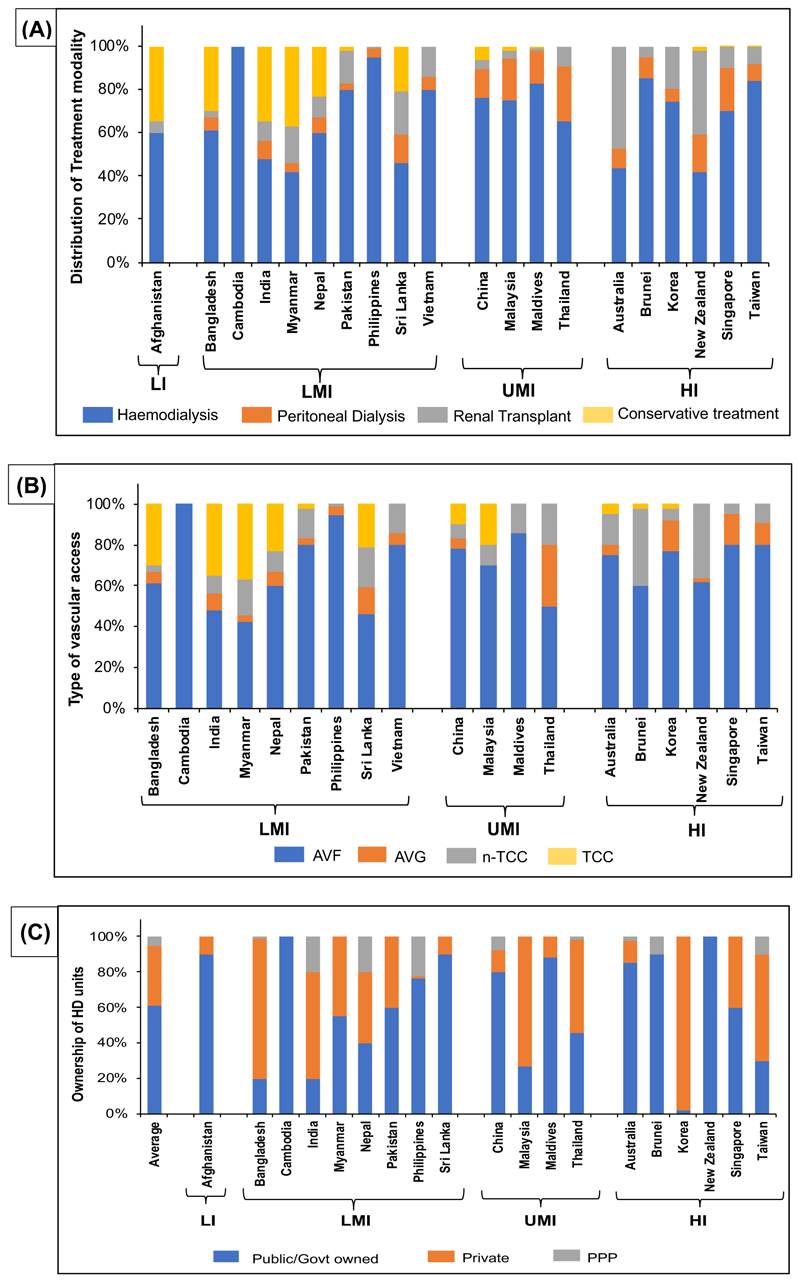
The Association of VA and intervenTionAl Renal physicians (AVATAR) Foundation from India conducted a multinational online survey amongst nephrologists from the Asia-Pacific to determine the practice of IN in the planning, creation, and management of dialysis access. The treatment modalities, manpower and equipment availability, monthly cost of treatment, specifics of dialysis access interventions, and challenges in the training and practice of IN by nephrologists were included in the survey.
Twenty-one countries from the APR participated in the survey. Nephrologists from 18 (85.7%) countries reported performing at least one of the basic dialysis access-related IN procedures, primarily the placement of non-tunnelled central catheters (n-TCC; 71.5%). Only 10 countries (47.6%) reported having an average of <4% of nephrologists performing any of the advanced IN access procedures, the most common being the placement of a peritoneal dialysis (PD) catheter (20%). Lack of formal training (57.14%), time (42.8%), incentive (38%), institutional support (38%), medico-legal protection (28.6%), and prohibitive cost (23.8%) were the main challenges to practice IN. The primary obstacles to implementing the IN training were a lack of funding and skilled personnel.
The practice of dialysis access-related IN in APR is inadequate, mostly due to a lack of training, backup support, and economic constraints, whereas training in access-related IN is constrained by a lack of a skilled workforce and finances.
本横断面调查旨在确定亚太地区(APR)的肾脏病专家中介入肾脏病学(IN)的实践情况,特别是与透析通路(DA)相关的情况。
印度 VA 和介入性肾脏病医师协会(AVATAR)基金会对亚太地区的肾脏病专家进行了一项多国在线调查,以确定 IN 在规划、创建和管理透析通路方面的实践情况。该调查包括治疗方式、人力和设备可用性、每月治疗费用、透析通路干预的具体情况以及肾脏病专家在 IN 培训和实践中面临的挑战。
APR 的 21 个国家参与了这项调查。18 个(85.7%)国家的肾脏病专家报告至少进行了一种基本的与透析通路相关的 IN 程序,主要是放置非隧道中央导管(n-TCC;71.5%)。只有 10 个国家(47.6%)报告平均有<4%的肾脏病专家进行任何高级 IN 通路程序,最常见的是腹膜透析(PD)导管的放置(20%)。缺乏正规培训(57.14%)、时间(42.8%)、激励措施(38%)、机构支持(38%)、医疗法律保护(28.6%)和高昂的费用(23.8%)是实践 IN 的主要挑战。实施 IN 培训的主要障碍是缺乏资金和熟练的人员。
APR 中与透析通路相关的 IN 实践不足,主要是由于缺乏培训、支持和经济限制,而与通路相关的 IN 培训受到缺乏熟练劳动力和资金的限制。