Department of Pharmaceutical Care, Faculty of Pharmacy, Chiang Mai University, Chiang Mai, Thailand.
Pharmacoepidemiology and Statistics Research Center (PESRC), Faculty of Pharmacy, Chiang Mai University, Chiang Mai, Thailand.
PLoS One. 2022 Feb 25;17(2):e0264393. doi: 10.1371/journal.pone.0264393. eCollection 2022.
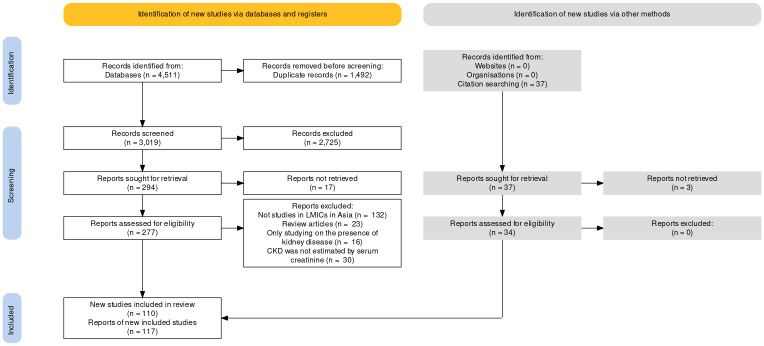
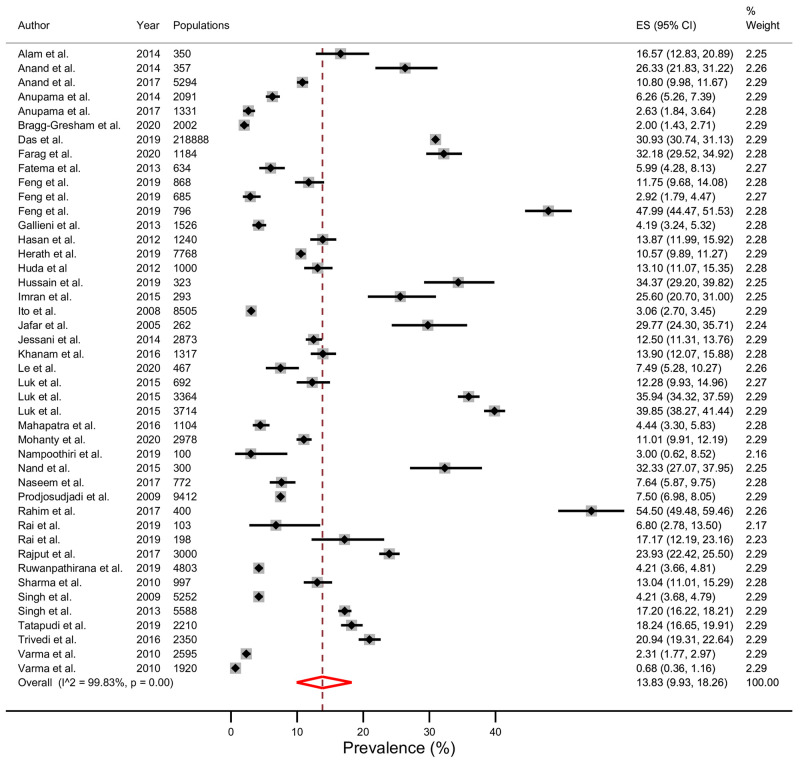
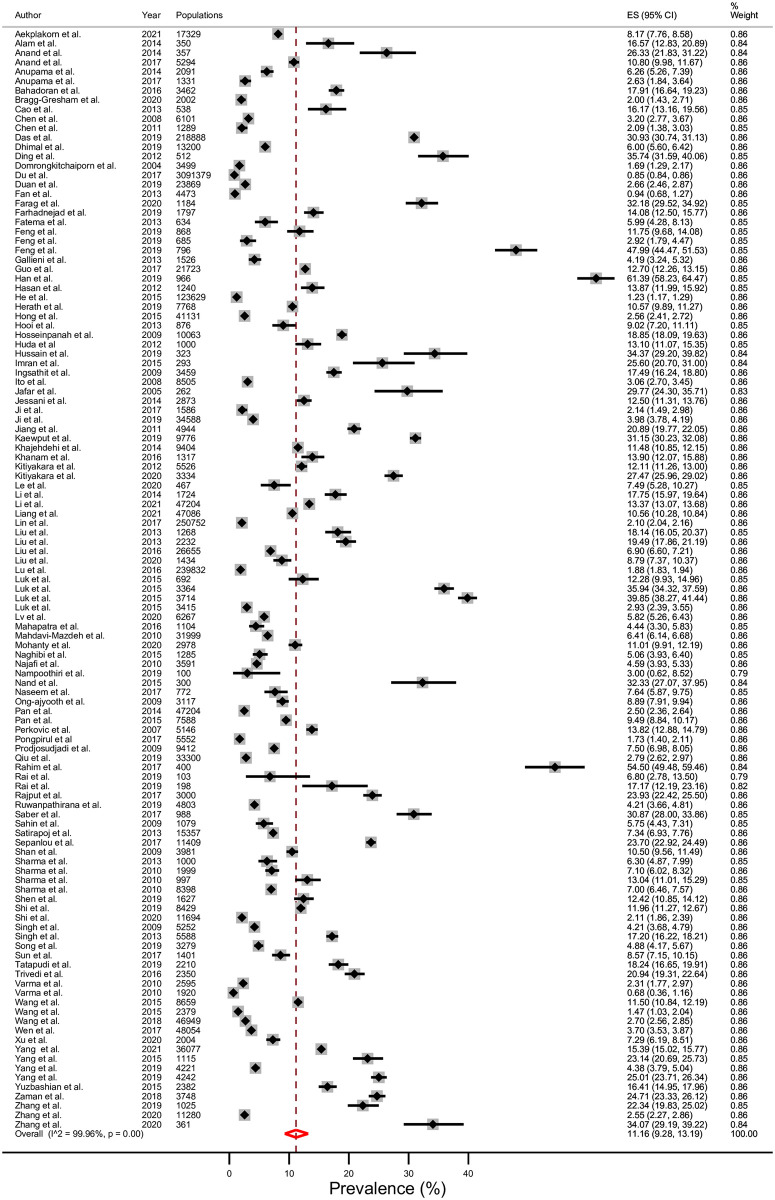
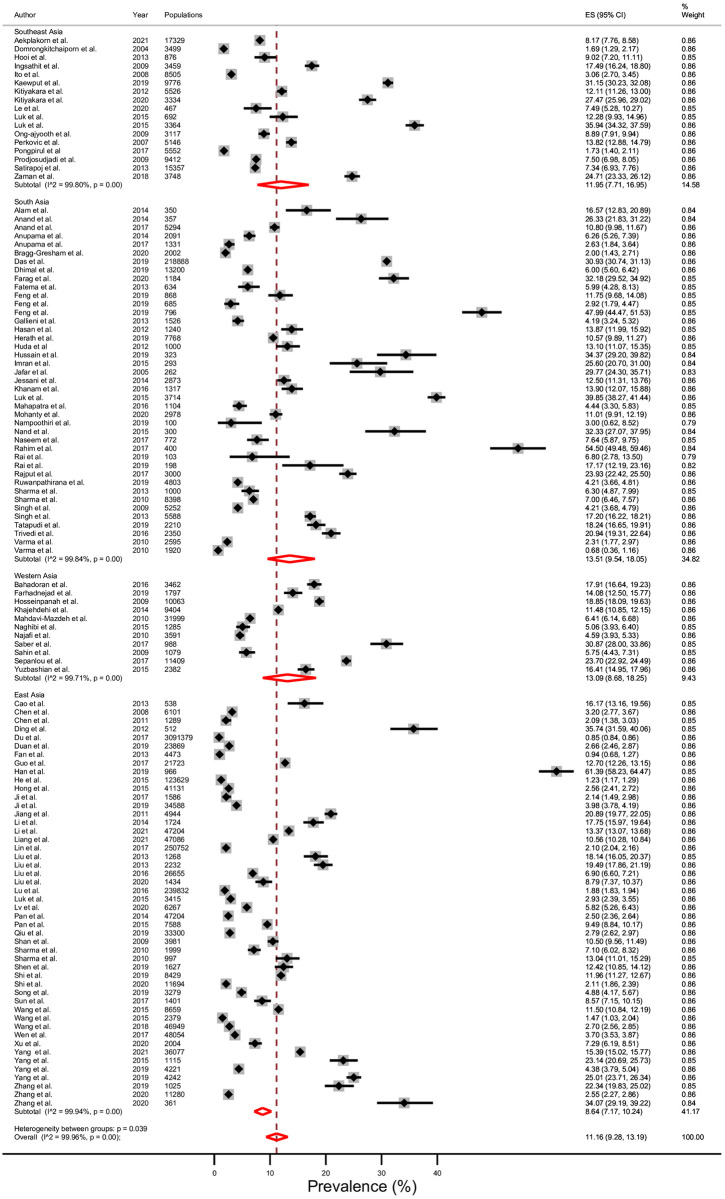
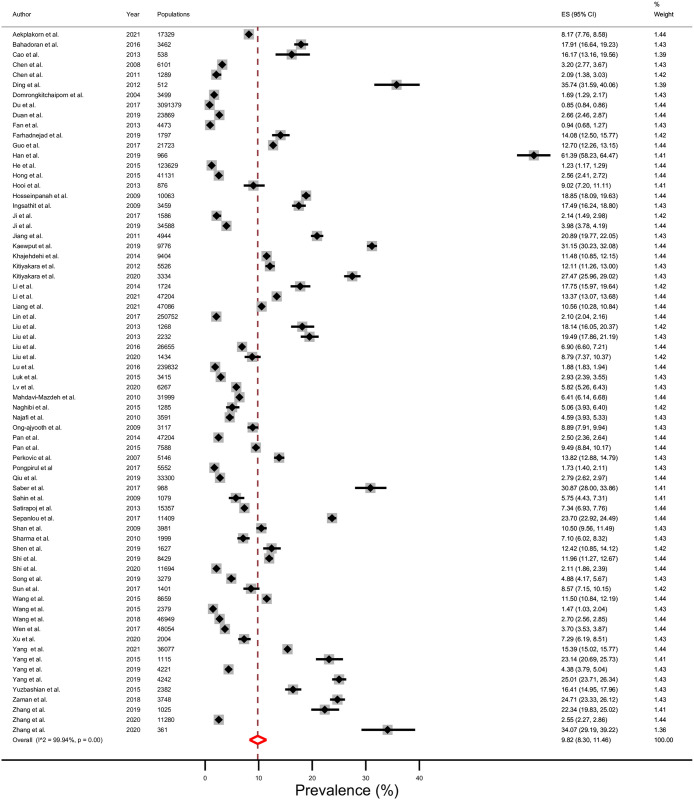
Chronic kidney disease (CKD) is a major public health problem in low- and middle-income countries (LMICs). Although CKD prevalence has been rapidly increasing in LMICs, particularly in Asia, quantitative studies on the current epidemiology of CKD in this region are limited. This study aimed to identify the prevalence of CKD stages 3-5 in LMICs in Asia, by subregion, country economy classification, identification of CKD, traditional and non-traditional risk factors. A systematic review and meta-analysis of observational studies was conducted through a literature search of seven electronic databases and grey literature search published until November 2021. The Newcastle-Ottawa quality assessment scale (NOS) was used to assess the risk of bias of each study. A random-effects model was used to estimate pooled prevalence. The protocol is registered in the International Prospective Register of Systematic Reviews (PROSPERO CRD42019120519). Of 4,548 potentially relevant records, 110 studies with moderate and high quality were included with 4,760,147 subjects. The average prevalence (95% CI) of CKD stages 3-5 in 14 LMICs in Asia was 11.2% (9.3-13.2%). The prevalence of CKD stages 3-5 was varied among subregions and country economic classification. CKD prevalence was 8.6% (7.2-10.2%) in east Asia, 12.0% (7.7-17.0%) in south-east Asia, 13.1% (8.7-18.2%) in western Asia, and 13.5% (9.5-18.0%) in south Asia. CKD prevalence was 9.8% (8.3-11.5%) in upper-middle-income countries and 13.8% (9.9-18.3%) in lower-middle-income countries. Prevalence of CKD stage 3-5 in LMICs in Asia is comparable to global prevalence. High level of heterogeneity was observed. Study of factors and interventions that lead to the delay of CKD progression is needed.
慢性肾脏病(CKD)是中低收入国家(LMICs)的一个主要公共卫生问题。尽管 CKD 在 LMICs 中的患病率迅速上升,特别是在亚洲,但关于该地区 CKD 目前流行病学的定量研究有限。本研究旨在通过亚区、国家经济分类、CKD 识别、传统和非传统危险因素,确定亚洲 LMICs 中 CKD 3-5 期的患病率。通过对截至 2021 年 11 月发表的七个电子数据库和灰色文献的文献检索,进行了观察性研究的系统评价和荟萃分析。使用纽卡斯尔-渥太华质量评估量表(NOS)评估每项研究的偏倚风险。使用随机效应模型估计汇总患病率。该方案已在国际前瞻性系统评价注册库(PROSPERO CRD42019120519)中注册。在 4548 份潜在相关记录中,有 110 项研究具有中高度质量,共纳入 4760147 名受试者。亚洲 14 个 LMICs 中 CKD 3-5 期的平均患病率(95%CI)为 11.2%(9.3-13.2%)。亚区和国家经济分类之间 CKD 患病率存在差异。东亚的 CKD 3-5 期患病率为 8.6%(7.2-10.2%),东南亚为 12.0%(7.7-17.0%),西亚为 13.1%(8.7-18.2%),南亚为 13.5%(9.5-18.0%)。中高收入国家的 CKD 3-5 期患病率为 9.8%(8.3-11.5%),中低收入国家为 13.8%(9.9-18.3%)。亚洲 LMICs 中 CKD 3-5 期的患病率与全球患病率相当。观察到高度的异质性。需要研究导致 CKD 进展延迟的因素和干预措施。