• 文献检索
  • 文档翻译
  • 深度研究
  • 学术资讯
  • Suppr Zotero 插件Zotero 插件
  • 邀请有礼
  • 套餐&价格
  • 历史记录
应用&插件
Suppr Zotero 插件Zotero 插件浏览器插件Mac 客户端Windows 客户端微信小程序
定价
高级版会员购买积分包购买API积分包
服务
文献检索文档翻译深度研究API 文档MCP 服务
关于我们
关于 Suppr公司介绍联系我们用户协议隐私条款
关注我们

Suppr 超能文献

核心技术专利:CN118964589B侵权必究
粤ICP备2023148730 号-1Suppr @ 2026

文献检索

告别复杂PubMed语法,用中文像聊天一样搜索,搜遍4000万医学文献。AI智能推荐,让科研检索更轻松。

立即免费搜索

文件翻译

保留排版,准确专业,支持PDF/Word/PPT等文件格式,支持 12+语言互译。

免费翻译文档

深度研究

AI帮你快速写综述,25分钟生成高质量综述,智能提取关键信息,辅助科研写作。

立即免费体验

利用综合分析数据集开发预测黏度和小鼠清除率的计算模型,该数据集涵盖了 83 种支架一致的单克隆抗体。

Development of in silico models to predict viscosity and mouse clearance using a comprehensive analytical data set collected on 83 scaffold-consistent monoclonal antibodies.

机构信息

Biologic Therapeutic Discovery, Amgen Research, Thousand Oaks, CA, USA.

Process Development, Amgen Operations, Thousand Oaks, CA, USA.

出版信息

MAbs. 2023 Jan-Dec;15(1):2256745. doi: 10.1080/19420862.2023.2256745.

DOI:10.1080/19420862.2023.2256745
PMID:37698932
原文链接:https://pmc.ncbi.nlm.nih.gov/articles/PMC10498806/
Abstract

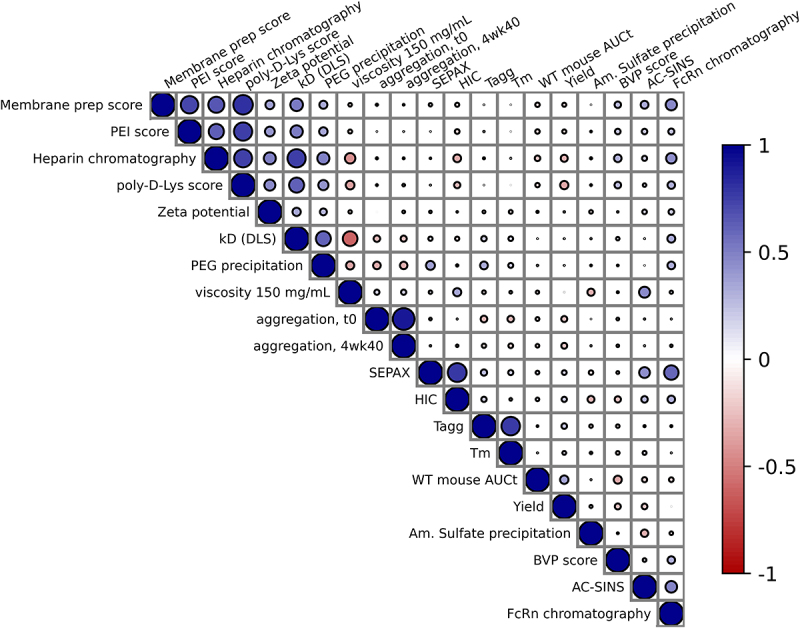
Biologic drug discovery pipelines are designed to deliver protein therapeutics that have exquisite functional potency and selectivity while also manifesting biophysical characteristics suitable for manufacturing, storage, and convenient administration to patients. The ability to use computational methods to predict biophysical properties from protein sequence, potentially in combination with high throughput assays, could decrease timelines and increase the success rates for therapeutic developability engineering by eliminating lengthy and expensive cycles of recombinant protein production and testing. To support development of high-quality predictive models for antibody developability, we designed a sequence-diverse panel of 83 effector functionless IgG1 antibodies displaying a range of biophysical properties, produced and formulated each protein under standard platform conditions, and collected a comprehensive package of analytical data, including in vitro assays and in vivo mouse pharmacokinetics. We used this robust training data set to build machine learning classifier models that can predict complex protein behavior from these data and features derived from predicted and/or experimental structures. Our models predict with 87% accuracy whether viscosity at 150 mg/mL is above or below a threshold of 15 centipoise (cP) and with 75% accuracy whether the area under the plasma drug concentration-time curve (AUC) in normal mouse is above or below a threshold of 3.9 × 10 h x ng/mL.

摘要

生物药物发现管道旨在提供具有精细功能效力和选择性的蛋白质治疗药物,同时还表现出适合制造、储存和方便患者给药的物理特性。能够使用计算方法从蛋白质序列预测物理特性,可能与高通量测定法结合使用,通过消除冗长和昂贵的重组蛋白生产和测试周期,缩短时间线并提高治疗可开发性工程的成功率。为了支持开发高质量的抗体可开发性预测模型,我们设计了一个由 83 种具有不同序列的效应功能缺失 IgG1 抗体组成的面板,这些抗体展示了一系列物理特性,在标准平台条件下生产和配制每种蛋白质,并收集了全面的分析数据,包括体外测定法和体内小鼠药代动力学。我们使用这个强大的训练数据集来构建机器学习分类器模型,这些模型可以根据这些数据以及从预测和/或实验结构中得出的特征来预测复杂的蛋白质行为。我们的模型以 87%的准确度预测 150mg/mL 时的粘度是否高于或低于 15 厘泊(cP)的阈值,以 75%的准确度预测正常小鼠中的血浆药物浓度-时间曲线下面积(AUC)是否高于或低于 3.9×10 h x ng/mL 的阈值。
https://cdn.ncbi.nlm.nih.gov/pmc/blobs/2089/10498806/9876cbf6541e/KMAB_A_2256745_F0003_B.jpg
https://cdn.ncbi.nlm.nih.gov/pmc/blobs/2089/10498806/53168d6c5af7/KMAB_A_2256745_F0001_OC.jpg
https://cdn.ncbi.nlm.nih.gov/pmc/blobs/2089/10498806/38d64878240b/KMAB_A_2256745_F0002_OC.jpg
https://cdn.ncbi.nlm.nih.gov/pmc/blobs/2089/10498806/9876cbf6541e/KMAB_A_2256745_F0003_B.jpg
https://cdn.ncbi.nlm.nih.gov/pmc/blobs/2089/10498806/53168d6c5af7/KMAB_A_2256745_F0001_OC.jpg
https://cdn.ncbi.nlm.nih.gov/pmc/blobs/2089/10498806/38d64878240b/KMAB_A_2256745_F0002_OC.jpg
https://cdn.ncbi.nlm.nih.gov/pmc/blobs/2089/10498806/9876cbf6541e/KMAB_A_2256745_F0003_B.jpg

相似文献

1
Development of in silico models to predict viscosity and mouse clearance using a comprehensive analytical data set collected on 83 scaffold-consistent monoclonal antibodies.利用综合分析数据集开发预测黏度和小鼠清除率的计算模型,该数据集涵盖了 83 种支架一致的单克隆抗体。
MAbs. 2023 Jan-Dec;15(1):2256745. doi: 10.1080/19420862.2023.2256745.
2
In vitro and in silico assessment of the developability of a designed monoclonal antibody library.体外和计算评估设计的单克隆抗体文库的可开发性。
MAbs. 2019 Feb/Mar;11(2):388-400. doi: 10.1080/19420862.2018.1556082. Epub 2019 Jan 18.
3
Differences in human IgG1 and IgG4 S228P monoclonal antibodies viscosity and self-interactions: Experimental assessment and computational predictions of domain interactions.人源 IgG1 和 IgG4 S228P 单克隆抗体的黏度和自身相互作用的差异:结构域相互作用的实验评估和计算预测。
MAbs. 2021 Jan-Dec;13(1):1991256. doi: 10.1080/19420862.2021.1991256.
4
Developability Assessment of Engineered Monoclonal Antibody Variants with a Complex Self-Association Behavior Using Complementary Analytical and in Silico Tools.使用互补分析和计算工具评估具有复杂自聚集行为的工程单克隆抗体变体的可开发性。
Mol Pharm. 2018 Dec 3;15(12):5697-5710. doi: 10.1021/acs.molpharmaceut.8b00867. Epub 2018 Nov 15.
5
In-silico prediction of concentration-dependent viscosity curves for monoclonal antibody solutions.单克隆抗体溶液浓度依赖性粘度曲线的计算机模拟预测
MAbs. 2017 Apr;9(3):476-489. doi: 10.1080/19420862.2017.1285479. Epub 2017 Jan 26.
6
Assessment of Therapeutic Antibody Developability by Combinations of In Vitro and In Silico Methods.通过体外和计算方法的组合评估治疗性抗体的可开发性。
Methods Mol Biol. 2022;2313:57-113. doi: 10.1007/978-1-0716-1450-1_4.
7
Current advances in biopharmaceutical informatics: guidelines, impact and challenges in the computational developability assessment of antibody therapeutics.生物制药信息学的最新进展:抗体治疗药物计算可开发性评估中的指南、影响和挑战。
MAbs. 2022 Jan-Dec;14(1):2020082. doi: 10.1080/19420862.2021.2020082.
8
Reduction of monoclonal antibody viscosity using interpretable machine learning.使用可解释机器学习降低单克隆抗体黏度。
MAbs. 2024 Jan-Dec;16(1):2303781. doi: 10.1080/19420862.2024.2303781. Epub 2024 Mar 12.
9
Machine learning prediction of antibody aggregation and viscosity for high concentration formulation development of protein therapeutics.机器学习预测抗体聚集和粘度,用于蛋白质治疗药物高浓度制剂的开发。
MAbs. 2022 Jan-Dec;14(1):2026208. doi: 10.1080/19420862.2022.2026208.
10
Holistic in silico developability assessment of novel classes of small proteins using publicly available sequence-based predictors.利用公开的基于序列的预测器对新型小分子蛋白进行整体计算可开发性评估。
J Comput Aided Mol Des. 2024 Aug 20;38(1):30. doi: 10.1007/s10822-024-00569-x.

引用本文的文献

1
Mechanistic and predictive formulation development for viscosity mitigation of high-concentration biotherapeutics.高浓度生物治疗药物粘度降低的机理和预测配方开发。
MAbs. 2025 Dec;17(1):2550757. doi: 10.1080/19420862.2025.2550757. Epub 2025 Sep 15.
2
Optimizing colloidal stability and viscosity of multispecific antibodies at the drug discovery-development interface: a systematic predictive case study.在药物发现与开发界面优化多特异性抗体的胶体稳定性和粘度:一项系统预测性案例研究
MAbs. 2025 Dec;17(1):2553622. doi: 10.1080/19420862.2025.2553622. Epub 2025 Sep 1.
3
Accelerating high-concentration monoclonal antibody development with large-scale viscosity data and ensemble deep learning.

本文引用的文献

1
Improved antibody pharmacokinetics by disruption of contiguous positive surface potential and charge reduction using alternate human framework.通过破坏连续的正表面电势和使用交替的人框架减少电荷来改善抗体药代动力学。
MAbs. 2023 Jan-Dec;15(1):2232087. doi: 10.1080/19420862.2023.2232087.
2
Low-data interpretable deep learning prediction of antibody viscosity using a biophysically meaningful representation.使用具有物理意义的表示方法进行低数据可解释的深度学习预测抗体黏度。
Sci Rep. 2023 Feb 20;13(1):2917. doi: 10.1038/s41598-023-28841-4.
3
Application of a Simple Short-Range Attraction and Long-Range Repulsion Colloidal Model toward Predicting the Viscosity of Protein Solutions.
利用大规模粘度数据和集成深度学习加速高浓度单克隆抗体开发
MAbs. 2025 Dec;17(1):2483944. doi: 10.1080/19420862.2025.2483944. Epub 2025 Apr 1.
4
PROPERMAB: an integrative framework for prediction of antibody developability using machine learning.PROPERMAB:一种使用机器学习预测抗体可开发性的综合框架。
MAbs. 2025 Dec;17(1):2474521. doi: 10.1080/19420862.2025.2474521. Epub 2025 Mar 5.
5
Predicting purification process fit of monoclonal antibodies using machine learning.使用机器学习预测单克隆抗体的纯化工艺适配性。
MAbs. 2025 Dec;17(1):2439988. doi: 10.1080/19420862.2024.2439988. Epub 2025 Jan 9.
6
Reconciling predicted and measured viscosity parameters in high concentration therapeutic antibody solutions.调和高浓度治疗性抗体溶液中预测粘度参数与实测粘度参数
MAbs. 2024 Jan-Dec;16(1):2438172. doi: 10.1080/19420862.2024.2438172. Epub 2024 Dec 11.
7
A comparative study of the developability of full-length antibodies, fragments, and bispecific formats reveals higher stability risks for engineered constructs.全长抗体、片段和双特异性形式的可开发性比较研究表明,工程构建体的稳定性风险更高。
MAbs. 2024 Jan-Dec;16(1):2403156. doi: 10.1080/19420862.2024.2403156. Epub 2024 Oct 4.
8
Holistic in silico developability assessment of novel classes of small proteins using publicly available sequence-based predictors.利用公开的基于序列的预测器对新型小分子蛋白进行整体计算可开发性评估。
J Comput Aided Mol Des. 2024 Aug 20;38(1):30. doi: 10.1007/s10822-024-00569-x.
9
Assessment and incorporation of in vitro correlates to pharmacokinetic outcomes in antibody developability workflows.评估和整合体外相关性以获得抗体可开发性工作流程中的药代动力学结果。
MAbs. 2024 Jan-Dec;16(1):2384104. doi: 10.1080/19420862.2024.2384104. Epub 2024 Jul 31.
10
Stability of Protein Pharmaceuticals: Recent Advances.蛋白质类药物的稳定性:最新进展
Pharm Res. 2024 Jul;41(7):1301-1367. doi: 10.1007/s11095-024-03726-x. Epub 2024 Jun 27.
简单短程吸引和长程排斥胶体模型在预测蛋白质溶液黏度中的应用。
Mol Pharm. 2022 Nov 7;19(11):4233-4240. doi: 10.1021/acs.molpharmaceut.2c00582. Epub 2022 Sep 21.
4
Physiologically Based Modeling to Predict Monoclonal Antibody Pharmacokinetics in Humans from in vitro Physiochemical Properties.基于生理学的模型预测单克隆抗体在人体内的药代动力学特性来自于体外的物理化学性质。
MAbs. 2022 Jan-Dec;14(1):2056944. doi: 10.1080/19420862.2022.2056944.
5
Progress and challenges for the machine learning-based design of fit-for-purpose monoclonal antibodies.基于机器学习的定制化单克隆抗体设计的进展与挑战。
MAbs. 2022 Jan-Dec;14(1):2008790. doi: 10.1080/19420862.2021.2008790.
6
Antibody structure prediction using interpretable deep learning.使用可解释深度学习进行抗体结构预测。
Patterns (N Y). 2021 Dec 9;3(2):100406. doi: 10.1016/j.patter.2021.100406. eCollection 2022 Feb 11.
7
Machine learning prediction of antibody aggregation and viscosity for high concentration formulation development of protein therapeutics.机器学习预测抗体聚集和粘度,用于蛋白质治疗药物高浓度制剂的开发。
MAbs. 2022 Jan-Dec;14(1):2026208. doi: 10.1080/19420862.2022.2026208.
8
In silico prediction of post-translational modifications in therapeutic antibodies.治疗性抗体中翻译后修饰的计算预测。
MAbs. 2022 Jan-Dec;14(1):2023938. doi: 10.1080/19420862.2021.2023938.
9
Effect of variable domain charge on in vitro and in vivo disposition of monoclonal antibodies.可变域电荷对单克隆抗体体内外分布的影响。
MAbs. 2021 Jan-Dec;13(1):1993769. doi: 10.1080/19420862.2021.1993769.
10
Identifying biophysical assays and properties that enrich for slow clearance in clinical-stage therapeutic antibodies.鉴定具有临床阶段治疗性抗体慢清除特征的生物物理分析方法和特性。
MAbs. 2021 Jan-Dec;13(1):1932230. doi: 10.1080/19420862.2021.1932230.