Department of Immunology, University of Oslo and Oslo University Hospital, Oslo, Norway.
School of Life Sciences, University of Warwick, Coventry, UK.
MAbs. 2022 Jan-Dec;14(1):2008790. doi: 10.1080/19420862.2021.2008790.
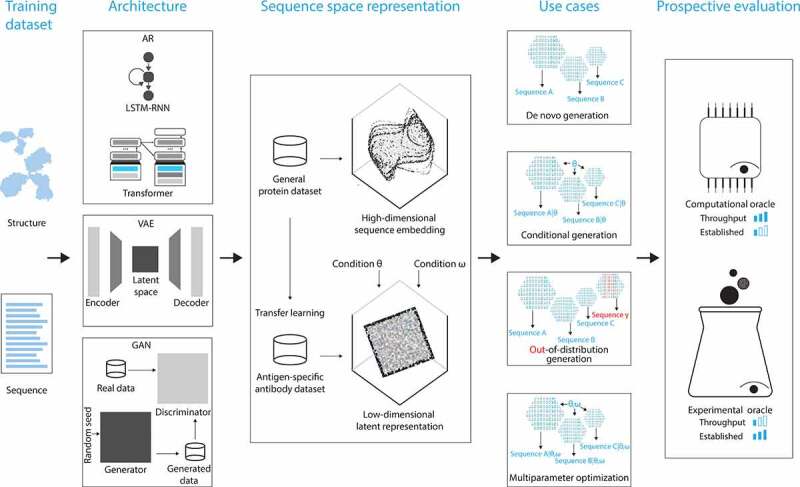
Although the therapeutic efficacy and commercial success of monoclonal antibodies (mAbs) are tremendous, the design and discovery of new candidates remain a time and cost-intensive endeavor. In this regard, progress in the generation of data describing antigen binding and developability, computational methodology, and artificial intelligence may pave the way for a new era of on-demand immunotherapeutics design and discovery. Here, we argue that the main necessary machine learning (ML) components for an mAb sequence generator are: understanding of the rules of mAb-antigen binding, capacity to modularly combine mAb design parameters, and algorithms for unconstrained parameter-driven mAb sequence synthesis. We review the current progress toward the realization of these necessary components and discuss the challenges that must be overcome to allow the on-demand ML-based discovery and design of fit-for-purpose mAb therapeutic candidates.
尽管单克隆抗体 (mAbs) 的治疗效果和商业成功是巨大的,但新候选物的设计和发现仍然是一项耗时且昂贵的工作。在这方面,描述抗原结合和可开发性的数据生成、计算方法和人工智能方面的进展可能为按需免疫疗法设计和发现的新时代铺平道路。在这里,我们认为用于 mAb 序列生成的主要必要机器学习 (ML) 组件是:对 mAb-抗原结合规则的理解、能够模块化地组合 mAb 设计参数,以及用于无约束参数驱动的 mAb 序列合成的算法。我们回顾了实现这些必要组件的当前进展,并讨论了必须克服的挑战,以便能够按需基于 ML 进行发现和设计适合用途的 mAb 治疗候选物。