
使用可解释深度学习进行抗体结构预测。
Antibody structure prediction using interpretable deep learning.
作者信息
Ruffolo Jeffrey A, Sulam Jeremias, Gray Jeffrey J
机构信息
Program in Molecular Biophysics, The Johns Hopkins University, Baltimore, MD 21218, USA.
Department of Biomedical Engineering, The Johns Hopkins University, Baltimore, MD 21218, USA.
出版信息
Patterns (N Y). 2021 Dec 9;3(2):100406. doi: 10.1016/j.patter.2021.100406. eCollection 2022 Feb 11.
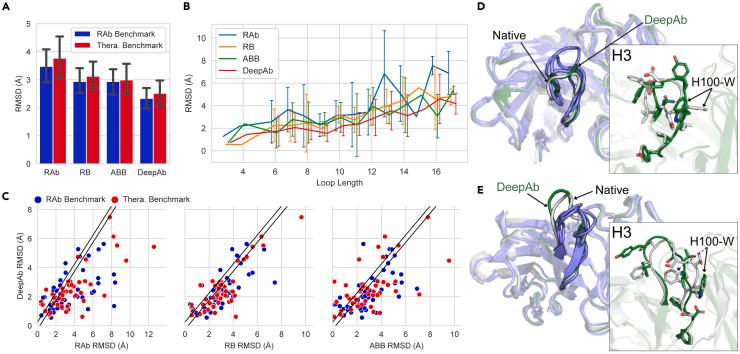
Therapeutic antibodies make up a rapidly growing segment of the biologics market. However, rational design of antibodies is hindered by reliance on experimental methods for determining antibody structures. Here, we present DeepAb, a deep learning method for predicting accurate antibody F structures from sequence. We evaluate DeepAb on a set of structurally diverse, therapeutically relevant antibodies and find that our method consistently outperforms the leading alternatives. Previous deep learning methods have operated as "black boxes" and offered few insights into their predictions. By introducing a directly interpretable attention mechanism, we show our network attends to physically important residue pairs (e.g., proximal aromatics and key hydrogen bonding interactions). Finally, we present a novel mutant scoring metric derived from network confidence and show that for a particular antibody, all eight of the top-ranked mutations improve binding affinity. This model will be useful for a broad range of antibody prediction and design tasks.
治疗性抗体在生物制品市场中所占份额正在迅速增长。然而,抗体的合理设计受到依赖实验方法来确定抗体结构的阻碍。在此,我们展示了DeepAb,一种用于从序列预测准确抗体F结构的深度学习方法。我们在一组结构多样、具有治疗相关性的抗体上评估了DeepAb,发现我们的方法始终优于主要的替代方法。以前的深度学习方法就像“黑匣子”一样运行,对其预测几乎没有提供什么见解。通过引入一种直接可解释的注意力机制,我们表明我们的网络关注物理上重要的残基对(例如,近端芳香族基团和关键氢键相互作用)。最后,我们提出了一种从网络置信度导出的新型突变评分指标,并表明对于一种特定抗体,排名前八位的所有突变都提高了结合亲和力。该模型将对广泛的抗体预测和设计任务有用。



 Zotero 插件