Carter Jocelyn, Swack Natalia, Isselbacher Eric, Donelan Karen, Thorndike Anne N
Division of General Internal Medicine, Massachusetts General Hospital, Harvard Medical School, Boston, MA, United States.
Division of General Internal Medicine, Massachusetts General Hospital, Boston, MA, United States.
JMIR Cardio. 2023 Oct 2;7:e47818. doi: 10.2196/47818.
Heart failure (HF) is one of the leading causes of hospital admissions. Clinical (eg, complex comorbidities and low ejection fraction) and social needs factors (eg, access to transportation, food security, and housing security) have both contributed to hospitalizations, emphasizing the importance of increased clinical and social needs support at home. Digital platforms designed for remote monitoring of HF can improve clinical outcomes, but their effectiveness has been limited by patient barriers such as lack of familiarity with technology and unmet social care needs. To address these barriers, this study explored combining a digital platform with community health worker (CHW) social needs care for patients with HF.
We aim to determine the feasibility and acceptability of an intervention combining digital platform use and CHW social needs care for patients with HF.
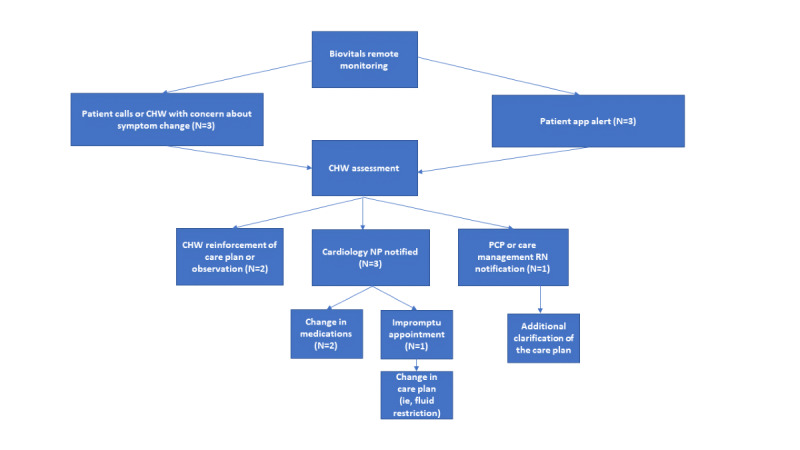
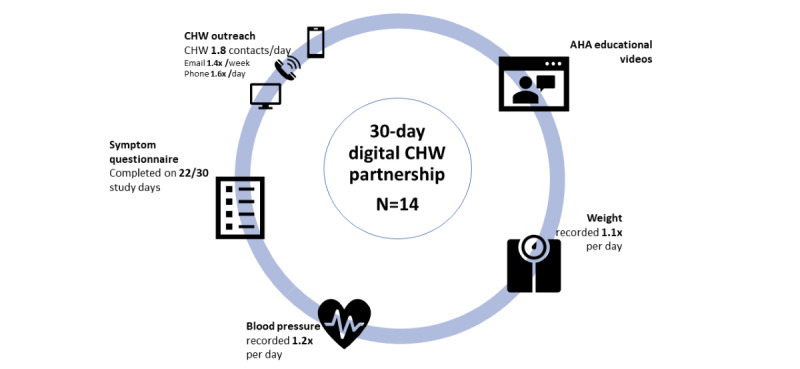
Adults (aged ≥18 years) with HF receiving care at a single health care institution and with a history of hospital admission in the previous 12 months were enrolled in a single-arm pilot study from July to November 2021 (N=14). The 30-day intervention used a digital platform within a mobile app that included symptom questionnaire and educational videos connected to a biometric sensor (tracking heart rate, oxygenation, and steps taken), a digital weight scale, and a digital blood pressure monitor. All patients were paired with a CHW who had access to the digital platform data. A CHW provided routine phone calls to patients throughout the study period to discuss their biometric data and to address barriers to any social needs. Feasibility outcomes were patient use of the platform and engagement with the CHW. The acceptability outcome was patient willingness to use the intervention again.
Participants (N=14) were 67.7 (SD 11.7) years old; 8 (57.1%) were women, and 7 (50%) were insured by Medicare. Participants wore the sensor for 82.2% (n=24.66) of study days with an average of 13.5 (SD 2.1) hours per day. Participants used the digital blood pressure monitor and digital weight scale for an average of 1.2 (SD 0.17) times per day and 1.1 (SD 0.12) times per day, respectively. All participants completed the symptom questionnaire on at least 71% (n=21.3) of study days; 11 (78.6%) participants had ≥3 CHW interactions, and 11 (78.6%) indicated that if given the opportunity, they would use the platform again in the future. Exit interviews found that despite some platform "glitches," participants generally found the remote monitoring platform to be "helpful" and "motivating."
A novel intervention combining a digital platform with CHW social needs care for patients with HF was feasible and acceptable. The majority of participants were engaged throughout the study and indicated their willingness to use the intervention again. A future clinical trial is needed to determine the effectiveness of this intervention.
心力衰竭(HF)是住院的主要原因之一。临床因素(如复杂的合并症和低射血分数)和社会需求因素(如交通便利性、食品安全和住房保障)都导致了住院率上升,这凸显了在家中增加临床和社会需求支持的重要性。专为远程监测HF设计的数字平台可以改善临床结果,但其有效性受到患者障碍的限制,如对技术不熟悉和社会护理需求未得到满足。为解决这些障碍,本研究探索了将数字平台与社区卫生工作者(CHW)对HF患者的社会需求护理相结合的方法。
我们旨在确定将数字平台使用与CHW对HF患者的社会需求护理相结合的干预措施的可行性和可接受性。
2021年7月至11月,在一家单一医疗机构接受治疗且在过去12个月有住院史的成年HF患者(年龄≥18岁)被纳入一项单臂试点研究(N = 14)。为期30天的干预在移动应用程序中使用了一个数字平台,该平台包括症状问卷和与生物传感器(跟踪心率、氧合和步数)、数字体重秤和数字血压计相连的教育视频。所有患者都与一名能够访问数字平台数据的CHW配对。在整个研究期间,CHW会定期给患者打电话,讨论他们的生物特征数据,并解决任何社会需求方面的障碍。可行性结果是患者对平台的使用情况以及与CHW的互动情况。可接受性结果是患者再次使用该干预措施的意愿。
参与者(N = 14)的年龄为67.7(标准差11.7)岁;8名(57.1%)为女性,7名(50%)由医疗保险承保。参与者在82.2%(n = 24.66)的研究天数佩戴了传感器,平均每天佩戴13.5(标准差2.1)小时。参与者平均每天使用数字血压计和数字体重秤的次数分别为1.2(标准差0.17)次和1.1(标准差0.12)次。所有参与者在至少71%(n = 21.3)的研究天数完成了症状问卷;11名(78.6%)参与者与CHW有≥3次互动,11名(78.6%)表示如果有机会,他们将来会再次使用该平台。退出访谈发现,尽管平台存在一些“故障”,但参与者普遍认为远程监测平台“有帮助”且“有激励作用”。
将数字平台与CHW对HF患者的社会需求护理相结合的新型干预措施是可行且可接受的。大多数参与者在整个研究过程中都积极参与,并表示愿意再次使用该干预措施。未来需要进行临床试验来确定该干预措施的有效性。