Curriculum in Genetics and Molecular Biology, University of North Carolina at Chapel Hill, Chapel Hill, North Carolina 27599, USA.
Curriculum in Bioinformatics and Computational Biology, University of North Carolina at Chapel Hill, Chapel Hill, North Carolina 27599, USA.
Genome Res. 2023 Aug;33(8):1258-1268. doi: 10.1101/gr.277397.122. Epub 2023 Sep 12.
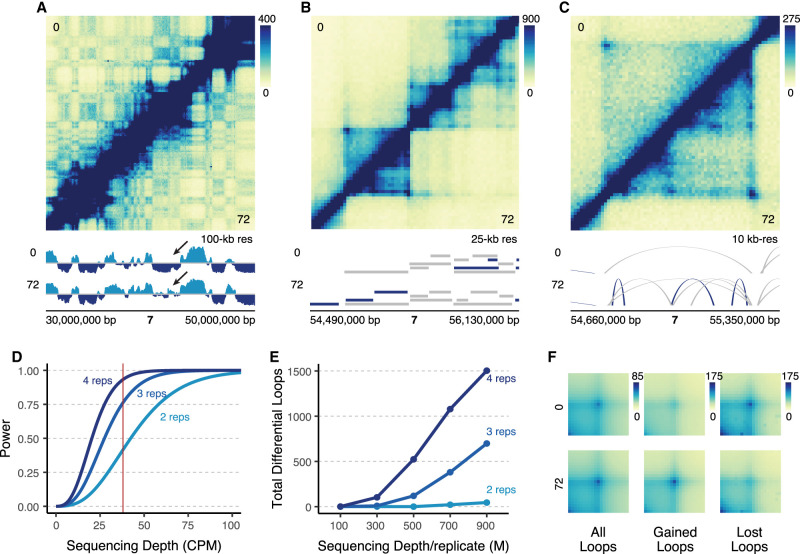
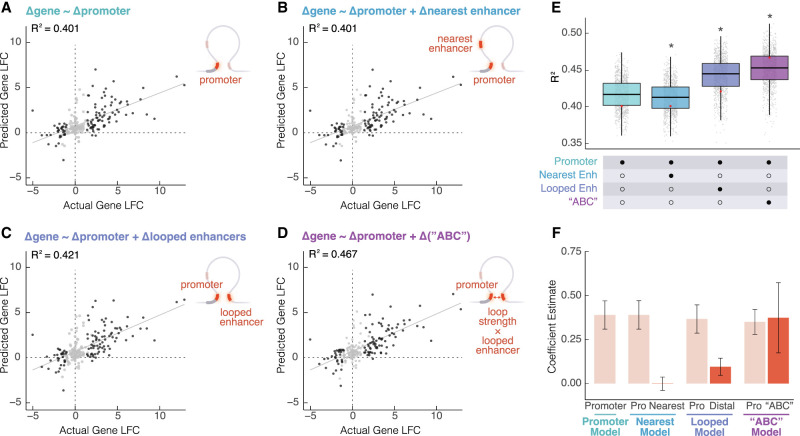
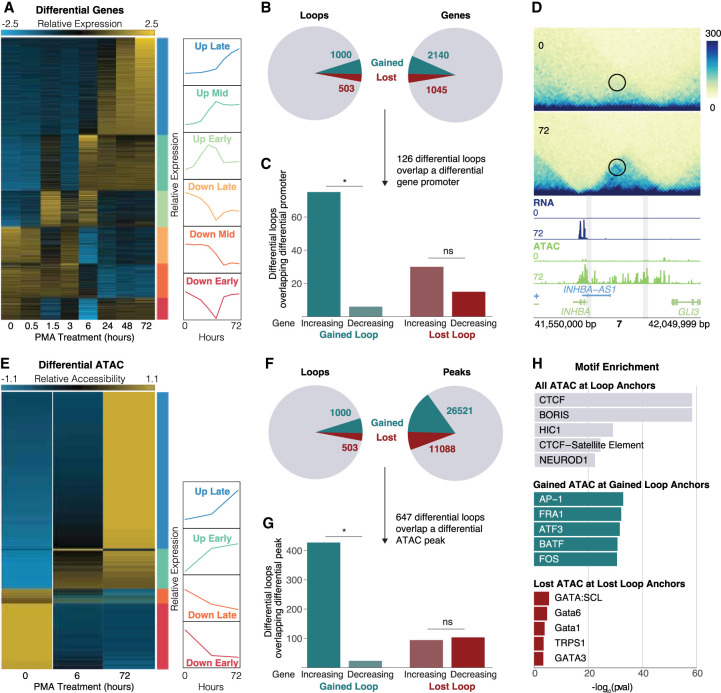
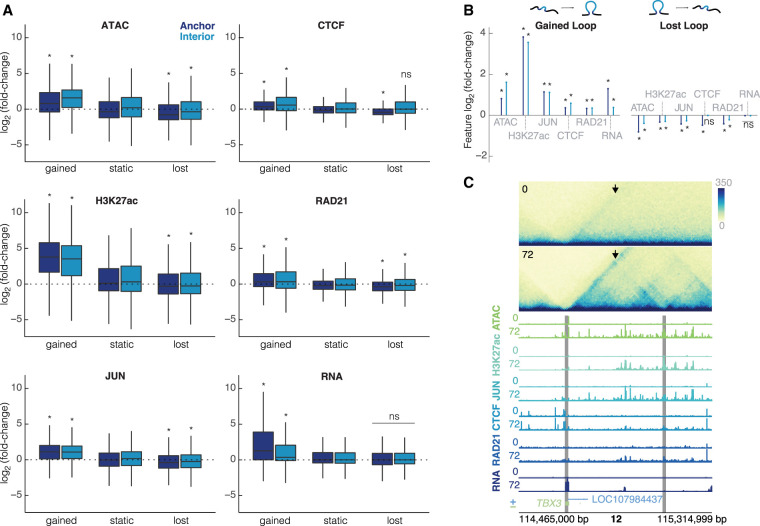
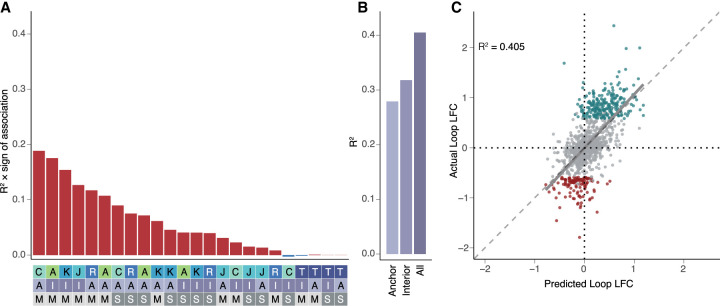
Three-dimensional (3D) chromatin structure has been shown to play a role in regulating gene transcription during biological transitions. Although our understanding of loop formation and maintenance is rapidly improving, much less is known about the mechanisms driving changes in looping and the impact of differential looping on gene transcription. One limitation has been a lack of well-powered differential looping data sets. To address this, we conducted a deeply sequenced Hi-C time course of megakaryocyte development comprising four biological replicates and 6 billion reads per time point. Statistical analysis revealed 1503 differential loops. Gained loop anchors were enriched for AP-1 occupancy and were characterized by large increases in histone H3K27ac (over 11-fold) but relatively small increases in CTCF and RAD21 binding (1.26- and 1.23-fold, respectively). Linear modeling revealed that changes in histone H3K27ac, chromatin accessibility, and JUN binding were better correlated with changes in looping than RAD21 and almost as well correlated as CTCF. Changes to epigenetic features between-rather than at-boundaries were highly predictive of changes in looping. Together these data suggest that although CTCF and RAD21 may be the core machinery dictating where loops form, other features (both at the anchors and within the loop boundaries) may play a larger role than previously anticipated in determining the relative loop strength across cell types and conditions.
三维(3D)染色质结构已被证明在生物转变过程中调节基因转录中发挥作用。尽管我们对环形成和维持的理解正在迅速提高,但对于驱动环变化的机制以及差异环对基因转录的影响知之甚少。一个限制因素是缺乏功能强大的差异环数据集。为了解决这个问题,我们进行了一个深入测序的巨核细胞发育 Hi-C 时间过程,包括四个生物学重复和每个时间点 60 亿个读数。统计分析显示了 1503 个差异环。获得的环锚点富含 AP-1 占据,其特征是组蛋白 H3K27ac 的大幅增加(超过 11 倍),但 CTCF 和 RAD21 结合的增加相对较小(分别为 1.26 倍和 1.23 倍)。线性建模显示,组蛋白 H3K27ac、染色质可及性和 JUN 结合的变化与环的变化比 RAD21 更好地相关,几乎与 CTCF 一样相关。与边界相比,在环内而非边界之间的表观遗传特征的变化高度预测了环的变化。这些数据表明,尽管 CTCF 和 RAD21 可能是决定环形成位置的核心机制,但其他特征(锚点和环边界内)在确定跨细胞类型和条件的相对环强度方面可能比以前预期的更为重要。