Department for Epigenetics and Systems Medicine in Neurodegenerative Diseases, German Center for Neurodegenerative Diseases Goettingen, 37075, Goettingen, Germany.
Department of Psychiatry and Psychotherapy, University Medical Center Goettingen, 37075, Goettingen, Germany.
Transl Psychiatry. 2023 Sep 13;13(1):294. doi: 10.1038/s41398-023-02582-4.
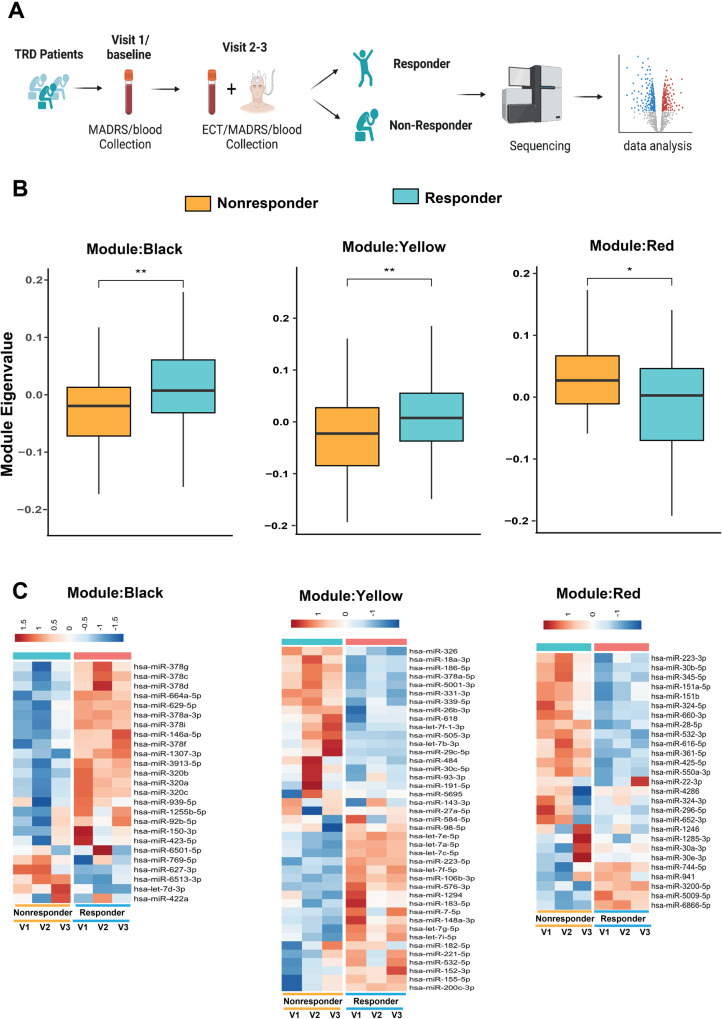
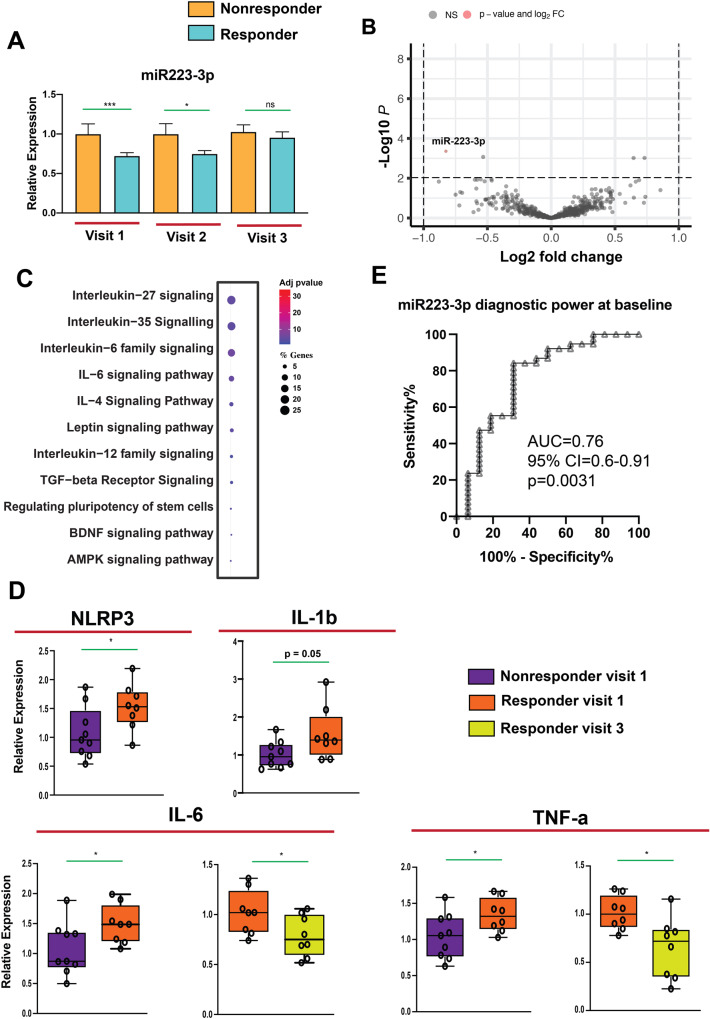
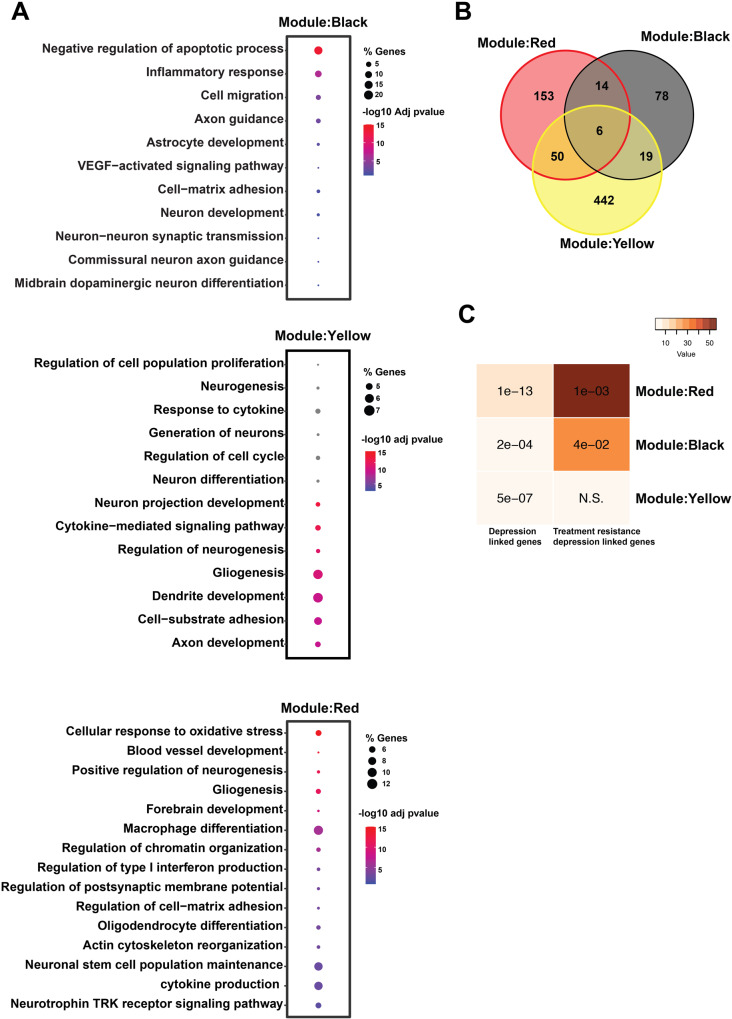
There is a strong medical need to develop suitable biomarkers to improve the diagnosis and treatment of depression, particularly in predicting response to certain therapeutic approaches such as electroconvulsive therapy (ECT). MicroRNAs are small non-coding RNAs that have the ability to influence the transcriptome as well as proteostasis at the systems level. Here, we investigate the role of circulating microRNAs in depression and response prediction towards ECT. Of the 64 patients with treatment-resistant major depression (MDD) who received ECT treatment, 62.5% showed a response, defined as a reduction of ≥50% in the MADRS total score from baseline. We performed smallRNA sequencing in blood samples that were taken before the first ECT, after the first and the last ECT. The microRNAome was compared between responders and non-responders. Co-expression network analysis identified three significant microRNA modules with reverse correlation between ECT- responders and non-responders, that were amongst other biological processes linked to inflammation. A candidate microRNA, namely miR-223-3p was down-regulated in ECT responders when compared to non-responders at baseline. In line with data suggesting a role of miR-223-3p in inflammatory processes we observed higher expression levels of proinflammatory factors Il-6, Il-1b, Nlrp3 and Tnf-α in ECT responders at baseline when compared to non-responders. ROC analysis of confirmed the diagnostic power of miR-223-3p demarcating ECT-responders from non-responder subjects (AUC = 0.76, p = 0.0031). Our data suggest that miR-223-3p expression and related cytokine levels could serve as predictors of response to ECT in individuals with treatment-resistant depressive disorders.
临床上强烈需要开发合适的生物标志物来改善抑郁症的诊断和治疗,尤其是在预测某些治疗方法(如电惊厥疗法(ECT))的反应方面。微小 RNA 是一种小的非编码 RNA,能够在系统水平上影响转录组和蛋白质稳态。在这里,我们研究了循环微小 RNA 在抑郁症中的作用以及对 ECT 反应预测的作用。在接受 ECT 治疗的 64 名治疗抵抗性重度抑郁症(MDD)患者中,62.5%的患者表现出反应,定义为从基线起 MADRS 总分降低≥50%。我们在第一次 ECT 前、第一次 ECT 后和最后一次 ECT 后采集的血液样本中进行了小 RNA 测序。比较了反应者和无反应者之间的微小 RNA 组。共表达网络分析确定了三个具有显著微小 RNA 模块的响应者和无响应者之间存在反向相关性,这些模块与炎症等其他生物学过程有关。在基线时,与无反应者相比,在 ECT 反应者中下调的候选微小 RNA,即 miR-223-3p。与 miR-223-3p 在炎症过程中起作用的数据一致,我们观察到 ECT 反应者的促炎因子 Il-6、Il-1b、Nlrp3 和 Tnf-α的表达水平在基线时高于无反应者。经确认的 miR-223-3p 的 ROC 分析区分了 ECT 反应者和非反应者(AUC=0.76,p=0.0031)。我们的数据表明,miR-223-3p 的表达和相关细胞因子水平可以作为治疗抵抗性抑郁障碍患者对 ECT 反应的预测指标。