Schouls Leo M, Witteveen Sandra, van Santen-Verheuvel Marga, de Haan Angela, Landman Fabian, van der Heide Han, Kuijper Ed J, Notermans Daan W, Bosch Thijs, Hendrickx Antoni P A
Centre for Infectious Disease Control. National Institute for Public Health and the Environment (RIVM), Bilthoven, The Netherlands.
Department of Medical Microbiology and Experimental Bacteriology, Leiden University Medical Center, Leiden, The Netherlands.
Commun Med (Lond). 2023 Sep 12;3(1):123. doi: 10.1038/s43856-023-00348-z.
Although the Netherlands is a country with a low endemic level, methicillin-resistant Staphylococcus aureus (MRSA) poses a significant health care problem. Therefore, high coverage national MRSA surveillance has been in place since 1989. To monitor possible changes in the type-distribution and emergence of resistance and virulence, MRSA isolates are molecularly characterized.
All 43,321 isolates from 36,520 persons, collected 2008-2019, were typed by multiple-locus variable number tandem repeats analysis (MLVA) with simultaneous PCR detection of the mecA, mecC and lukF-PV genes, indicative for PVL. Next-generation sequencing data of 4991 isolates from 4798 persons were used for whole genome multi-locus sequence typing (wgMLST) and identification of resistance and virulence genes.
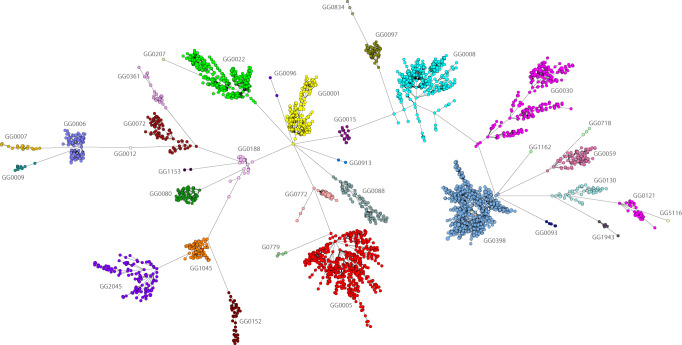
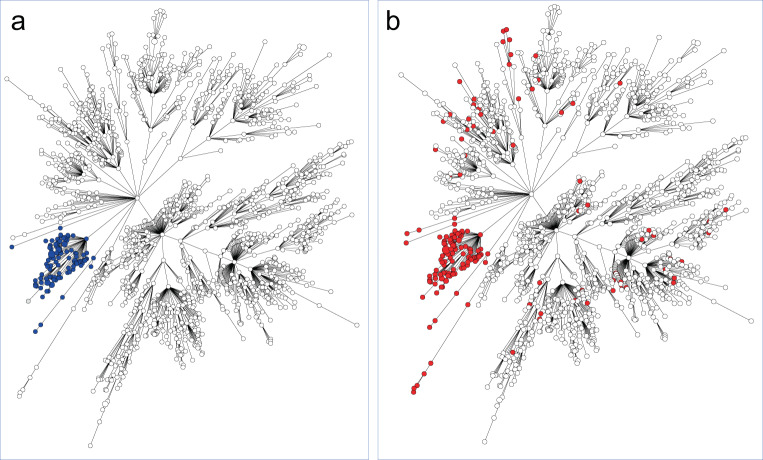
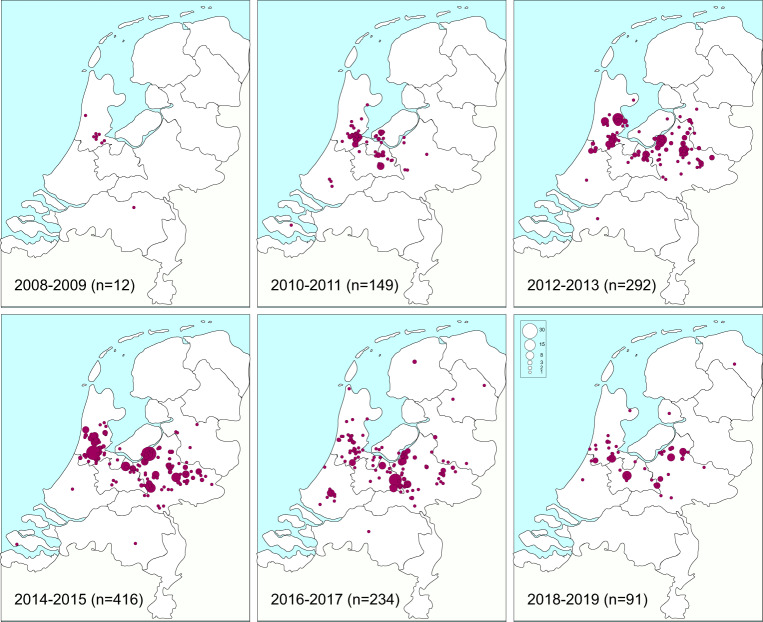
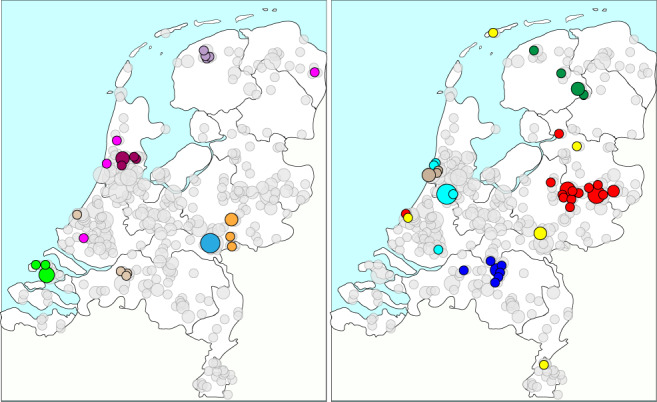
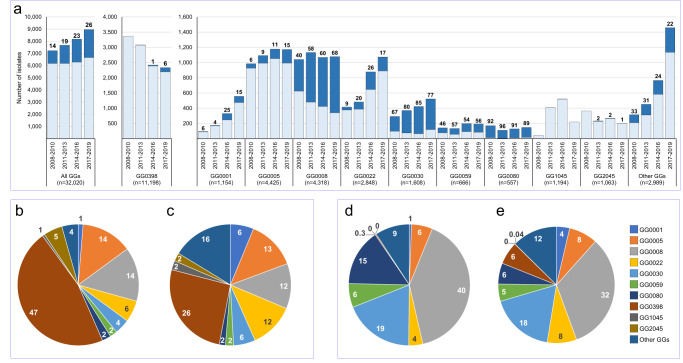
We show temporal change in the molecular characteristics of the MRSA population with the proportion of PVL-positive isolates increasing from 15% in 2008-2010 to 25% in 2017-2019. In livestock-associated MRSA obtained from humans, PVL-positivity increases to 6% in 2017-2019 with isolates predominantly from regions with few pig farms. wgMLST reveals the presence of 35 genogroups with distinct resistance, virulence gene profiles and specimen origin. Typing shows prolonged persistent MRSA carriage with a mean carriage period of 407 days. There is a clear spatial and a weak temporal relationship between isolates that clustered in wgMLST, indicative for regional spread of MRSA strains.
Using molecular characterization, this exceptionally large study shows genomic changes in the MRSA population at the national level. It reveals waxing and waning of types and genogroups and an increasing proportion of PVL-positive MRSA.
尽管荷兰是一个地方流行水平较低的国家,但耐甲氧西林金黄色葡萄球菌(MRSA)仍构成重大的医疗保健问题。因此,自1989年以来,荷兰已开展了覆盖范围广泛的全国性MRSA监测。为监测耐药性和毒力的类型分布及出现情况的可能变化,对MRSA分离株进行了分子特征分析。
收集了2008年至2019年期间来自36,520人的43,321株分离株,采用多位点可变数目串联重复序列分析(MLVA)进行分型,并同时通过PCR检测mecA、mecC和lukF-PV基因(PVL的指示基因)。来自4798人的4991株分离株的二代测序数据用于全基因组多位点序列分型(wgMLST)以及耐药和毒力基因的鉴定。
我们发现MRSA群体的分子特征随时间发生变化,PVL阳性分离株的比例从2008 - 2010年的15%增至2017 - 2019年的25%。在从人类分离出的与家畜相关的MRSA中,2017 - 2019年PVL阳性率增至6%,分离株主要来自养猪场较少的地区。wgMLST显示存在35个基因组群,具有不同的耐药、毒力基因谱和标本来源。分型显示MRSA携带持续时间延长,平均携带期为407天。在wgMLST中聚类的分离株之间存在明显的空间关系和较弱的时间关系,表明MRSA菌株存在区域传播。
通过分子特征分析,这项规模异常庞大的研究显示了国家层面MRSA群体的基因组变化。它揭示了不同类型和基因组群的兴衰以及PVL阳性MRSA比例的增加。