Biostatistics Research Group, Department of Population Health Sciences, George Davies Centre, University of Leicester, University Road, Leicester, LE1 7RH, UK.
Leicester Real World Evidence Unit, Diabetes Research Centre, University of Leicester, Leicester, UK.
Popul Health Metr. 2023 Sep 13;21(1):13. doi: 10.1186/s12963-023-00313-x.
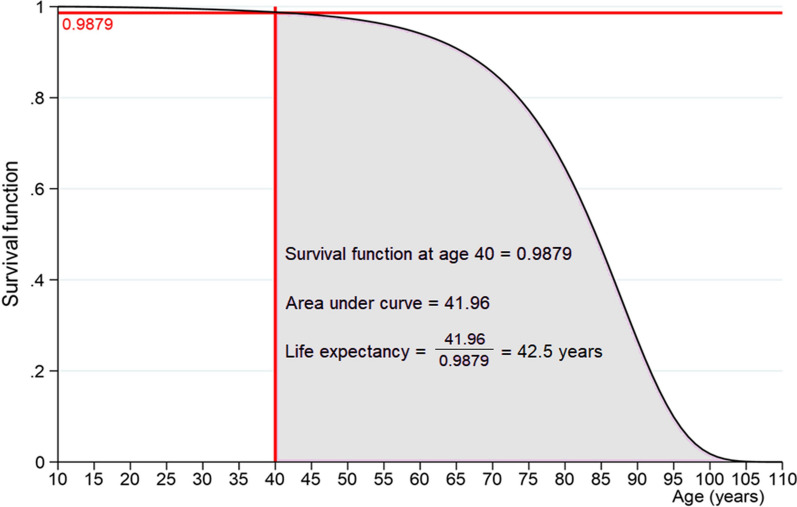
Life expectancy is a simple measure of assessing health differences between two or more populations but current life expectancy calculations are not reliable for small populations. A potential solution to this is to borrow strength from larger populations from the same source, but this has not formally been investigated.
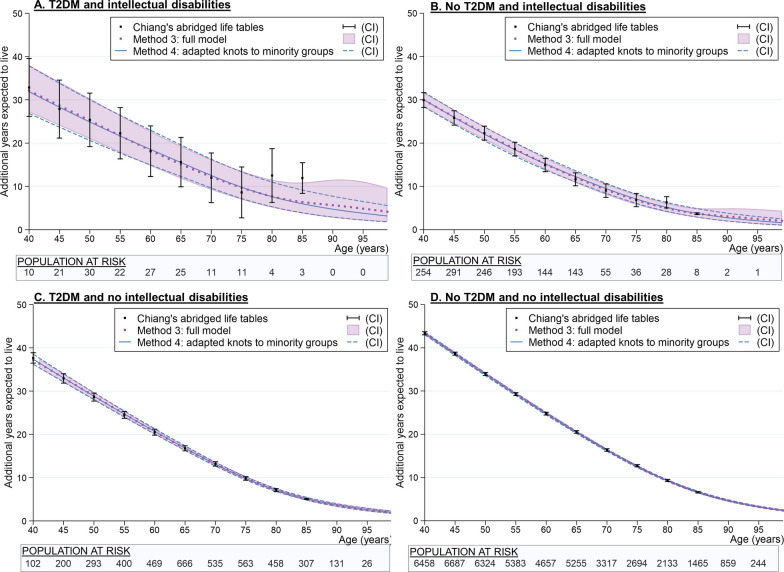
Using data on 451,222 individuals from the Clinical Practice Research Datalink on the presence/absence of intellectual disability and type 2 diabetes mellitus, we compared stratified and combined flexible parametric models, and Chiang's methods, for calculating life expectancy. Confidence intervals were calculated using the Delta method, Chiang's adjusted life table approach and bootstrapping.
The flexible parametric models allowed calculation of life expectancy by exact age and beyond traditional life expectancy age thresholds. The combined model that fit age interaction effects as a spline term provided less bias and greater statistical precision for small covariate subgroups by borrowing strength from the larger subgroups. However, careful consideration of the distribution of events in the smallest group was needed.
Life expectancy is a simple measure to compare health differences between populations. The use of combined flexible parametric methods to calculate life expectancy in small samples has shown promising results by allowing life expectancy to be modelled by exact age, greater statistical precision, less bias and prediction of different covariate patterns without stratification. We recommend further investigation of their application for both policymakers and researchers.
预期寿命是评估两个或多个人群健康差异的简单指标,但当前的预期寿命计算对于小人群并不可靠。解决这个问题的一个潜在方法是从同一来源的更大人群中借用力量,但这尚未得到正式研究。
使用来自临床实践研究数据链接的关于 451222 个人的智力残疾和 2 型糖尿病存在/不存在的数据,我们比较了分层和组合灵活参数模型,以及 Chiang 的方法,用于计算预期寿命。置信区间使用 Delta 方法、Chiang 的调整生命表方法和引导法计算。
灵活参数模型允许通过确切年龄和传统预期寿命年龄阈值之外计算预期寿命。拟合年龄交互效应作为样条项的组合模型通过从小的子组中借用力量,为较小的协变量子组提供了更小的偏差和更高的统计精度。然而,需要仔细考虑最小组中事件的分布。
预期寿命是比较人群健康差异的简单指标。使用组合灵活参数方法在小样本中计算预期寿命,通过允许通过确切年龄、更高的统计精度、更小的偏差和预测不同的协变量模式而无需分层来建模预期寿命,显示出有希望的结果。我们建议进一步研究它们在政策制定者和研究人员中的应用。