Kaje Kaini Cecilia, Dsilva Fatima, Sanal T S, Latha T, Kumar Shishir, D'Souza Caren
Department of Medical Surgical Nursing, Nitte Usha Institute of Nursing Sciences, NITTE (Deemed to be) University, Mangaluru, Karnataka, India.
Department of Research and Statistics, JDC Hospital and Research Center, Trivandrum, Kerala, India.
Indian J Palliat Care. 2023 Jul-Sep;29(3):223-233. doi: 10.25259/IJPC_125_2022. Epub 2023 Jan 12.
Inflammatory markers play a substantial role in the prognosis of breast cancer (BC). Studies have been conducted, evaluating the effect of yoga intervention (YI) on inflammatory biomarkers among BC cases. This systematic review consolidates the outcome of YI in the cancer microenvironment.
The objective of the study was to evaluate the effect of YI in the cancer microenvironment among BC women.
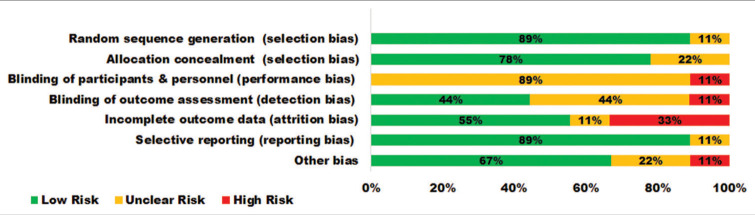
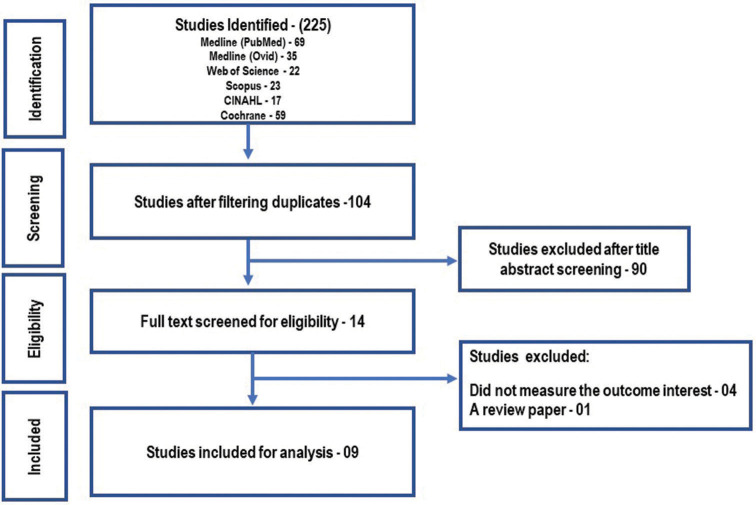
This review was conducted from May 2021 to December 2021. The inclusion criteria were experimental studies on adult BC cases with isolated YI. Studies conducted among paediatrics, case reports and case series were excluded from the study. Medline (PubMed), Medline (Ovid), Web of Science (WOS), Scopus, CINAHL and Cochrane Central databases were searched. The data were restricted from January 2000 to December 2021 with studies published in English. 'The Cochrane risk of bias assessment tool' was mobilised to evaluate the quality of the included studies.
A total of nine studies met the inclusion criteria and comprised a sample size of 905 BC cases with a mean age of 50.26±8.27 years. Three studies evaluated tumour necrosis factor-alpha (TNF-α) and INTERLEUKIN (IL)-6, where two studies on TNF-α and one on IL-6 favoured the YI group. A study investigated soluble TNF receptor II (TNF-RII) and another on IL-1beta (IL-1β) has shown improved levels post-YI. A downward trend of cortisol levels was noted in four out of five studies. Two studies that examined the C-reactive protein and a study on IL-8 did not show any difference between the YI and the control groups.
This review's findings showed the downregulation of cortisol, markers of inflammation; TNF-α, IL-6, TNF-RII and IL-1β immediately to post-YI. Heterogeneities in terms of YIs, number of days of practice, duration and training received and the grade of BC cases are the concern of this review. However, YI can be considered a supportive therapy for BC.
炎症标志物在乳腺癌(BC)的预后中起着重要作用。已有研究评估了瑜伽干预(YI)对BC患者炎症生物标志物的影响。本系统评价汇总了YI在癌症微环境中的结果。
本研究的目的是评估YI对BC女性癌症微环境的影响。
本评价于2021年5月至2021年12月进行。纳入标准为针对成年BC患者进行的单独YI实验研究。儿科研究、病例报告和病例系列研究被排除在本研究之外。检索了Medline(PubMed)、Medline(Ovid)、科学网(WOS)、Scopus、CINAHL和Cochrane中心数据库。数据限制在2000年1月至2021年12月,研究以英文发表。使用“Cochrane偏倚风险评估工具”评估纳入研究的质量。
共有9项研究符合纳入标准,样本量为905例BC患者,平均年龄为50.26±8.27岁。3项研究评估了肿瘤坏死因子-α(TNF-α)和白细胞介素(IL)-6,其中2项关于TNF-α的研究和1项关于IL-6的研究支持YI组。一项研究调查了可溶性TNF受体II(TNF-RII),另一项关于IL-1β的研究显示YI后水平有所改善。五项研究中有四项观察到皮质醇水平呈下降趋势。两项检测C反应蛋白的研究和一项关于IL-8的研究未显示YI组和对照组之间有任何差异。
本评价的结果显示,YI后立即出现皮质醇、炎症标志物TNF-α、IL-6、TNF-RII和IL-1β的下调。YI的类型、练习天数、持续时间和接受的训练以及BC病例的分级方面的异质性是本评价关注的问题。然而,YI可被视为BC的一种支持性治疗方法。