Biostatistics Research Group, Department of Population Health Sciences, University of Leicester, Leicester, UK.
Oncology Biometrics Statistical Innovation, AstraZeneca, Cambridge, UK.
Stat Med. 2023 Nov 30;42(27):5007-5024. doi: 10.1002/sim.9898. Epub 2023 Sep 13.
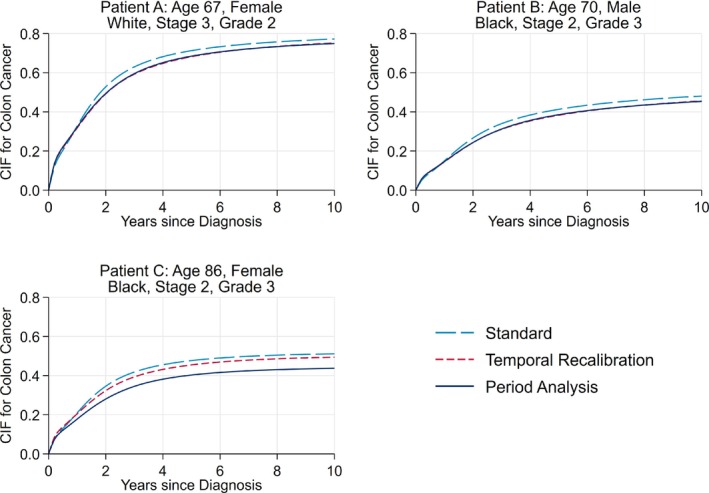
We have previously proposed temporal recalibration to account for trends in survival over time to improve the calibration of predictions from prognostic models for new patients. This involves first estimating the predictor effects using data from all individuals (full dataset) and then re-estimating the baseline using a subset of the most recent data whilst constraining the predictor effects to remain the same. In this article, we demonstrate how temporal recalibration can be applied in competing risk settings by recalibrating each cause-specific (or subdistribution) hazard model separately. We illustrate this using an example of colon cancer survival with data from the Surveillance Epidemiology and End Results (SEER) program. Data from patients diagnosed in 1995-2004 were used to fit two models for deaths due to colon cancer and other causes respectively. We discuss considerations that need to be made in order to apply temporal recalibration such as the choice of data used in the recalibration step. We also demonstrate how to assess the calibration of these models in new data for patients diagnosed subsequently in 2005. Comparison was made to a standard analysis (when improvements over time are not taken into account) and a period analysis which is similar to temporal recalibration but differs in the data used to estimate the predictor effects. The 10-year calibration plots demonstrated that using the standard approach over-estimated the risk of death due to colon cancer and the total risk of death and that calibration was improved using temporal recalibration or period analysis.
我们之前提出了时间校准,以解释随时间推移的生存趋势,从而提高新患者预后模型预测的校准。这涉及首先使用所有个体的数据(完整数据集)估计预测因子的影响,然后使用最近数据的子集重新估计基线,同时约束预测因子的影响保持不变。在本文中,我们通过分别重新校准每个特定原因(或亚分布)风险模型来展示时间校准如何应用于竞争风险环境。我们使用来自监测、流行病学和最终结果(SEER)计划的结肠癌生存数据来说明这一点。使用 1995-2004 年诊断的患者数据分别拟合两个因结肠癌和其他原因导致的死亡模型。我们讨论了为应用时间校准需要考虑的因素,例如在重新校准步骤中使用的数据选择。我们还演示了如何评估这些模型在随后于 2005 年诊断的新患者数据中的校准。与标准分析(不考虑随时间的改进)和类似时间校准但用于估计预测因子影响的数据不同的时期分析进行了比较。10 年校准图表明,使用标准方法高估了结肠癌死亡和总死亡风险,而时间校准或时期分析可以改善校准。