Musicò Angelo, Zenatelli Rossella, Romano Miriam, Zendrini Andrea, Alacqua Silvia, Tassoni Selene, Paolini Lucia, Urbinati Chiara, Rusnati Marco, Bergese Paolo, Pomarico Giuseppe, Radeghieri Annalisa
Department of Molecular and Translational Medicine, University of Brescia Viale Europa 11 25123 Brescia Italy
CSGI, Center for Colloid and Surface Science 50019 Florence Italy.
Nanoscale Adv. 2023 Jul 19;5(18):4703-4717. doi: 10.1039/d3na00280b. eCollection 2023 Sep 12.
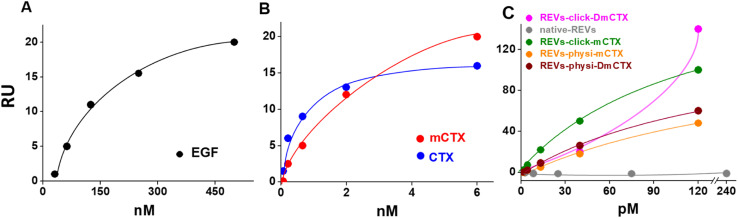
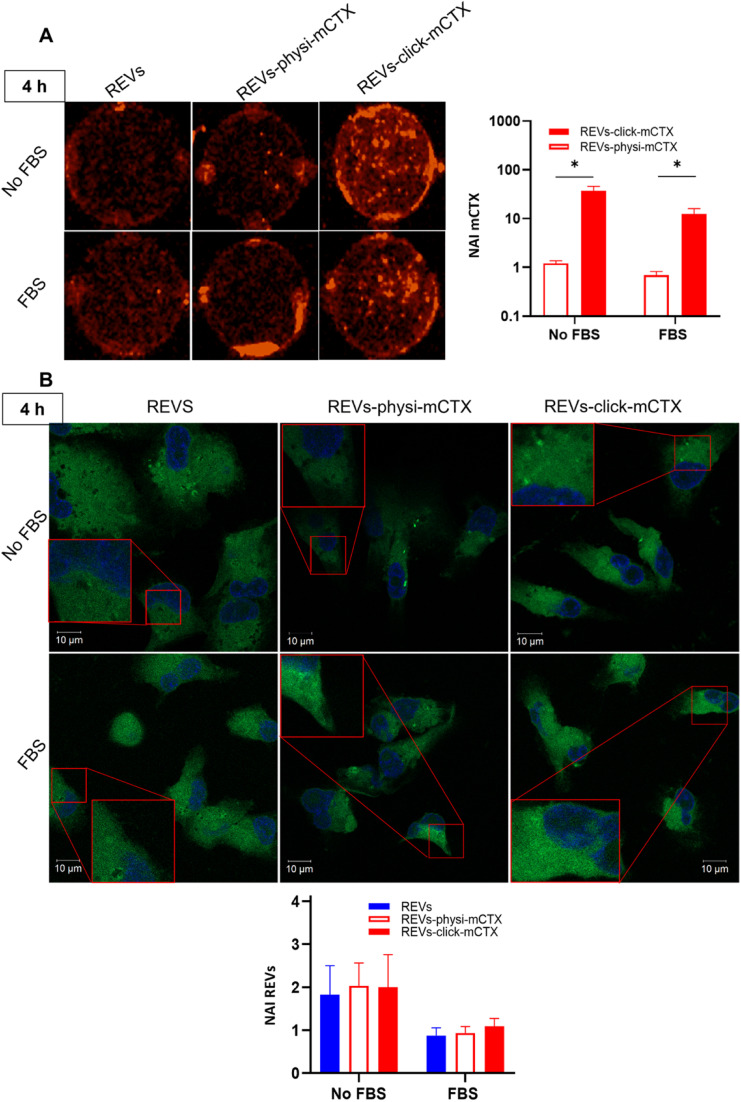
To be profitably exploited in medicine, nanosized systems must be endowed with biocompatibility, targeting capability, the ability to evade the immune system, and resistance to clearance. Currently, biogenic nanoparticles, such as extracellular vesicles (EVs), are intensively investigated as the platform that naturally recapitulates these highly needed characteristics. EV native targeting properties and pharmacokinetics can be further augmented by decorating the EV surface with specific target ligands as antibodies. However, to date, studies dealing with the functionalization of the EV surface with proteins have never considered the protein corona "variable", namely the fact that extrinsic proteins may spontaneously adsorb on the EV surface, contributing to determine the surface, and in turn the biological identity of the EV. In this work, we explore and compare the two edge cases of EVs modified with the antibody Cetuximab (CTX) by chemisorption of CTX (through covalent binding biorthogonal click-chemistry) and by formation of a physisorbed CTX corona. The results indicate that (i) no differences exist between the two formulations in terms of binding affinity imparted by molecular recognition of CTX its natural binding partner (epidermal growth factor receptor, EGFR), but (ii) significant differences emerge at the cellular level, where CTX-EVs prepared by click chemistry display superior binding and uptake toward target cells, very likely due to the higher robustness of the CTX anchorage.
为了在医学中得到有益的应用,纳米级系统必须具备生物相容性、靶向能力、逃避免疫系统的能力以及抗清除能力。目前,生物源纳米颗粒,如细胞外囊泡(EVs),作为一种自然具备这些急需特性的平台而受到深入研究。通过用特定的靶向配体(如抗体)修饰EV表面,可以进一步增强EV的天然靶向特性和药代动力学。然而,迄今为止,关于用蛋白质对EV表面进行功能化的研究从未考虑过蛋白质冠层的“变量”,即外在蛋白质可能会自发吸附在EV表面,从而影响其表面性质,进而决定EV的生物学特性。在这项工作中,我们探索并比较了通过化学吸附西妥昔单抗(CTX)(通过共价结合的生物正交点击化学)和形成物理吸附的CTX冠层对EV进行修饰的两种极端情况。结果表明,(i)就CTX与其天然结合伴侣(表皮生长因子受体,EGFR)的分子识别所赋予的结合亲和力而言,两种制剂之间不存在差异,但(ii)在细胞水平上出现了显著差异,通过点击化学制备的CTX-EV对靶细胞显示出更强的结合和摄取能力,这很可能是由于CTX锚定的更高稳定性。