Shadmand Foumani Moghadam Mohammad Reza, Shahraki Jazinaki Mostafa, Rashidipour Mina, Rezvani Reza, Pezeshki Parnian, Ghayour Mobarhan Majid, Hosseini Zohre
Department of Nutrition Science Varastegan Institute for Medical Sciences Mashhad Iran.
Department of Nutrition Science, Faculty of Medicine Mashhad University of Medical Sciences Mashhad Iran.
Aging Med (Milton). 2023 Jun 22;6(3):264-271. doi: 10.1002/agm2.12257. eCollection 2023 Sep.
This study aims to identify a new barrier to the use of the Mini-Nutrition Assessment Short-Form (MNA-SF), which is a malnutrition assessment tool for the risk assessment of sarcopenia in a nourished population.
The MNA-SF was completed, and individuals with a score of > 11 were considered nourished in this cross-sectional feasibility study of a registry. Sarcopenia was assessed in 766 healthy, nourished adults (33.4% men, 64.9 ± 7.1 years) based on the European Working Group on Sarcopenia in Older People 2 (EWGSOP2).
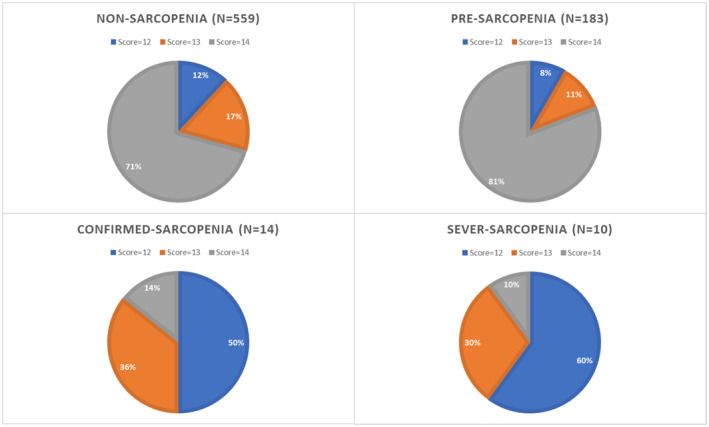
The MNA-SF scores for non-sarcopenia, pre-, confirmed, and severe sarcopenia were 13.59 ± 0.69, 13.73 ± 0.60, 12.64 ± 0.74, and 12.5 ± 0.71, respectively. The higher MNA-SF score association with pre-sarcopenia [odds ratio (OR): 1.41, 95% confidence interval (CI): 1.06-1.86, = 0.02], confirmed sarcopenia (OR = 0.25, 95% CI: 0.13-0.49, < 0.001), and severe sarcopenia (OR = 0.20, 95% CI: 0.09-0.46, < 0.001) was as significant as in the MNA-SF categories. Individuals with a score = 13 (compared with 14), had a higher risk of confirmed sarcopenia (OR = 10.07, 95% CI: 1.92-52.71, = 006) and severe sarcopenia (OR = 12.09, 95% CI: 1.24-117.50, = 0.032). Individuals with a score of 12 had a higher risk of confirmed sarcopenia (OR = 30.94, 95% CI: 4.25-103.02, < 0.001) and severe sarcopenia (OR = 35.90, 95% CI: 4.25-303.07, = 0.001) compared with subjects with a score of 14. The models also showed that MNA-SF < 13 could predict sarcopenia.
There was a significant association between MNA-SF and confirmed and severe sarcopenia in nourished people. Sarcopenia assessment in people with MNA-SF < 13 can be beneficial. Developing a tool to identify the risk of malnutrition and sarcopenia at the same time based on MNA-SF can be considered.
本研究旨在确定使用微型营养评定简表(MNA-SF)的一个新障碍,MNA-SF是一种用于评估营养良好人群肌肉减少症风险的营养不良评估工具。
在一项登记处的横断面可行性研究中,完成了MNA-SF评估,得分>11分的个体被视为营养良好。基于欧洲老年人肌肉减少症工作组2(EWGSOP2)对766名健康、营养良好的成年人(33.4%为男性,年龄64.9±7.1岁)进行了肌肉减少症评估。
非肌肉减少症、前期、确诊和严重肌肉减少症患者的MNA-SF得分分别为13.59±0.69、13.73±0.60、12.64±0.74和12.5±0.71。MNA-SF得分越高与前期肌肉减少症[比值比(OR):1.41,95%置信区间(CI):1.06-1.86,P=0.02]、确诊肌肉减少症(OR=0.25,95%CI:0.13-0.49,P<0.001)和严重肌肉减少症(OR=0.20,95%CI:0.09-0.46,P<0.001)的关联与MNA-SF类别中的关联同样显著。得分=13的个体(与14分相比)确诊肌肉减少症(OR=10.07,95%CI:1.92-52.71,P=0.006)和严重肌肉减少症(OR=12.09,95%CI:1.24-117.50,P=0.032)的风险更高。与得分14分的受试者相比,得分12分的个体确诊肌肉减少症(OR=30.94,95%CI:4.25-103.02,P<0.001)和严重肌肉减少症(OR=3